



'/%3E%3C/svg%3E "Youtube")
Saleh Ibrahim16 September 2026
This investigation reveals how internally displaced Syrians from the Hama countryside have been coerced into signing ‘direct investment’ contracts for their agricultural land, through a company that holds significant influence in that governorate, while they remain unable to return to it.
When he heard the news, Mu’tasim felt as though a crushing weight had settled on his chest. He had lived for many years under the shade of those trees, depending on them for his livelihood, and now they had been felled. The bitterness that followed extended beyond the loss itself to the heartless advice to sell the land for a fraction of its value.
For two days, he felt anxious, like a father waiting for news of his children. He would always say: “A tree is as precious as a child.”. The car ride to his village of Al-Mubattan in the Syrian province of Hama takes no more than an hour, but he has been unable to return to check on his land since leaving at sunset on December 4, 2024. On that day, the ‘Deterrence of Aggression’ forces (a coalition of armed Syrian opposition groups led by Hay’at Tahrir al-Sham (HTS) advanced towards the village. He has remained trapped in that moment, watching from afar as the foundations of his life were destroyed with every fallen tree.
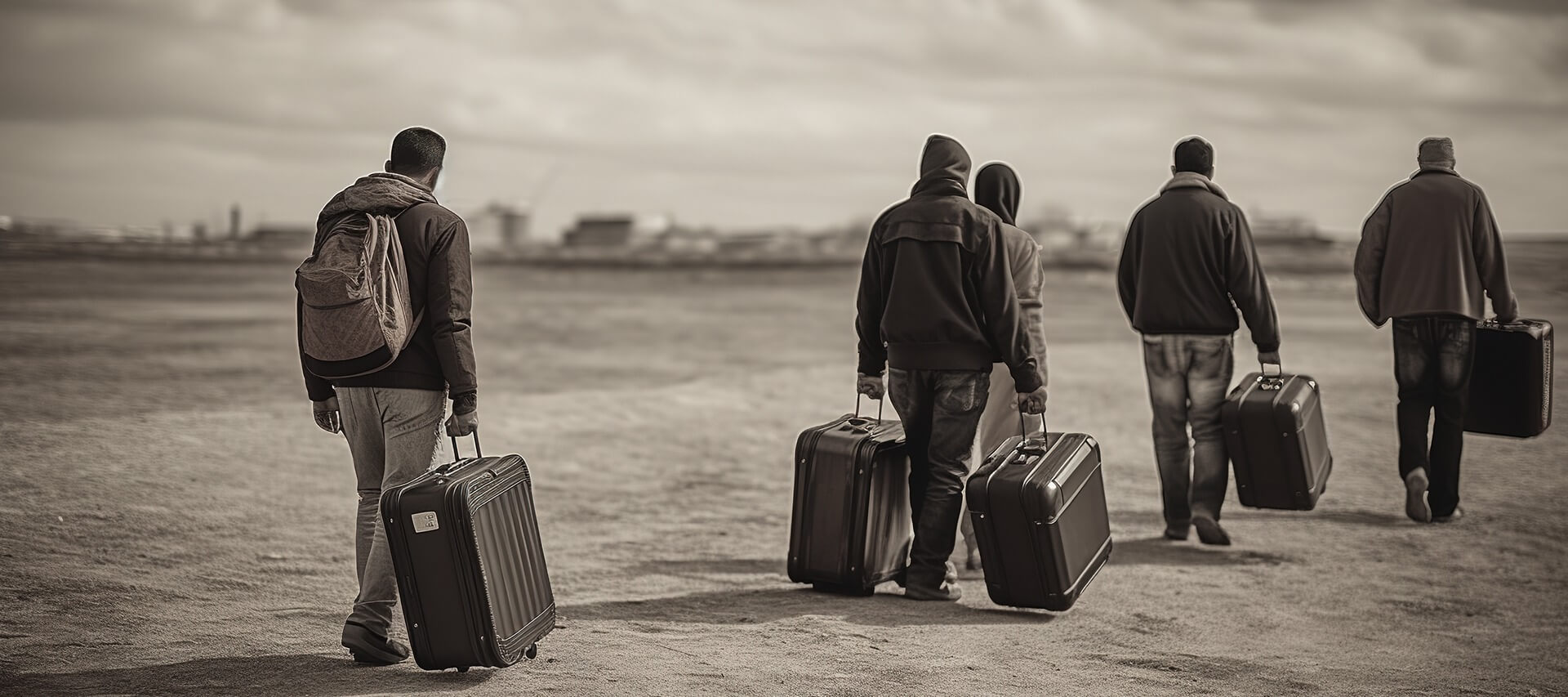
The image was created using AI
With nowhere else to turn and the dwindling hope of returning to the home he had fled nearly a year and a half earlier (as of the date of publication of this investigation), Mu’tasim found himself with no option but to seek the help of an investor – a last resort to save what remained of his family’s legacy.
Mu’tasim’s tragedy is just one chapter in the many stories surrounding the waves of internal displacement that Syria experienced as a result of the “Deterrence of Aggression” military operation and subsequent events. According to estimates by the United Nations High Commissioner for Refugees (UNHCR), over one million people were displaced at the height of the crisis, between November 27 and December 12, 2024.
Following the fall of former President Bashar al-Assad’s regime and the subsequent major political upheaval, displaced people began returning to their hometowns in droves, but this was not a possibility for everyone. As of the time of publication, large groups of displaced people from the Hama countryside – particularly from predominantly Alawite villages – remain unable to return to their homes and land. The fate of their properties remains unclear, caught between the hardships of displacement and attempts at exploitation.
Following that wave of displacement, agricultural land was left neglected, its future uncertain. Although the landowners sought to ensure its upkeep by entrusting acquaintances from neighbouring villages to ‘invest in’ it through verbal contracts or agreements, the formalization of these contracts stalled for no apparent reason, according to the landowners.
A few months later, a new reality emerged. Much to their surprise, the displaced persons were approached by individuals linked to an agricultural investment company, who offered them what became known as investment contracts. The landowners found themselves compelled by circumstances to accept these offers as the only available option.
The pressure was not limited to investment alone: some even received offers to sell their land at paltry prices that did not reflect its true value. As some clung to their land, refusing to sell, a series of attacks began, targeting centuries-old trees, which were felled by unknown perpetrators. These attacks inflicted heavy and unforeseen losses on the farmers.
For the purposes of this investigation, we interviewed 12 displaced individuals from villages in northern Hama, and have withheld all their names to ensure their personal safety. These testimonies included accounts from three displaced people who were forced to sign direct investment contracts, and two others whose trees were felled.
Using remote sensing technology and field photographs, we documented the deterioration of their agricultural land, and the felling of trees during their absence.
We also traced – through the contracts and video footage – the identities of some of the investors, and uncovered links connecting them to the branch manager of an influential company in Hama Governorate, whose former managing director is the current Minister of Agriculture. According to one of the farmers who benefited from the scheme, it was the company manager in Hama who oversaw the distribution of land among them.
Mu’tasim had hoped that his displacement from his hometown would be temporary, and that he would return to repair the damage caused to his Aleppo pistachio trees by his absence. However, this hope was dashed by a bitter reality. When a delegation from his village, Al-Mubattan, and the neighbouring village of Muraywid tried to return, they were turned back at security checkpoints, where officers claimed that they were “unable to guarantee their safety.”
Every attempt to meet the Governor of Hama failed and was met with the same excuse. This plunged Mu’tasim into a spiral of despair, as July was approaching and the harvest season — which waits for no one — drew ever nearer.
In June, however, a delegation from the villages of Al-Zaghba, Al-Talisiya, Al-Fan and Ma’an managed to meet the governor of Hama. He told them that they needed to sign ‘investment’ contracts to ensure the protection of their land, safeguard their crops from damage and disease, and prevent overgrazing, based on terms agreed upon with the ‘investors’.
The governor of Hama, Abdul Rahman al-Sahyan, was a senior member of HTS and was nicknamed ‘Abu Firas al-Hamawi’.
We analysed satellite imagery data for the Al-Mubattan area between 2024 and 2025, and the results showed a loss of green cover. While roughly 86.5 percent of the land was used for agricultural purposes in 2024, this figure decreased to 22.3 percent in 2025.
The area of land with dense vegetation also decreased from around 1,642 hectares to 423 hectares, whereas the area of land not used for agriculture expanded to more than 77 percent of the total examined area.
2024
86.5%
of land was used for agriculture
2025
22.3%
of the land was used for agriculture
These indicators reflect a depletion of local vegetation cover density in 2025, suggesting that agricultural land was not cultivated during this period. This finding is consistent with accounts from displaced individuals.
Initially, Mu’tasim tried to adhere to local tradition, so he offered his land to a local farmer with whom he had a good relationship and mutual trust, on the basis of a ‘daman’ agreement (land-lease and crop-sharing agreement). This customary oral arrangement allows the farmer to cultivate the land or make use of it in exchange for a return agreed with the landowner.
The agreement somewhat eased Mu’tasim’s worries, as it provided him with a sufficient income to meet his basic needs while ensuring that his trees remained in safe hands. However, this sense of reassurance quickly evaporated when the ‘guarantor’ was evicted from the land by unknown assailants.
As the weeks passed and the pressures of life mounted, Mu’tasim was forced to accept an offer from an Aleppo pistachio trader from the town of Suran in Hama. He signed an investment contract with him, a copy of which we have obtained.
Mu’tasim continued to await news of his land, and was often unable to verify the information he received. By the end of July 2025, he still had not received any news of his harvest, nor of the fulfilment of the terms of the ‘investment’ contract that he had signed with the trader from Suran.
He finally heard that the 2025 harvest on his land had been stolen and that his land had been left untended. He was then surprised to discover that, for unknown reasons, his contract with the trader had not been notarised. A rumour that the trees on his land were being felled then prompted him to accept another offer of ‘investment’.
“I expected the investment to be a temporary solution,” says Mu’tasim, “because I want to return to my village once transitional justice has been carried out. I hoped it would protect my trees from being cut down or harmed, and prevent me from receiving veiled threats, forcing me to sell them at a fraction of their value, so that if I ever return, I’ll find the trees still standing there, waiting for me.”
We obtained records of the conversations between Mu’tasim and the other investor, which revealed that he had begun cultivating his land in late autumn of 2025. We also obtained videos documenting this.
The conversations also revealed that he had acquired another plot of land “for investment” – according to a notarised contract we obtained – following instructions from a man named “Abu al-Baraa”, a name that will crop up again, but this time in Al-Zaghba.
The contract stipulates that the first party shall hand over agricultural land to the second party “for investment” for a period of two years, in return for a 40 percent share of the yield for the owner and a 60 percent share for the ‘investor’.
Two-year contract
Owner40%
The landowner’s share of the yield
“Investor”60%
The party receiving the land for investment
The contract also requires the ‘investor’ to cover all service and cultivation costs, and prohibits them from transferring the investment to third parties. It also requires them to vacate the land upon expiry of the contract or when the landowners return to their villages. This contract is consistent with others that displaced individuals have signed with other investors, according to the testimonies and contracts we have obtained.
Mu’tasim’s decision to sign investment contracts did not come out of nowhere. Rather, he was driven to it by stories circulating about people in the northern Hama countryside whose pistachio and olive groves had been felled, such as the land belonging to Fayyad in Al-Mubattan.
Fayyad says:, “My neighbours sold their land for two thousand dollars, whereas a single dunum (1,000 m²) in neighbouring villages was sold for 7,000 dollars. My land is a grove, and my neighbours advised me to follow their example so that the trees wouldn’t be cut down, but I refused.” He added that he told them, “I want to return to my village. Every grain of soil there is worth the entire world to me.” Two days later, he received photos via WhatsApp showing that the trees on his land had been cut down.
We obtained photographs showing felled trees on his land. Using satellite imagery, we were also able to pinpoint the location. A comparison of the plot’s location with satellite imagery revealed signs of land clearing. An analysis of the village’s agricultural land showed that more than 2 percent of it had been completely cleared, corroborating the source’s testimony that the specified area had been cleared.
According to the testimony of a farmer in Morek, trees on some abandoned plots of land had been cut down and looted. He described this as “an angry reaction by the families of Sunni victims who had lost loved ones, which took the form of cutting down trees and vandalism.” He added that the state had seized control of the land in order to protect it.
By monitoring the Facebook pages of estate agents, we observed a fall in land prices in northern Hama villages. Listings included plots in the villages of Al-Mubattan, Muraywid, Ma’an and Abu Mansaf, with prices ranging from $700 to $2,000 per dunum for unplanted land. Tree-covered land was priced at between $1,500 and $2,200 per dunum for olive groves, and between $2,500 and $3,600 per dunum for Aleppo pistachio groves, depending on the age of the trees.
Bare land
$700 – $2,000
Dunum of olive grove (depending on the age of the trees)
$1,500 – $2,200
Dunum of Aleppo pistachio grove (depending on the age of the trees)
$2,500 – $3,600
$3,600$0
Villages covered:Al-MubattanMuraywidMa’anAbu Mansaf
These prices indicate that the market value per dunum has fallen by more than half compared to prices before the fall of the regime, according to estimates by landowners who were forced to sell due to economic hardship and sales contracts drawn up before the fall of the regime.
Comparison of the average change in vegetation cover in the village of Al-Zaghba (on the right: March 2025; on the left: March 2024)
The situation in the village of Al-Mubattan is similar to that in other villages in the north-eastern Hama countryside. Musa from Al-Zaghba was forced to leave his land and flee to a safer place.
“I left the village on December 2, 2024,” says Musa. “After our families had departed, the men remained in the village to keep an eye on what was happening, but then we were all forced to leave, abandoning our land, which was left deserted and uncared for.”
According to the Normalised Difference Vegetation Index (NDVI), the average monthly vegetation cover in Al-Zaghba declined throughout 2025, in contrast to 2024, which saw peak vegetation cover during the winter season.
Months later, Musa heeded the Governor of Hama’s advice and signed a preliminary investment contract with an investor from Morek, a village in the Hama countryside. The investor was a trader in Aleppo pistachios and the contract terms were identical to those that Mu’tasim had agreed to.
Musa later learned that the same investor had also invested in a large area of land in Al-Zaghba; which he described as having the most abundant pistachio groves, where trees are over 40 years old. We obtained preliminary contracts, signed by the investor or members of his family with displaced people from Al-Zaghba. However, the final legal validation process had not been completed, according to the landowners.
In order to discover who is behind the land division in Al-Zaghba, we obtained a video in which a farmer, at the end of the video, thanks “Sheikh Abu al-Baraa” for distributing the land among “the poor coming from the north,” noting that they had been displaced since 2017.
The name Abu al-Baraa is frequently mentioned by those who were forced to sign investment contracts. So who is Abu al-Baraa?
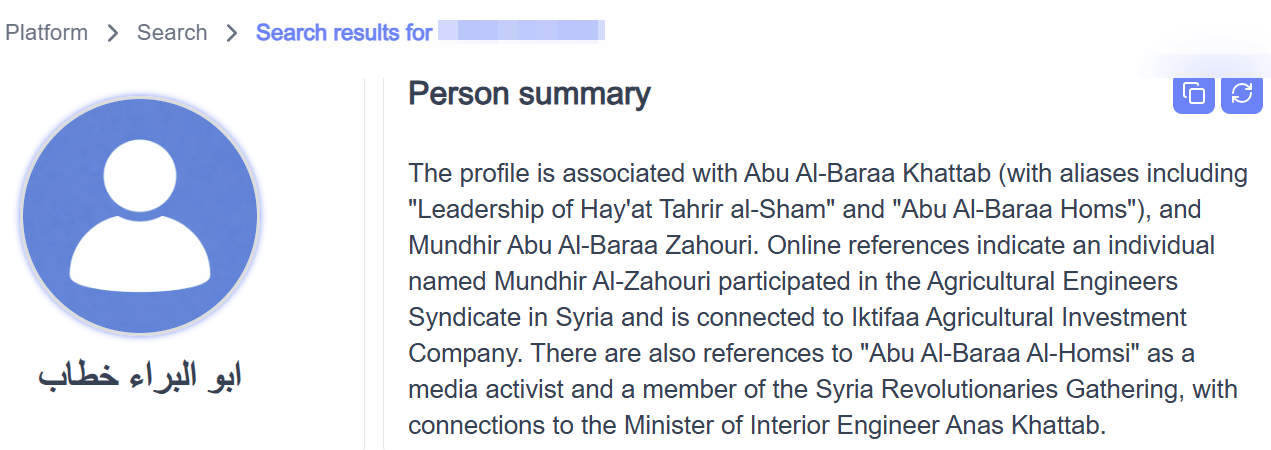
Abu al-Baraa is the nickname of Munthir al-Zouhouri, an engineer and a member of the Agricultural Engineers’ Syndicate Board. The Hama Governorate’s Facebook page published a post describing al-Zouhouri as the head of agriculture for the central region of the governorate.
The Iktifaa page lists al-Zouhouri as the “manager of the company’s Hama branch.” When we contacted him, he denied having any ties to the governorate, stating instead that he is the manager of the ‘Iktifaa’ Hama branch.
He also appears in photographs from private seminars organised by Gheras Agricultural Investment Company, before it changed its name to Iktifaa Agricultural Investment and Development.
Our findings are consistent with reports released by Syrians for Truth and Justice, the Syrian Observatory for Human Rights, and other organizations, who have stated that Iktifaa has been facilitating investment operations involving the land of displaced persons, who have effectively lost the ability to manage their own land.
Iktifaa Agricultural Investment and Development Company was established in Idlib in October 2024. On its official website -which does not disclose information about its owner- it presents itself as a company operating in agricultural production, food security, agro-processing and smart farming.
Iktifaa is linked to Gheras for Agricultural Development and Investment”, formerly managed by Bassel Sweidan – the former director of Iktifaa – and the Sovereign Wealth Fund for the Agricultural Sector. Sweidan now serves as head of the Anti-Corruption Commission and as Minister of Agriculture in the current Syrian government. Furthermore, the current director of Iktifaa, Mohammed Hanouf, was in charge of the mushroom project at Gheras.
We carried out a telecom network analysis of 60 unique telephone numbers linked to three main entities: Iktifaa Agricultural Investment Company, Gheras Agricultural Investment, and Al-Khadra Agricultural Investment, all of which were also established in Idlib. Our analysis revealed that the three companies are all linked to an international number.
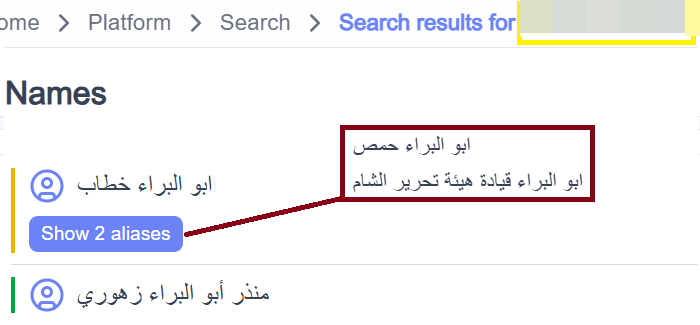
Analysis of Iktifaa numbers also revealed that Abu al-Baraa’s number was linked to one of the company’s numbers. This number was registered to Abu al-Baraa Homs, Abu al-Baraa Hay’at Tahrir al-Sham, and Munthir Abu al-Baraa Zouhouri. This name matches that of the individual through whom some investors claimed to have acquired plots of land belonging to displaced persons from Hama.
ARIJ contacted the Hama Governorate via the email address published on its official pages to forward the displaced persons’ testimonies. We received a reply from a man named “Abu al-Baraa al-Hamawi”, who informed us that he was in fact Munthir al-Zouhouri, the manager of the Iktifaa branch.
Al-Zouhouri described the testimonies of the displaced people we met as “false,” and urged us to visit his office along with our sources “to respond to their false allegations.”
We contacted al-Zouhouri again by telephone and email, and stressed that we could not reveal the identity of our sources. We reiterated our request for a response, which we said would be published in full. However, we received no reply from him by the time of publication.
The hopes of people displaced from the northern villages of Hama to return home are slowly fading. Nearly a year and a half after the fall of the regime, their connection to their land hangs by a single tenuous thread: the investment contracts.
“I lost everything I owned when I left my village. At that moment, I felt I was about to lose something far greater than material possessions. I would lose my land and the place where I grew up, raised my children and buried the most precious person in my life – my father.”
A sense of anxiety gripped Mu’tasim as he spoke. He clasped his hands over his chest as if permanently on guard, and his gaze wavered as he wondered: “Could that glance I cast upon my home and my village truly have been my last?”
This investigation was produced with support from ARIJ.