



'/%3E%3C/svg%3E "Youtube")
“The corridors are no longer safe.”
A sentence used by Elham, a nurse at Al Sadr Hospital in Beni Sueif, to describe her fears every time she crossed the hallway to the coronavirus isolation section. It didn’t take long for her fears to become a reality. She developed symptoms, tested positive and was transferred to another hospital to receive the same care she had been providing her patients.
Sayed, a nurse working at the National Cancer Institute, also developed symptoms. He couldn’t get a diagnostic test at his hospital so he had to use his colleague’s car to drive to several hospitals before being able to get tested.
Ghada, a nurse at Ain Shams General Hospital, continued working after being exposed to droplets from a patient. She couldn’t get a test at her hospital as the health ministry’s guidelines stated that only healthcare workers who have symptoms can be tested. When her children started showing symptoms, Ghada finally managed to coordinate with a member of the infection control team to get the PCR test as a regular patient. She and two of her four children tested positive.
This report follows cases of healthcare workers who were infected with Covid-19 and documents how the Egyptian Health Ministry failed to protect public healthcare workers by following incomplete, sometimes contradictory safety protocols and not adopting clear strategies for early detection and limiting of infections amongst public hospitals’ staff.
Ain Shams General Hospital teamNumber of workers in the health sector
according to data by the Central Agency for Public Mobilization and Statistics 2018
Nurse
Doctor
HospitalPublic sector
143,200
75,700
691Private sector
22,800
25,130
1,157
According to the World Health Organization (WHO) as a healthcare worker with exposure to the virus, Ghada should have been equipped with the highly effective N95/FFP2 mask. She should have also been given a PCR test after 14 days of self-isolation, based on the Egyptian health ministry’s own guidelines. Ghada says none of this was implemented.
After isolating at home, Ghada developed complications that necessitated her transfer to the hospital. “I self-administered the oxygen. The building security personnel and my colleagues were afraid of me,” she remembers.
She still had symptoms when she was called back to work, so she requested a test to confirm her recovery. The hospital denied her request and gave her no choice but to return to work. According to the Health Ministry’s guidelines at the time, 28 days were considered sufficient confirmation for recovery which meant infected healthcare workers returning to work were not tested. Ghada says the hospital did a throat swab test for healthcare workers who were in self-isolation, but they were never shown the results.
The hospital’s infection control director, who had tested positive himself, could not be reached for comment. Meanwhile, the head of the nursing team, who preferred to only publish her first initials N.A., agreed that the ministry did not provide a sufficient number of PCR tests.
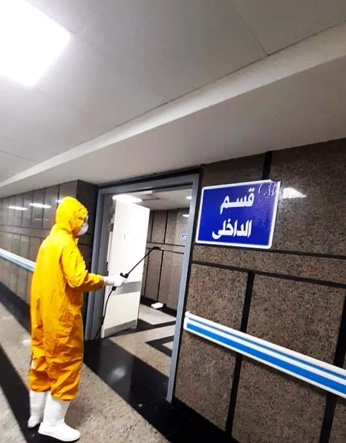

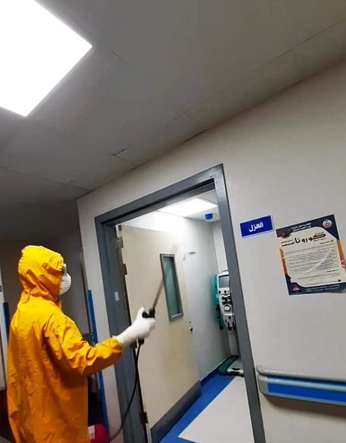
By mid-April, two months after the first infection in Egypt, the Ministry of Health had not yet announced a unified protocol to deal with infected healthcare workers. It was left up to each hospital’s administration. Meanwhile, Egyptian Minister of Health Hala Zayed announced setting up thirty isolation centers in hospitals across Egypt for Covid-19 patients.
The first unified protocol was issued on April 18. However, according to the doctors syndicate, public hospitals’ healthcare workers in clinics and emergency rooms continued to work without a clear and unified protocol. Doctors and syndicate members said different hospitals and clinics were using different protocols that were inadequate in fighting the pandemic. The syndicate accused the health ministry of being responsible for the death of healthcare workers because of “negligence.”
The Health Ministry database did not have updated numbers for infected healthcare workers until June 1st.
But the ministry’s official records show that the numbers increased from a handful in mid-March to 81 at the beginning of April, about 10 percent of the reported cases in Egypt at the time. The number of infected healthcare workers rose again to 13% by mid-April according to statements by the former WHO official in Egypt, Jan Jabbour.Hospitals designated to deal with COVID-19 patients nationwide
According to data from the Ministry of Health and Population as of June 3, 2020 20
20
University hospitals 320
320
Public and central hospitals to serve COVID-19 patients 24
24
University hospitals
35,152Bed in the internal section643Xray device3.539Intensive care bed125ct device539Intensive care bed2,218Artificial breathing apparatus
* Click on the red dots to see the number of hospitals in each governorate
A health ministry statement issued later, on May 25th, said 11 healthcare workers had died of Covid-19 and 291 were infected. A statement with conflicting numbers was issued on the same day by the doctors syndicate putting the number of deaths amongst healthcare workers at 19 deaths and infections at 350. The numbers increased to 160 deaths and over a thousand cases by mid-September, according to Dr. Mohamed Abdel-Hamid, treasurer of the doctors syndicate. By early November, the death toll surpassed 200 and infections 3500, according to Dr. Iman Salama, the rapporteur of the doctors’ syndicate’s social committee.
Estimates by the local syndicate branches show that over 20 percent of healthcare workers were infected in some hospitals. Out of 300 thousand nurses in Egypt, 220 thousand of whom work in public hospitals, 21 thousand were admitted to isolation centers, according to head of the Egyptian nursing syndicate Kawthar Mahmoud.
Over the course of three months, from mid-February to mid-May, this report tracked news of hospital closures in news websites and newspapers, and documented, through official sources, confirmed cases of infection transmission amongst healthcare workers in over 30 hospitals including Ain Shams, Zaytoun Specialist, Al Zahra Al Jamii, Al Shorouk and Banha Al Jamii. According to 30 testimonies, the reasons for the infections included the absence of clear protocols to deal with the pandemic or confusion due to adopting updated protocols that contradicted existing ones. The report also documents 20 cases, through hospital data that included the date of infection, diagnosis and tests taken as well as data issued by the Ministry of Health which followed treatments given to Covid-19 patients.