



'/%3E%3C/svg%3E "Youtube")
Nour Mostafa17 September 2026Egypt – Upper Egypt and border governorates
The image was created using AI
160+women and girls involved in incidents documented in this investigation
50+women from a single family were taken away during the Balina incident in Sohag in 2025
30+years this practice has continued – from 1995 to 2025
This investigation reveals a pattern in Egypt where some security agencies raid the homes of wanted individuals and take their female relatives hostage, to pressure them into giving themselves up. This is in violation of the principle of “the principle that punishment is personal” guaranteed by the Egyptian Constitution, and happens without any official record being kept of their detention.
In the middle of a hot July day in 2024, the household was experiencing one of the regular rolling power cuts. The only thing disturbing the quiet was the family’s attempts to cope with the heat, which seemed particularly hard on the children.
Suddenly cars and armored police vehicles could be heard pulling up outside the house, in one of the villages in Luxor in southern Egypt. Security forces, led by a number of officers, stormed the house and several neighboring houses, causing panic among the residents.
“We screamed because they dragged us out without the chance to get dressed properly… and we’d done nothing wrong,” recalls Nagat Ali, who was taken to a police van, to find three other women inside, all of whom the security forces had taken from neighboring houses.
Nagat left three children behind and the front door wide open. Her eldest daughter, in Year 5 at primary school, watched as her mother was taken away – a sight that has stayed with her ever since. For six months afterwards she would suffer recurrent bouts of fainting, at school and at home, says her mother.
Nagat was not a suspect in any criminal case. The police took her away because her husband’s family was related to a man wanted in connection with a criminal case, and their aim was to force him to turn himself in.
What Nagat Ali went through was not a one-off incident. We have heard several similar stories over the past five years, in Upper Egypt and Egypt’s border provinces, that show a pattern. Women, whether they are mothers, wives, sisters or female relatives – at least 160 women and girls in all in the cases we have documented in this investigation – are taken from their homes by the security forces, not because they face charges or are suspected of committing crimes, but to force their relatives, who are wanted by the security services, to give themselves up.
In almost every account we heard, kinship alone was grounds for detention. Women are used as an instrument to pressure their relatives – a practice that contravenes the principle of “personal liability for punishment” inherent in the Egyptian Constitution and the law, which limits criminal liability to the accused alone.
“Penalties are personal. There shall be no crime or punishment except pursuant to a law, and a penalty may only be inflicted by a court judgment. Penalty shall only be imposed for acts committed after the effective date of the law imposing it.”
Article 95 of the Egyptian Constitution
The Egyptian Constitution: Part IV; The Rule of Law
A few days before the raid took place, there was a dispute in the village over the ownership of agricultural land which escalated. In the end two people were left dead and a number of others injured. The main suspect subsequently fled his home and became a fugitive in connection with the case, the details of which we have withheld to protect the witnesses.
The police were unable to find him and began raiding homes in the village – not that of the fugitive, however, but those of his relatives, specifically the women. In the first raid, the security forces arrested the suspect’s mother, hoping that detaining her would prompt the man to emerge from hiding and give himself up. But that did not happen.
So in a follow-up raid they widened the scope of detentions to include more distant female relatives, one of whom was Nagat Ali.
Nagat told us about what happened at home before she was taken away. The officers who stormed the house did not just search for the missing suspect, but also damaged parts of the home the family had built: “They smashed up the courtyard… they started tearing down the things we’d constructed ourselves out of mud, searching here and there and everywhere” .
When Nagat tries to explain what happened to her, she does not dwell so much on the details of the crime – about which she knows nothing – but on her own situation: a woman taken from her home, not for anything she had done, but because her husband was a relative of the wanted suspect. She sums it all up by saying: “God knows who the killer was and who got killed, but the authorities would come every so often and take women away …even if they had nothing to do with it.”
For Nagat’s eldest daughter, who opened the door to the security forces when they threatened to break it down, her ordeal did not end when her mother was released after hours of detention.. She continued for several months to suffer repeated bouts of fainting at school. After numerous medical tests and procedures, the doctors concluded that her symptoms were caused by psychological trauma from witnessing the police raid. She would even wake up in the night sobbing and screaming: “Come and get me, mum.”
Nagat talks about her daughter’s suffering after Nagat’s intimidation at the hands of the police during the raid on their homeClick to read transcript
Nagat was not alone in the police van. Among the three women already picked up was Amina Mahmoud, whose account of what had happened matches Nagat’s in all essential details..
Amina’s story, though, was about more than just being taken away. Before that she and her husband were beaten by the police, who at the same time demanded to know the whereabouts of the wanted men: “They beat me and my husband…they beat us half to death.”
Nor were the children spared. Amina’s baby daughter was taken with her to the van, before being snatched away from her as she wept. And one of the policemen chased after her eldest daughter as she tried to flee across the fields, terrified by what she had seen.
Amina says that what happened in her home happens every time there is an incident in the village where the police are called. Women are taken away to put pressure on wanted men to turn themselves in.
Amina: “The police arrived with more than twenty armored vehicles to arrest me.”Click to read transcript
“Personal freedom is a natural right, shall be protected and may not be infringed upon. Except for the case of being caught flagrante delicto, it is not permissible to arrest, search, detain, or restrict the freedom of anyone in any way except by virtue of a reasoned judicial order that was required in the context of an investigation.”
Article 54 of the Egyptian Constitution
The Egyptian Constitution: Part Three; Rights, Freedoms and Public Duties
Amina and Nagat were luckier than the other women who were with them in the van. Before they even entered the police station they were released, after mediation by the village elders and heads of prominent families. So they were spared what other had to go through – particularly the mother of one of the fugitives, who told us more of what happened.
When the security forces raided the village the first time, the wanted suspect was not at home. But they went on with the operation nonetheless, arresting women in his household, to pressure him into turning himself in. So the suspect’s mother, Sabira Abdel Razeq, was taken away: “They raided the houses… and took us, the women.” She says the journey to the police station was no less an ordeal than the raid itself for an elderly woman, forced out of her home for the first time in her life: “We didn’t know what was going on … It was the first time we’d ever left our homes.”
Once inside the police station, Sabira was placed in a room full of women like herself. There she spent four days, without being charged, or brought before the public prosecutor, or questioned about any alleged offense. She told us those detaining her kept asking her one question over and over again: “Where’s your son?” She was told bluntly that her release was dependent on him turning himself in.
On the fourth day, her elderly husband could no longer bear the idea of her being detained. And, although he was not the one they were looking for, he handed himself over and she was released.
The father’s detention achieved nothing, however. The man they were looking for did not give himself up. And pressuring a man – even if he is his father – is not as effective as pressuring a woman. So a new round of police raids began again.
Sabira was again taken to the police station, this time along with the wife of her fugitive son. And both faced the same questioning: “Where is your son? Where is your husband?”
This time, Sabira was kept at the station for a whole week. Food for the detainees came from the villagers and the village headman, not from the authorities holding them. But in the end the saga ended as it began – not with any decision from the public prosecutor’s office, or the conclusion of an investigation – which had never legally begun – but through the intervention of mediators: “People got involved and said ‘enough’s enough’ and they let the women out.”
Sabira: “They raided the houses and took me away.”Click to read transcript
“The judicial officer must immediately hear the statement of the arrested suspect, and if he fails to provide evidence of his innocence, he must be sent within twenty-four hours to the competent Public Prosecutor. The Public Prosecutor must interrogate him within twenty-four hours, and then order either his arrest or release.”
Code of Criminal Procedure No. 150 of 1950
Code of Criminal Procedure: Book II, Chapter III (On the Arrest of the Accused)
There is no trace in any official record of what happened to the women from the village. The file on the criminal case for which these women were taken into custody contains nothing to show that any one of them was charged or referred to the public prosecutor. Nor is there a record of any of the women spending one day in detention, except what we have established through this investigation with independent testimonies, each collected separately, which agree on the essential facts.
A few dozen kilometers away, in a village in Qena Governorate, a man – not a woman – was this time at the heart of the story. Hamam Abdel-Aty did the same as Sabira’s husband and handed himself in to the police to divert their attention away from his wives, but this time they would not accept him as a substitute.
It all began in 2022, the day the crime was committed. A man from another family was killed and two of Hamam’s brothers were accused, prompting the security forces to raid their home. Hamam says they included the chief detective and his deputy and came in three or four police vans. They failed to find the suspects, as they had fled, but they did find Hamam and his two sisters. Hamam says he decided not to do what others would have done. “I stood my ground and didn’t try to escape… but it wasn’t enough for the policeman to arrest just me.” They put him in the police van first. Then, he says, the officer in charge ordered that his two sisters be put in the van with him.
At the station, the two sisters were held in a separate room along with two women from neighboring villages. They were released the next day, after the local mayor intervened. Hamam, on the other hand, was in custody for four days. During this time he was brought before the public prosecutor and charged, though ultimately acquitted. But this young man, who refused to run away, now has an official record on file – a charge, a court appearance and a verdict – while his sisters are not mentioned at all in the records, as if their night in the police station had never happened.
Hamam: “They shouldn’t have taken the women as long as there was a man to go with them.”Click to read transcript
A similar incident to what Hamam describes had previously erupted publicly in Qena Governorate. In August 2017, a video went viral showing an altercation outside the police station in the town of Farshut between Hamza Abu Sahli, then a member of parliament (MP) and the police. The account of the security forces at the time was that the dispute was over two women against whom the police had filed a report.
The MP said, however, in a TV interview that he had gone to the station because he had been asked for help in connection with the arrest of two women from his hometown, with “no just cause”. This was against the backdrop of a feud between two families. When he arrived, the MP found one of the women unconscious and in physical distress. Her son had been shot a few hours before.
The MP asked for her to be taken to hospital, but that was rejected. He then offered to take her in his own car, but this led to a confrontation with the assistant director of security. The MP himself was then stopped from leaving the police station for some time, and the situation was only resolved after calls to the director of security, the governor and the assistant minister of the interior.
The MP justified his intervention by saying that local traditions in Upper Egypt were against women being arrested without legal justification. It is now some years since the incident, but he told us that it is standard practice when the security forces are dealing with wanted individuals: “When they take the man’s wife, sister or daughter when he’s on the run, and has various cases and convictions against him, custom in Upper Egyptmeans he’s forced to give himself up.”
From Qena Governorate to Sohag, this practice is commonplace. In September 2025, after a man was killed in a feud between two families in the village of Al-Halafi, in the Balina district, the security forces raided all the homes of the accused man’s family, and took dozens of the women and girls off to the police station. This time it was not only local people who bore witness to what had happened. The Egyptian Network for Human Rights also documented it in a statement describing what had happened as “collective punishment”. And it demanded the immediate release of the women detained and an end to retaliatory practices.
Taha, from one of the families, recounts what he saw when things started to get out of control. The two families clashed in the street, after which the security forces poured into the area but found the accused was gone. So they arrested whoever they could find from his family. Taha says that more than 50 women of his family were detained: “Yes, it happened… it really did happen.”
When asked about what they were charged with, he says: “No, by God, there were no charges made or anything, it was only to put an end to the.”
What Taha told us is corroborated by a written complaint – of which we managed to obtain a copy – listing the names of the women and children detained at the police station during the incident.
Taha: Their detention was to “put an end to the problem”Click to read transcript
“Any person who has come to know of a detainee who has been detained illegally or in a place other than the places designated for detention may inform any member of the Public Prosecution, who, once having been informed, shall head immediately to the place where the detainee is kept and shall conduct an investigation and order the release of any detainee kept illegally. A report of the incident shall be made.”
Article 43 of the Code of Criminal Procedure No. 150 of 1950
Code of Criminal Procedure: Part II, Chapter III (On the Arrest of the Accused)
We found this same practice in tribal communities from the far south of Egypt to the northwest. In the second week of April 2025, security forces set up an ambush in the village of Al-Nagila, in the governorate of Matrouh, to arrest a suspected drug trafficker named Fayez Amira.
The ambush resulted, however, in the deaths of three of the security forces and the escape of the suspect and his cousin. Reprisals targeted people who had not fled and had not been charged. Homes were raided and 24 women, including Hamid’s wife, were detained at the Al-Nagila police station without any legal justification.
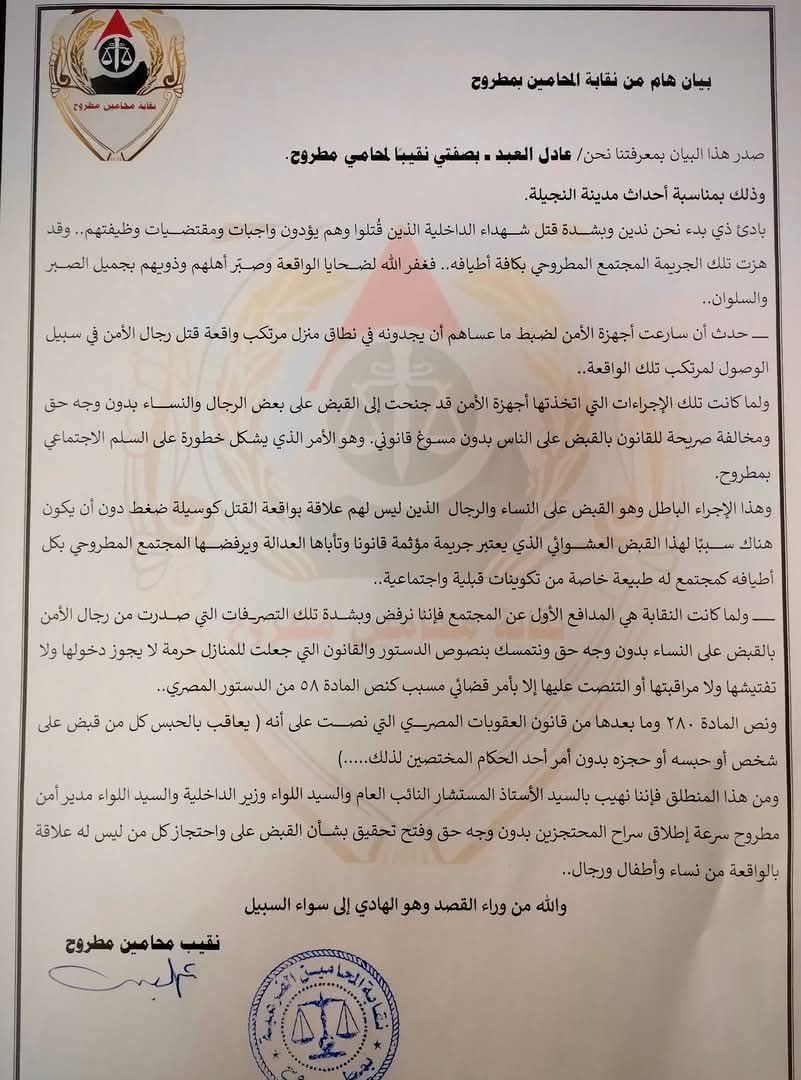
The day after the women were detained, officers at the station and the mayor of Al-Nagila, Hamad Bolqara, agreed to their release, in exchange for the handover of two young men from the suspect’s family, including his half-brother, Youssef Eid Fadl al-Sarhani. The mayor, Bolqara, personally handed them over to a National Security officer, and the women were released. A few hours later, Al-Sarhani and his companion, Faraj Rabash Al-Fazari, were found dead in a remote desert area. The Interior Ministry announced they had been killed in an “exchange of fire” and denied the women had been detained at all, though this was documented and reported publicly by the Egyptian Initiative for Personal Rights.Matrouh74 Women detainedSinai32 Women detainedUpper Egypt60 Women detainedThe numbers of women detained in three Egyptian regions.
Source: data compiled by the investigation team
Mamdouh al-Darbali, the former head of the Matrouh Bar Association, says that taking women hostage without cause is common practice in the governorate. He has personally witnessed three such incidents, the cruelest of which involved when police took into custody 50 women from one of the tribes in Matrouh, because they had been unable to apprehend wanted individuals.
Local people had sought his help, so he went to the police station to find the 50 women sitting on the floor. They were released the same day, but only after intervention by an MP from the National Democratic Party, which was dissolved before the January 2011 revolution.
During the incident in Al-Nagila, Al-Darbali says he wrote to the minister of the interior, posting the letter on his Facebook page, and the Matrouh Bar Association issued a statement – of which we have a copy – saying that the police had acted without lawful grounds and in breach of the law in detaining women with no connection to the killing, It emphasized that raids on the women’s homes were a breach of Article 58 of the Constitution, which prohibits entering or searching homes except with a court order. Al-Darbali summed up what happened as: “gangsterism”.
The bar association points out that Article 280 of the Egyptian Penal Code No. 58 of 1937 stipulates that:
“Any person who arrests, imprisons, or detains any person without an order from a competent authority and outside the cases in which laws and regulations authorize the arrest of suspects shall be punished by imprisonment or by a fine not exceeding two hundred Egyptian pounds.”
Article 280 of the Egyptian Penal Code No. 58 of 1937
This practice is common across western and northeastern Egypt. In Sinai, Al Jazeera Net reported that 32 women and girls from the Al-Fawakhiriya – one of the largest tribes in North Sinai and El-Arish – had been held unlawfully, after police failed to arrest two men wanted by the security services. They were taken to force the men to hand themselves in.
There is, in theory, a legal route for challenging this type of detention. The familiar steps involved were spelled out to us by a lawyer, who preferred not to be named: An urgent fax to the minister of the interior and public prosecutor saying the women were in police custody on a specific date and at a specific time, to prevent any later report being made with a different date or details. If the problem cannot be resolved amicably with the investigating authorities, then a report goes to the public prosecutor with a question the authorities would have to answer: if the women are witnesses, they must be released; if they are suspects, why were they not brought before the public prosecutor within twenty-four hours, as the law requires?
Families rarely go down this route, according to the lawyer, because legal pressure on a security officer may force him to implicate the detainees to protect himself: “Instead of taking responsibility, he files a report saying they’re criminals, and then it is up to you to prove they’re innocent.”
Faced with an inherently unequal burden of proof – the officer’s word is taken at face value because he is an authority figure, while your word is dismissed unless it is backed up by evidence – a complaint can turn dangerous. A woman detained without charge could find herself a suspect, on the basis of a fabricated report. So families opt to remain silent, says the lawyer.
Esraa Salama, a lawyer at the Court of Cassation and the Supreme Administrative Court, stresses that detaining women without legal grounds is a breach of both the Egyptian Constitution of 2014 and the Penal Code; since criminal proceedings can apply only to perpetrators of an offence, not to their relatives.
Esraa speaks not only from her knowledge of the legal texts, but from actual cases she has handled involving women detained in this way. Most of them, she says, decide not to claim their rights or even to document what has happened to them: “Sadly, most of them are afraid to demand their rights, because they fear that police officers or constables will single them out or harm their families.”
A female lawyer from Upper Egypt, who preferred to remain anonymous, told us she personally acted as a mediator at a police station in Qena to secure the release of female detainees by offering the usual deal: “We’ll bring you the suspect, so let the woman go.” But because this formula has been used repeatedly, it began to backfire. She says that some wanted men no longer give themselves up when their wives are arrested, but let matters take their course. They say: “Let them take her,” knowing that the woman has not committed any crime and so she “will spend two days at the station” and then be out. So the woman is left alone to face the resulting detention on her own.
The testimonies documented in this investigation are not where the story begins. A Human Rights Watch (HRW) report on the same practice was published in January 1995, thirty years ago, entitled “Egypt: Hostage-Taking and Intimidation by Security Forces”. It compiled cases dating back to 1990, including a woman in her fifties who was detained for six days at a police station in Minya because her son was on the wanted list. She summed up her situation to HRW by saying: “I was a hostage”.
The report documented no fewer than 250 people taken hostage in a single month in 1992 in the city of Qena and surrounding villages, and 70 complaints of detention made to the public prosecutor in the same governorate in just two months. Among the cases the report documented were hat of a sick woman in her seventies who was detained twice to force her fugitive son to give himself up; and the detention of forty people from a single village. The HRW report also documented mud-brick houses being demolished, and detainees being released after local residents intervened.
The HRW report also revealed that none of these cases of detention had been officially recorded and that the police had not even admitted the existence of the detainees. State Security admitted to a defence lawyer at the time, however, that his two detained clients would be released only if their wanted brother turned himself in.
The report concluded that the widespread nature of this practice in villages in Upper Egypt indicated that it had become systematic, perhaps even directed by senior levels of the security services.
Three decades later, HRW documented the same practice again in a report published in May 2025 on what happened in Al-Nagila in Matrouh. It confirmed that between 20 and 24 women and girls had been detained to force their relatives to turn themselves in. It also showed that the Interior Ministry had denied the detentions had happened, despite this being confirmed by multiple sources.
A striking change has clearly happened in the time between these two reports. Those taken hostage in the 1990s were mostly relatives of individuals wanted in cases of political violence, when armed confrontations were taking place between the state and Islamist groups, and under the cover of a prolonged state of emergency. Today’s hostages, however, are taken in connection with ordinary criminal cases, like blood feuds, land disputes, individual murders and drug-related offenses.
This activity is regarded as criminal not only under Egyptian law. Egypt is a party to the International Covenant on Civil and Political Rights, Article 9(1) of which prohibits arbitrary arrest, while Article 17(1) prohibits arbitrary interference in family affairs. In 1990, Egypt ratified the Convention on the Rights of the Child, in which Article 37(b) forbids the detention of a child except as a last resort, for the shortest appropriate time. These are among the provisions HRW has cited since 1995 in characterizing this practice, emphasising that the state of emergency cannot by itself justify the detention of any person merely on the basis of their family ties to a wanted person.
In the end, women are still the most vulnerable group, particularly in tribal and family-oriented societies. And they are used to pressure individuals wanted by the security services, without any legal justification and in violation of all laws and customs, as well as the Egyptian Constitution.
This investigation was produced with the support of ARIJ.
* Some of the details of the events described have been altered to protect witnesses.
* Most of the names of those interviewed in this report have been changed.