



'/%3E%3C/svg%3E "Youtube")
Reman Baroud and Abir Berriche
06 May 2026
Outside a popular café in Tunis, dozens of African migrants have gathered, hoping to find a job to help to cover essential expenses. Usually in transport, construction or olive harvesting.
One of those hoping to find a day’s work is Traoré. “We don’t have any particular jobs, we’ll do everything, but there isn’t always work, ” he says.
Traoré is from Côte d’Ivoire and spent a year travelling through Burkina Faso, Niger, and Algeria.

Harsh living conditions were not the only thing Traoré has faced in Tunisia. “If you’re black in Tunisia, you’re powerless. Everyone does what they want to you, and you can’t do anything about it.”
While thousands of sub-Saharan African migrants like Traore face this difficulty on the ground, disinformation campaigns are running rampant in the digital sphere, stirring up hatred against them.
On March 6, 2025, Tunisian Member of Parliament Fatma Al-Masdi visited a migrant camp in El Amra, in the southern province of Sfax. The camp is a focal point for migrants from various African countries. In a post on her Facebook page following the visit, Fatma attached photos of the camp with the caption “A state within a state.” The post went viral and sparked a disinformation campaign on Facebook, inciting hatred against migrants from sub-Saharan Africa.
The following investigation reveals the details of disinformation campaigns circulating on Facebook, fuelled by misleading posts and allegations against sub-Saharan migrants. These led on to actual attacks on these migrants.
We analyzed posts about these migrants across 13 accounts and pages: Oussema Arfa, Ben Arfa (linked to Oussema Arfa’s page), Nizar Boudaya, Mohamed Missaoui, Aymen Guissi, “قهواجي البرلمان”,
“الصفحة الرسمية”, Politiket, Erajilelly9harhoum, TadamonLive, Ghostpolitic, BelFallegii, Carthage News, and TN أخبار.
Our investigation monitored every post on their accounts and pages related to African migrants in Tunisia. There were a total of 2,044 posts from March 6 to May 6, 2025.
We used the Arab Fact-Checking Network (AFCN) classification system for posted claims and assertions: true, partially false, false, sarcastic, unproven, missing context, context unclear, and modified. We classified posts that had no information requiring verification as “general content.”
We then analyzed 1,403 misleading posts about migrants, classifying them as: partially false, false, unproven, missing context, and context unclear.
Posts from personal accounts and pages included in our investigation – which we will refer to as “accounts” – focused on two main themes: promoting the idea that migrants want to settle in Tunisia and make it their alternative homeland; and calling for their deportation. Posts also carried visual and written content suggesting migrants were responsible for incidents of assault or theft against Tunisian citizens and for spreading disease.
BelFallegii219PageTadamonLive176Pageقهواجي البرلمان205PagePolitiket132Pageالصفحة الرسمية310PageCarthage News133Pageأخبار TN92PageGhostpolitic97PageAymen Guissi68Personal AccountOussema Arfa93Personal AccountMohamed Missaoui26Personal AccountNizar Boudaya16Personal AccountErajilelly9harhoum40Page
On March 8, there was intense posting of an “alleged” project to settle migrants in Tunisia. Aymen Guissi’s account carried several posts on migrants, including one asking if there was a project to resettle Africans. On the same day, four pages (“قهواجي البرلمان”, TadamonLive, BelFallegii, and Carthage News) all published a false post about the Tunisian foreign minister and a supposed collusion to resettle African Migrants.
Half an hour later, another page – Politiket- put up a post by opposition politician Thameur Bdida, which included documents allegedly revealing an agreement between Tunisia and the European Union to resettle migrants from sub-Saharan Africa. Another page, Ghostpolitic, also published the post at around the same time as TadamonLive and BelFallegii. Four of the accounts simultaneously published a post featuring a video of politician Lotfi Maraihi, alongside text in which he talked about an agreement to resettle migrants and said he had been arrested for speaking out about it. The following day, three of the accounts posted false claims that there were 13,000 African migrants in Tunisia between 2011 and 2019, compared to 1.1 million African migrants, including 560,000 undocumented ones, under Kais Saied’s presidency.
The accounts posted content simultaneously on various topics concerning migrants that contained misleading claims. Our tracking of misleading posts showed that posts about African migrants had gradually increased from March 8, 2025.
MisleadingSarcasticTrueGeneral Content
Misleading claims include posts that contain any of the following: False, partially false, missing context, unproven, context unclear.
By tracking the accounts, we noticed that many that were published at the same time, carried identical or similar posts. Among these were claims that the Tunisian parliament had rejected a proposal to deport migrants and had passed laws to integrate them. When we looked into this claim, it turned out to be “false”. The parliamentary bureau had passed no law on the deportation of irregular migrants, but had set aside a day to look into the issue. It also did not enact laws to accelerate their integration.
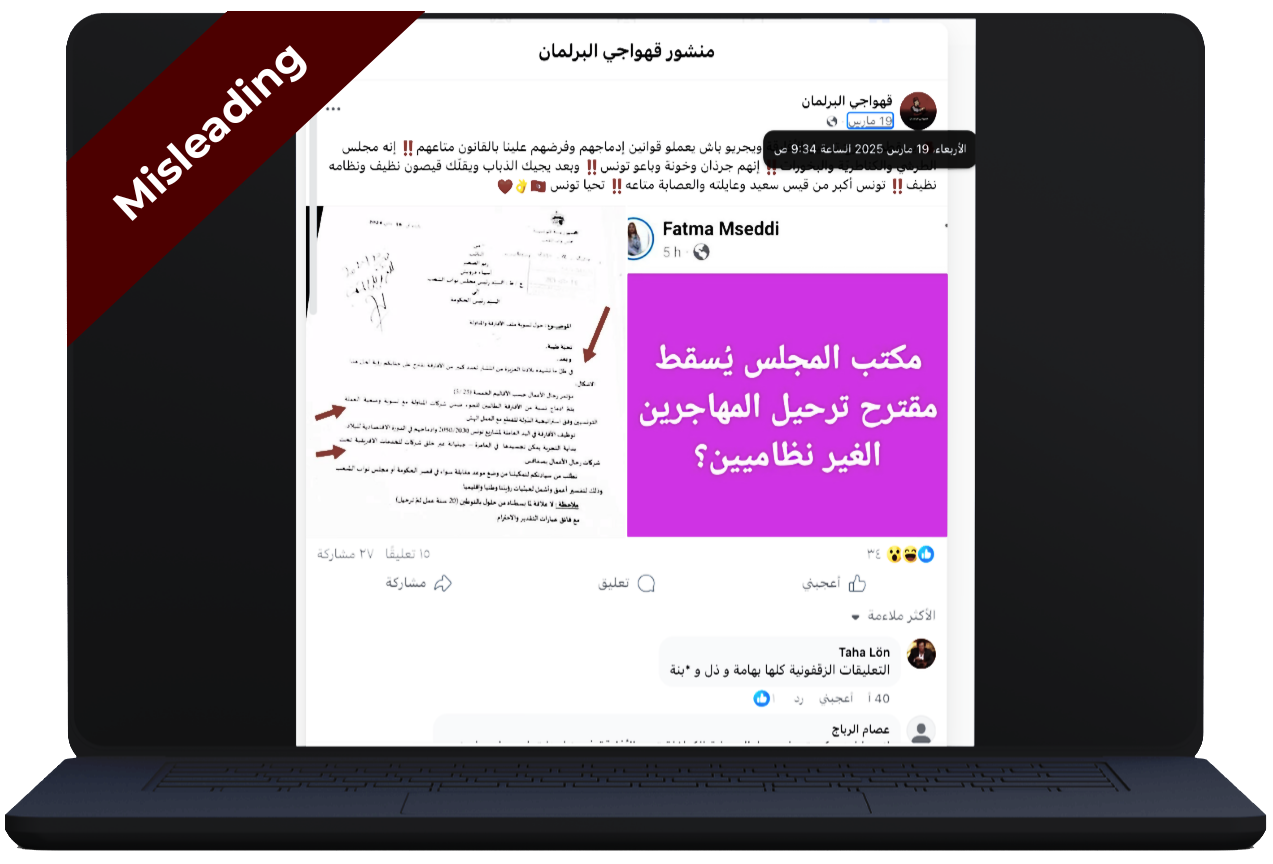
6
accounts
reposted the rumourwithin 6 minutes

Click to view accounts and posting times
09:3119 March 202509:3319 March 202509:3419 March 202509:3519 March 202509:3719 March 2025

carthage news

Fact: The Parliamentary Bureau passed no law to regulate the deportation of irregular migrants, but organizsed a day to study the issue. It did not put forward laws to accelerate their integration.
We noticed that the claim was posted on six accounts using the same wording, with identical images, and at almost the same time, which suggests that these accounts are coordinated or have the same administrator.
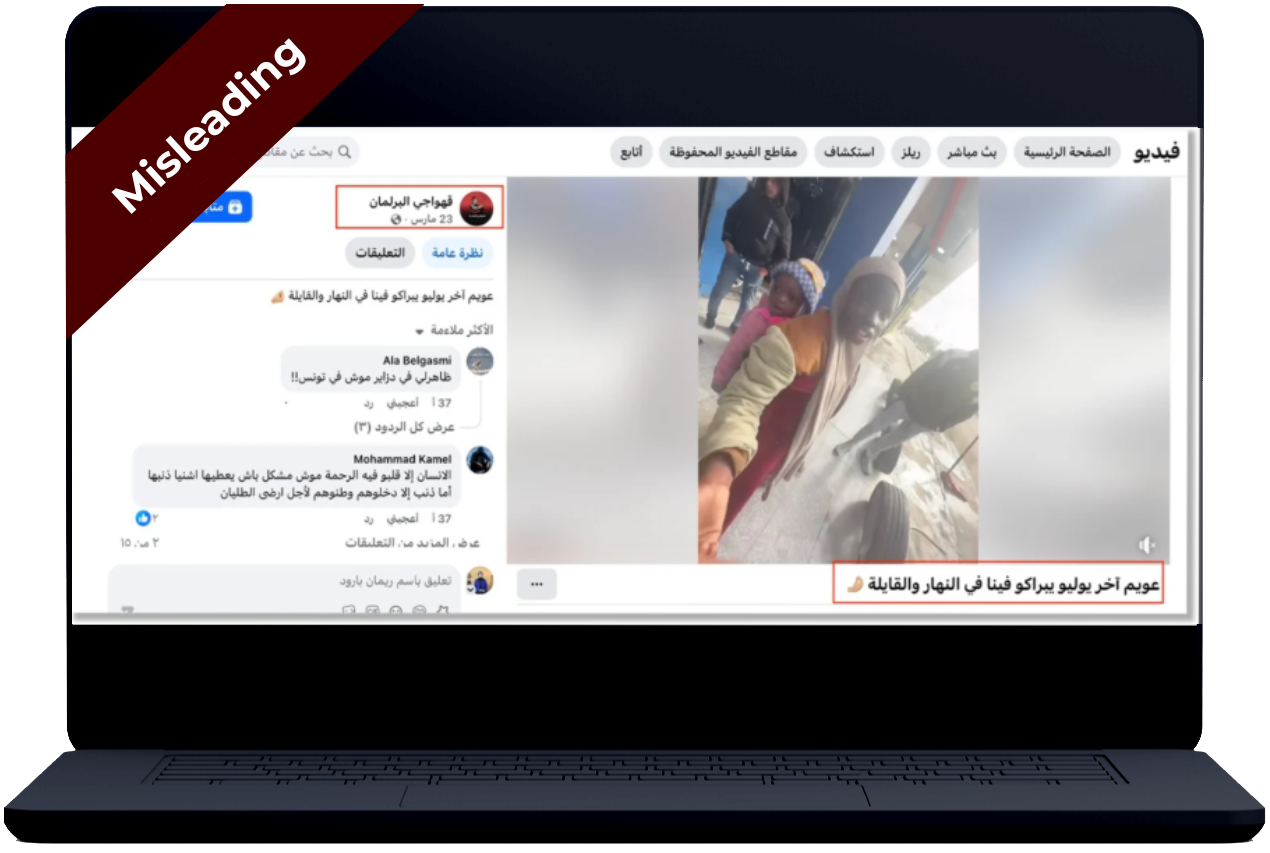
7
accounts
reposted the rumourwithin 12 minutes
Click to view accounts and posting times
12:4412:4512:4612:56
BelFallegii
Ghostpolitic
قهواجي البرلمان
Fact: video was shot in Algeria, not Tunisia
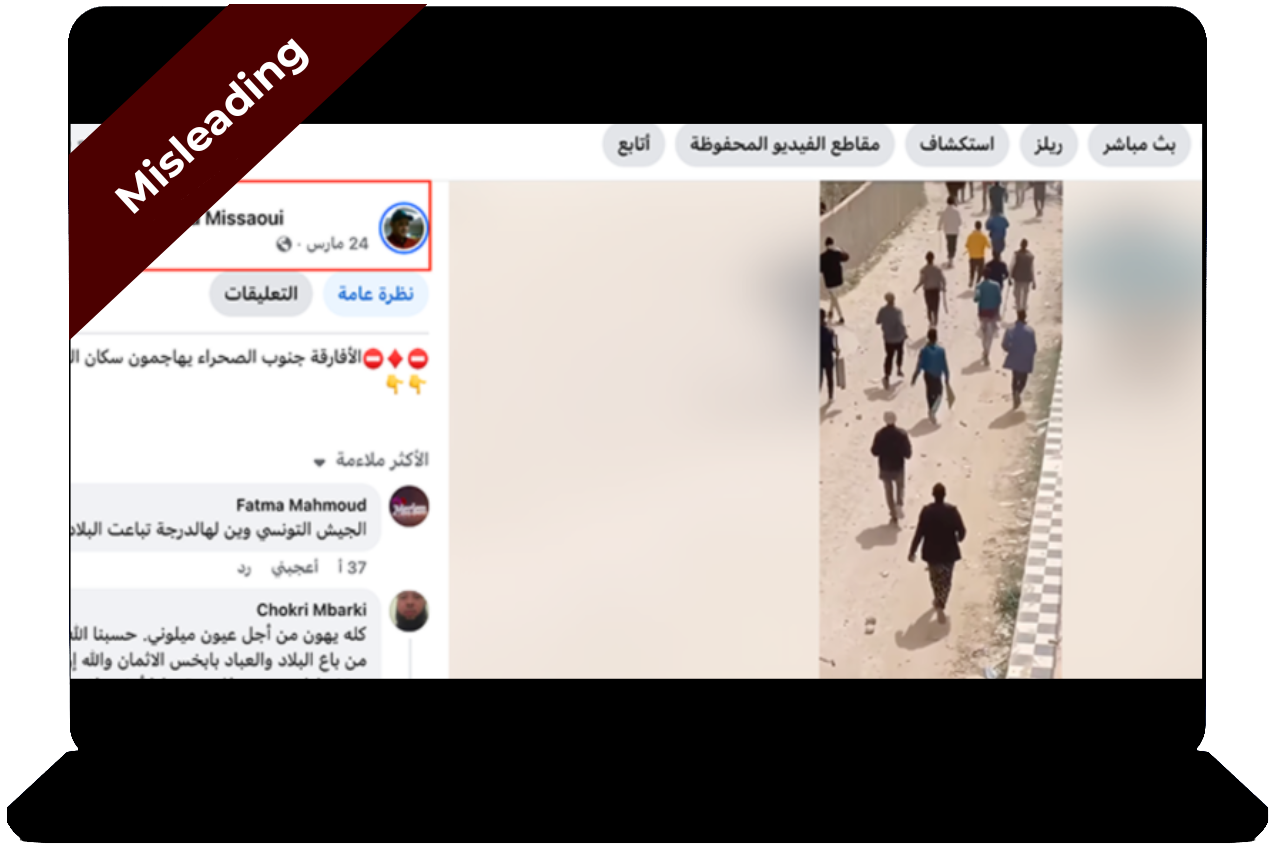
10
Rumour reposted by
ten accounts
Click to view accounts and posting times
21:5224 March 202522:2424 March 202523:2124 March 202514:1725 March 202516:0025 March 202518:2125 March 202509:2626 March 202509:2726 March 202509:3426 March 2025
Mohamed Missaoui
Fact: two groups of migrants in video posted in 2024
Accounts appeared to be coordinated through using the same profile images. Eight accounts posted identical profile images almost simultaneously on April 17, 2025. The accounts also live-streamed identical video footage at the same time on multiple instances. This strongly reinforces the hypothesis that these accounts are jointly managed or closely coordinate their content.
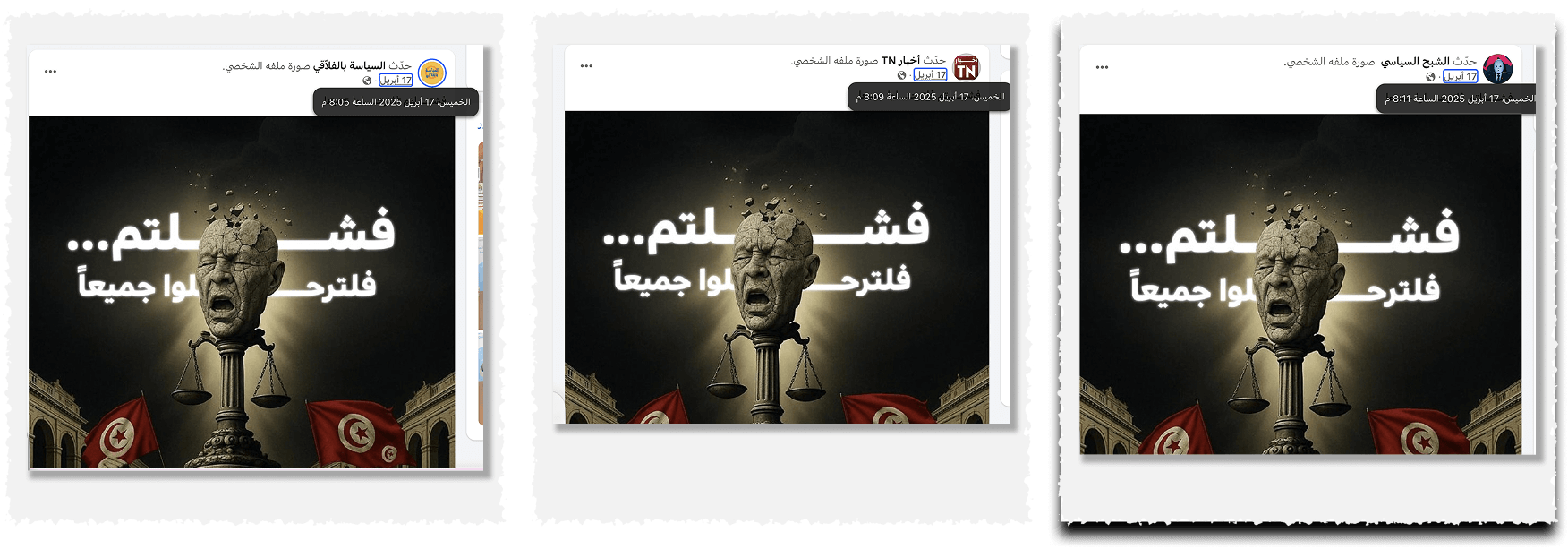
Click to view accounts and posting times
19:4917 April 202519:5117 April 202519:5317 April 202519:5517 April 202520:0517 April 202520:0917 April 202520:1017 April 202520:1117 April 2025
TadamonLive
A number of the accounts we analyzed follow each other on Facebook.
Tracking the network of accounts shows how they relate to each other on the platform. For example, we found that Mohamed Missaoui’s account follows five others: Ghostpolitic, TN News, BelFallegii, TadamounLive, and “قهواجي البرلمان”.
“الصفحة الرسمية” follows three accounts: TadamounLive, Belfallegi, and Nizar Boudaya, but none of them follow back.
Click to view accounts and posting timesCentral AccountsActive AccountsMedium AccountsIndividual Accounts
It was not possible to determine whether Oussema Arfa was a follower of the other accounts, as this account does not show who it follows. However, it appeared that he manages a group called “No to Settlement, No to Resettlement,” overseeing it along with others. This group has at least 75,000 members, including Nizar Boudaya and Mohamed Missaoui.
We extracted the most frequently used words in misleading and inflammatory posts using content analysis. Many of the posts not only described migrants as “illegal” or “irregular,” but used racist terms, including a whole set of racist expressions, associating migrants with animals and diseases.
In these posts, migrants were likened to “black locusts,” in reference to their skin color and large numbers, as if they were comparing them to a plague that was ravaging the country. They also used the word “al-hawayish”, a local term for animals, and “plague,” which portrays migrants as a threat to health and society.
The word “wasfan”- the plural of “wasif, ” meaning servant or slave in Arabic – appears repeatedly, “Deportation” is also a word that appears often with a negative undertone in the network of accounts we monitored. When it appears, it is a call for the immediate mass expulsion of “Africans”.
Other words pop up like “settlement,” “colonization,” and “settlers”- central to the conspiracy theory promoted by these accounts. They allege that there is a plan to settle “African” migrants in Tunisia. This incitement is not limited to online activity, but has morphed into calls for action on the ground through protest marches under the slogan “Deportation, not settlement,” with the accompanying expansion of the use of the hashtag #No_to_settlement.
The discourse also features military and political terms like “invasion,” “occupation,” “African colonialism,” “borders,” and “sovereignty.” Posts sometimes carry explicit calls for violence and exclusion, through actions such as “deportation” and “expulsion.”
One of the most striking terms for Africans we have observed is “Ajsi” or just “A” – an acronym for“Africans south of the Sahara,” which has become a common way to classify migrants on a geographical-ethnic basis.
The inflammatory rhetoric also links migrants to security, health and economic threats by repeating words such as “danger,” “disease” and “crime.” This systematic association creates a stereotypical image in the mind of the person reading these posts, which portray migrants as an existential threat to Tunisian society.
Posts included incitement against African migrants, accusing them of committing numerous crimes. On the evening of March 11, 2025, there was a coordinated release of allegations that there were “3,000 cases of AIDS” among migrants. Eight accounts published this claim the same day.
On examination, we found the information to be completely “false”. There was no organisation in Tunisia named the “Tunisian Observatory for Health Prevention,” and we found no reports or statistics issued by such a body. Figures issued by the health ministry in January 2025, indicated that there were no more than 317 AIDS cases among irregular migrants – about one-tenth of the number claimed.
The campaign did not stop with accusations regarding health. On 12 March, allegations of a “girl being kidnapped” spread across four major Facebook pages in just 12 hours, though we were able to classify them all as “false.” A reverse image search revealed that the image used had been circulating for years on a dating site and was of a Moroccan girl who had no connection to Tunisia or to migrants.
The same pattern was repeated on April 13, when there was a claim of “child abduction in Sousse.” Seven accounts posted the same content between 9:15 pm and 10:31 pm the same evening. Our investigation found the claim to be “unproven”, as we found no trace of the story in any Tunisian media outlet or official government sources.
Accusations against African migrants arose in other areas, and the claim that they had “burned olive groves in El Amra” were posted on seven accounts in under four hours. Once it was revealed that the video used was from outside Tunisia, the claim was shown to be completely “false”. ” An allegation of “black magic” also appeared on Nizar Boudaya’s account, but this was classified as “false” as well.
Even an allegation that Africans “dig wells on Tunisians’ land without permission” appeared across seven accounts in one night, between 13 and 14 March, though it was completely “false.” It turned out that the video was of a worker from Mali who had posted it on his TikTok page to advertise his professional services in digging wells. A more serious claim was made by a member of the Tunisian parliament that “Boko Haram elements” had infiltrated the country along with migrants. This was carried by five major Facebook pages, even though it was “unproven.
”These kinds of serious accusations relating to security, along with repeated claims of “rape,” “murder,” and “possession of weapons” (most of which we classified as “unproven” or “with incomplete context”), reveal a systematic strategy to portray migrants as a wholesale security, social and health threat, with no reliable Evidence.
We tried to identify the sources of funding used by the network to promote misinformation and incitement against sub-Saharan migrants. We searched the Meta Ad library, and could only find the account of Nizar Boudaya, who used funded ads to disseminate videos inciting hatred against migrants. Boudaya posted four paid videos on April 6 and 9, 2025, three of which were related to migrants. This took place after the Tunisian authorities evacuated some of the migrant camps in Sfax.


According to the library, Nizar Boudaya is both the beneficiary and the one who paid for the sponsored adverts. But the library did not specify the actual amount he paid them.
Page showing Nizar BD as the funder of and beneficiary from the ads`
We looked into the videos funded by Nizar Boudaya’s account and found that the account had posted one on April 6, 2025 showing a newly built city where migrants were supposedly to be transferred, after being evacuated from their camps. The video was untrue, and was of a tourist campsite called “Zmela” in southern Tunisia, not housing units made ready for irregular migrants.
Despite this, seven accounts had posted the video on April 7 using the same title and with less than a 30-minute interval between posting times.
Another video promoted by Nizar Boudya’s account was posted on April 7, 2025, with the title “Jendouba… The lie of deportation… Security forces move Africans from Amiriya to the cities…Africans return to the capital and coastal areas.” This video also turned out to be false.
Through tracking, we found six Facebook pages from the network that had posted the video shortly after Nizar Boudaya, using the same title: “the deportation lie, ” following the closure of some migrant camps in Sfax by the Tunisian security forces.
A third video, which talked about Africans entering Tunisia while critically ill, turned out to be “true.”
This incitement against migrants had an impact well beyond “hate” posts on Facebook. People formed patrols and went looking for irregular migrants in order to hand them over to the police. In May 2025, Amnesty International warned of what it called a continuing escalation of racial violence against refugees and “black migrants” in Tunisia, particularly in border areas. It said social media users had posted videos of themselves “tracking down black Africans” and threatening them with violence, and abuse. The authorities had also dismantled migrant camps on several occasions.
EuroMed Rights has documented two murders of migrants – a Malian national who was killed by aTunisian, and a 32-year-old Guinean migrant, who was shot dead by a Tunisian. We contacted the organisation for details of the two incidents,but they are yet to respond.
We contacted the accounts of the individuals mentioned in this investigation. We have not received a response from any of them, except Nizar Boudaya, who denied being involved in promoting material against African migrants in Tunisia.
The investigation was conducted in partnership with Tafnied.