


'/%3E%3C/svg%3E "Youtube")
Nour Galal
26 April 2026
Amna Ali (a pseudonym) locked herself in her room after losing her appetite. The 15-year-old girl began avoiding interaction with everyone around her. Amna recalls: “I didn’t want anyone to see me; I felt ugly and didn’t want to go out anymore.”
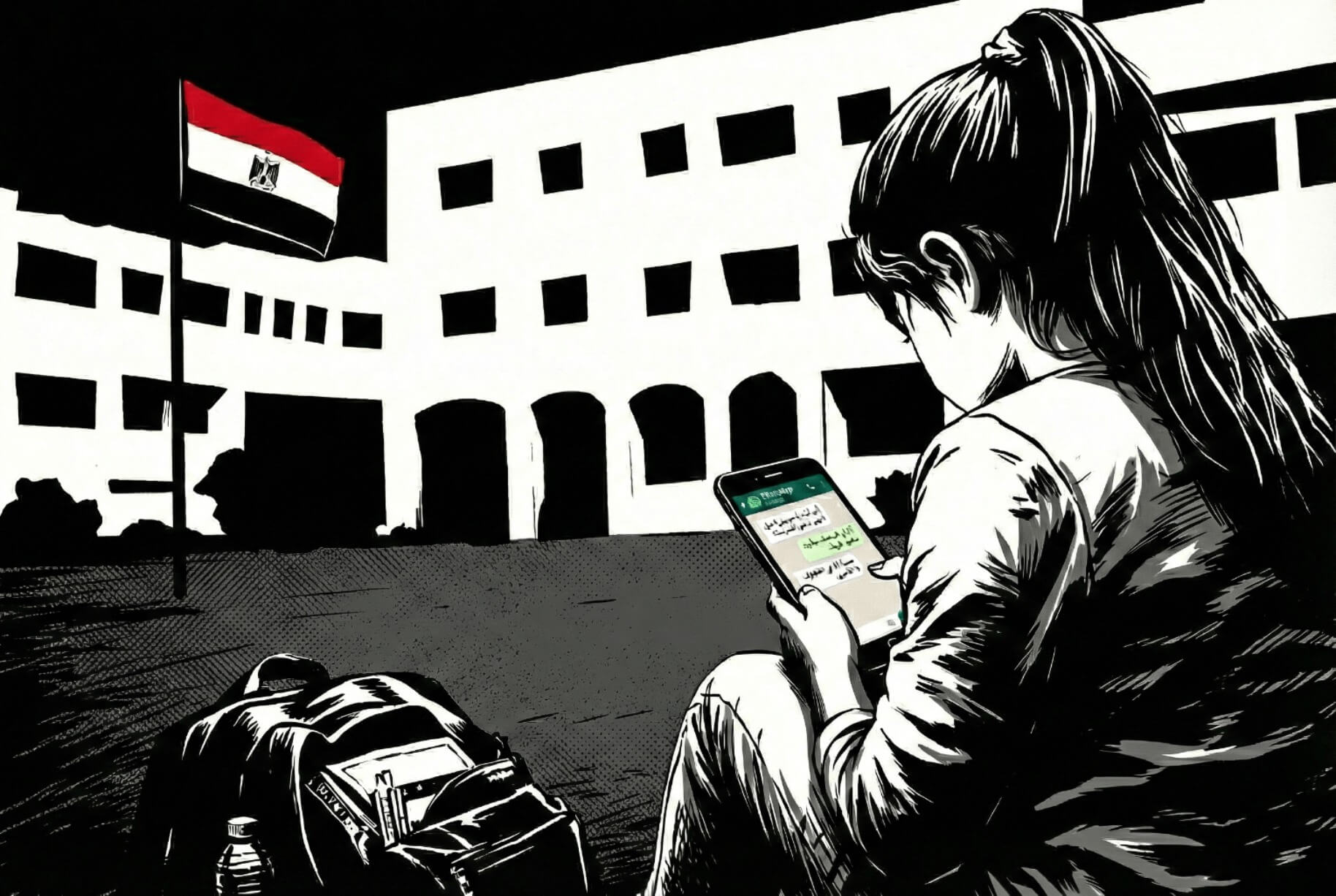
Amna is being bullied due to a dental condition. When asked about her classmates, she says: “They made stickers of me and posted them on WhatsApp to bully me.” Amna is a student at a school in Al Agouza, Giza.
That wasn’t the end of it; the bullying turned into physical violence. Amna’s female classmates assaulted her while filming the attack, threatening to post the video on WhatsApp and Facebook. Her mother went to the school officials for help, but their response was just a temporary fix. The bullying simply never stopped.
Salma Ahmed (a pseudonym) is a third-year middle school student at a school in Imbaba, Giza.
She says some female classmates created a WhatsApp group bearing her name and added her to it, turning her skin color into a target for mockery and bullying. “They would say, ‘Come on, dark girl—why are you trying to talk to us?’”
Salma withdrew into isolation after being bullied by her classmates at school.
The girl was involved in an accident that left her with a broken leg. After that, the bullying only intensified, with classmates mocking her and making fun of the way she walked. Salma recalls, “They used to call me ‘crippled’… and there were all kinds of insults.”
The bullying didn’t remain confined to the digital space; it spilled over into real life. Salma adds, “They would go and tell people outside about it, saying things like, ‘Look what we did—Salma is weak against us and always crying,’ even though I never responded to them or paid them any attention.”
Reports received by Egypt’s Child Helpline (16000), run by the National Council for Childhood and Motherhood, show that 70 percent of bullying complaints occur in schools. According to the helpline, Giza ranks third in the number of bullying reports.
Hoda Galal, a teacher, explains that what used to be dismissed as “just joking” among students is now considered real bullying. She notes that cyberbullying among students has increased over the past two years (2024–2025). She adds, “Students send voice notes to each other and gang up on one classmate, turning him into the target of a whole ‘bullying party’—where? On WhatsApp.”
Cyberbullying includes spreading lies about someone, posting embarrassing photos on social media, and sending harmful messages or threats through messaging platforms.
Ahmed Hassan (a pseudonym), a school principal in Giza, says he handled 150 cases of cyberbullying over six months—out of a student body of around three thousand.
According to Hassan, the school’s disciplinary code is applied to bullies, and social workers play a role in guiding students to improve their behavior.
The school’s disciplinary code defines four levels of student misconduct. “Tier Three,” reserved for serious offenses, includes all forms of bullying, attempts to defame classmates or staff online, and the unauthorized sharing or circulation of photos. Despite these rules, Principal Ahmed Hassan believes some cases are so serious that the students involved should be moved to homeschooling. He notes, however, that implementing such a measure at the primary school level is nearly impossible.
Hoda Galal, a veteran educator with over three decades of experience, points out that school social workers are too tied up in administrative and clerical tasks to handle the toughest cases. She explains, “When it comes to the really difficult situations, they just have to move on—the school is so full of bullying that they simply don’t have time for five or six new cases every day.” Over her long career, she says, she has had to find her own ways to intervene and address the problem.
Social worker Buthaina Ibrahim explains that school social workers are instructed to raise awareness among students and organize sessions and workshops to highlight the dangers of bullying. Buthaina, who previously served as a Senior Supervisor for Social Education at the Ministry of Education, notes that bullying occurs across all age groups, but younger students often treat it as “just joking,” which later escalates into clear and overt harassment in high school. She emphasizes that students who are bullied may end up skipping school entirely to avoid it.
“I didn’t want to go to school anymore. I just wanted to be alone and didn’t want to speak to anyone,” says Sanaa Omar (a pseudonym), after being cyberbullied by her classmates because of acne on her face.
She adds, “They made videos on WhatsApp with my name in them, calling me ‘Sanaa the Pimple,’ and bullied me a lot.” The bullying was not limited to WhatsApp—it spread to a wider digital space. Sanaa, a second-year middle school student at a school in Dokki, Giza, says her classmates also posted videos of her on TikTok. She sees no difference between in-class bullying and online bullying, as both cause her the same pain.
Lubna Said, Sanaa’s mother, says she went to the school, which addressed the issue, but her daughter continues to suffer psychologically. She notes that Sanaa has become isolated from the rest of the family: “She has withdrawn from us and lives alone… she says she wants to die.”
A UNICEF report indicates that 70 percent of children in Egypt aged 13 to 15 have experienced bullying. A separate Egyptian study on cyberbullying shows that around 85 percent of students have been targeted through digital media. The study, which surveyed a sample of high school students, was published in the Egyptian Journal of Media Research by the Faculty of Mass Communication at Al‑Azhar University. The results show that WhatsApp and Facebook are the most common platforms for bullying. The study also found that only 26 percent of students reported such incidents to a parent.
Psychologist Khulood Mohamed explains that children who experience bullying may exhibit sudden behavioral changes, including withdrawal, social isolation, poor academic performance, sleep and eating disturbances, low self-esteem, and, in extreme cases, self-harm or suicide.
Khulood emphasizes the importance of equipping parents with the skills to support children experiencing cyberbullying, educating both boys and girls about the issue, and fostering trust so that children feel safe sharing potentially dangerous experiences. She notes that when a child feels secure with their parents and teachers, they are far more likely to report any incidents.
Eman Sayed, a specialist in psychological education, notes from her professional experience that girls are more vulnerable to bullying related to their appearance and reputation, which can have deeper psychological effects.
She adds that cyberbullying in schools is harder to deal with than face-to-face bullying, which ends when the school bell rings. Online harassment follows students everywhere. Sayed notes, “The phone is with them even in their room, so the sense of danger is constant, undermining their feeling that home is a safe place.”
This report was produced with the support of ARIJ.