



'/%3E%3C/svg%3E "Youtube")
 Arab World
 November 2, 2025
 Climate Change
Salam Freihat – Jordan / Helwa Arouri – Palestine
The use of electric vehicles (EVs) is significantly increasing worldwide. Over 17 million EVs were sold in 2024, compared to seven thousand in 2010, according to the International Energy Agency.
Worldwide sales of diesel and petrol-driven vehicles have been declining since 2018, as countries move to reduce emissions in the transport sector.
Made with Flourish • Create a chart
Chart showing global EV sales between 2010 and 2024, according to the International Energy Agency, last updated on July 13, 2025
The solar energy market is growing rapidly worldwide, especially across the global north, and is projected to reach $607.8 billion by 2030. This momentum is also evident in the Middle East and North Africa, where countries are increasing their investments in renewables. Many have made formal commitments at COPs to expand their reliance on clean energy sources, including solar.
Against this backdrop, some oil industry experts are promoting misleading claims, based on inaccurate data from oil company-funded podcasts, that the damage caused by alternative energy outweighs its benefits. This report looks into the most prominent of these claims in order to debunk them.
Anas Alhajji, a Syrian energy expert and one of the most influential figures in the oil and gas sector worldwide, according to a 2019 report by GlobalData, writes for several publications, including Independent Arabia, and his articles are published by several Arab media outlets, such as Al Arabiya.
His most famous interview was with the Finjan podcast, broadcast on Saudi Arabia’s Radio Thamaniya, in June 2025. This is one of the most popular podcasts in the Arab world, with one of its episodes making the Guinness Book of World Records. Thamaniya has nearly five million followers on YouTube.
Anas Alhajji’s episode “How can the world give up oil?” broadcast by Thamaniya Radio, was viewed around 900,000 times on YouTube and about 36,000 times on the station’s X platform. It received another 70,000 views after being reposted on X, while the Thamaniya app has been downloaded more than 500,000 times on Google Play and has more than 30,000 followers on SoundCloud.
In the interview, Alhajji claims he is not against any non-oil energy source. But throughout the interview he continually casts doubt on renewable energy and on EVs as an alternative to petrol vehicles.
In reply to the presenter, Alhajji defines renewable energy as “a marketing label, because there’s no such thing as renewable energy. Sunlight is renewable, the sun rises and there’s sunlight, the wind blows and I get renewable wind, but solar energy projects are limited. I can sign a 30-year contract on the basis that, after 30 years, the panels stop working efficiently and I’ll have to change them or scrap the whole thing.”
Finan Podcast interview with Anas Alhajji: “How can the world do without oil?”
According to a study published in 2024 on the academic research platform of Oxford University Press – a comprehensive review of the reliability and degradation of solar panels – the decline in panel efficiency is between 0.2 percent and 3 percent per year. This is based on specific mechanisms causing failure, including dust accumulation or corrosion in the components of the panel. This decline is linked to specific mechanisms such as dust accumulation or corrosion in panel components. However, the study shows that modern solar panels, particularly monocrystalline models, remain highly efficient for several decades when produced by reliable manufacturers and installed in suitable environments. In fact, many panels maintain at least 80 percent efficiency even after 30 years of operation.
Saed Essalaimeh, an energy and sustainability policy consultant, explains that solar panels do not stop working once the manufacturer’s warranty expires. The commonly cited 20 to 30 years refers only to the warranty period for standard panels, not their actual operational lifespan, and it does not mean they must be replaced once that period ends.
Essalaimeh says that, based on his technical and professional experience, the efficiency of panels decreases gradually over time. But, at the same time, as long as panels are operating under the right conditions, that is, away from factors that reduce their efficiency, like high humidity, they can easily last 40 to 60 years.
EVs are defined as those containing a battery instead of a fuel tank and an electric motor instead of an internal combustion engine. They are designed to be the technological key to decarbonising road transport, which contributes more than 15 percent of global energy-related emissions, according to the International Energy Agency.
In his podcast interview, Alhajji continually stated that the estimated reduction in emissions achieved by EVs had been exaggerated.
He tried to back up his claims that EVs were worthless and had a shorter lifespan than petrol cars by telling the interviewer that no special wheels had been made for electric cars to cope with their weight:
“Wheels on petrol vehicles last a certain time before you need to change them, but over the same period you’d need to change the wheels on an EV four times, because of their weight. That’s because they made EVs but didn’t make wheels to cope with their weight. So they still use wheels from petrol cars, and this pushes up oil consumption. According to our calculations, this has increased consumption by 60 million barrels between 2016 and 2022.”
Carbon Brief, an organization that works on fact-checking claims related to emissions, concludes that it is misleading to claim that “in countries that rely heavily on coal for electricity generation, the benefits of EVs are smaller, and that they can have similar emissions over their lifetime as the more efficient conventional vehicles.”
From examining the websites of three EV manufacturers, Mercedes, Tesla, and Volkswagen, we found that Alhajji’s claim regarding wheels is false, as all three companies manufacture special wheels for their EVs.
The Mercedes website states that the wheels of its EVs are made of strong rubber compounds to provide greater grip when driving and cope with the greater weight of the battery. Volkswagen says that wheels for its EVs are made with wider rims than for conventional cars. Similarly, Tesla also manufactures special wheels for its EVs.
We could find no sources quoted by Alhajji in his interview to support his calculation that oil consumption was increased by more frequent replacement of the wheels on EVs. Despite the increase in global oil consumption up to 2022, the figure he quotes is inaccurate and is unsupported by any trusted evidence.
Aِttaqa platform where Anas Alhajji works as an “editorial advisor” was set up in 2020. It specializes in energy and many experts working in the oil sector write for it.
We attempted to contact Anas Alhajji through his social media accounts to request clarification, but our messages did not go through. We also asked for his contact information in the comments of posts on his active X account, yet received no reply. Additionally, we submitted inquiries through his website, but did not receive a response there either.
When we looked further into Anas Alhajji, we found that his inaccurate claims were not only made in interviews, but also on his podcast Anasiyyat Attaaqa, to which he invites people like energy expert Torki Al Hemsh, who was Alhajji’s guest in July 2024. Al Hemsh has held several positions in the Syrian oil sector, as well as working as an oil expert at the Organisation of Arab Petroleum Exporting Countries (OAPEC). Al Hemsh repeats similar claims as Alhajji about EVs.
Al-Hemsh claimed during the episode that “making one single battery for a Tesla electric car with a capacity of 80 kilowatts, for example, could produce between 2.4 and 16 tonnes of carbon dioxide emissions.”
We contacted Al-Hemsh through his Facebook account and he responded to our findings by saying his information had come from data published on the Climate Portal of the Massachusetts Institute of Technology’s Climate Change Initiative, and that this data was referenced in a study – Electric Cars: Reality and Prospects – published by the OAPEC, which he had worked on himself.
We found this data on the Climate Portal website, but it was in an article headed by encouraging the production of EV batteries from clean sources, which stated that the “worst” batteries were still less harmful than emissions from petrol car emissions.
A study by the Massachusetts Institute of Technology (MIT) shows that although manufacturing EV batteries generates higher initial emissions, these are offset over the vehicle’s lifetime. As the car is used, its operational emissions remain significantly lower than those of conventional vehicles, meaning EVs ultimately play a greater role in reducing pollution.
The results of Tesla’s 2021 annual report analyzing the life-cycle emissions of its cars compared to similar internal combustion vehicles in the US, Europe, and China, showed that driving a Tesla Model 3 produced fewer greenhouse gases than burning petrol in all three regions. This remained true even after factoring in the environmental costs of manufacturing the vehicle, including its battery.
The Tesla Model 3 also received a near-perfect score of 9.8/10 in Green NCAP‘s assessment of greenhouse gas emissions.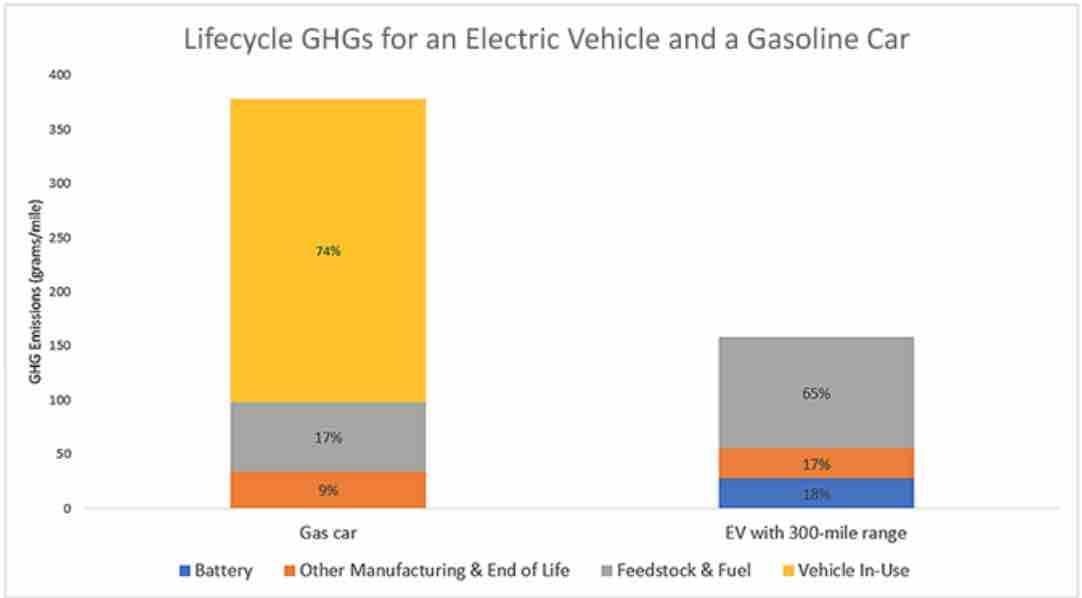
Graph showing that the total carbon emissions of an EV over its lifetime are significantly lower than those of a petrol car, even though its manufacturing emissions are higher, according to a report by the US Environmental Protection Agency (EPA).
Climate Feedback, which specializes in checking climate-related information, says that EVs are far from zero emissions, since electricity generation and battery production are major sources of greenhouse gases. But it points out that claiming EVs produce more carbon dioxide emissions than diesel vehicles is inaccurate. There are, however, specific instances where some diesel vehicles produce fewer emissions than some EVs, but this is not the norm.
This report was produced as one of the graduation projects for the Arab Fact-Checkers Network’s (AFCN) “ARIJ Fact-Checking Diploma 2025.”