


'/%3E%3C/svg%3E "Youtube")
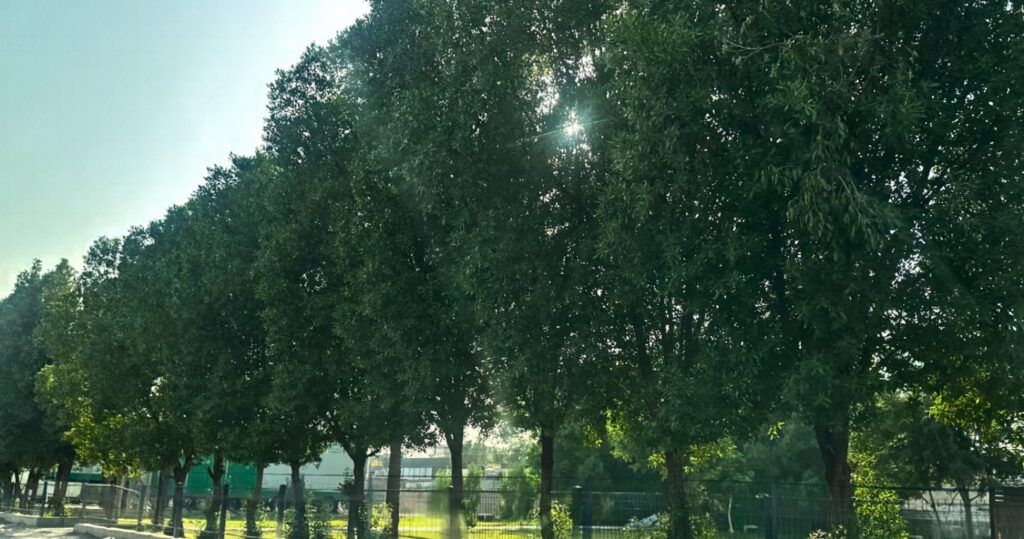
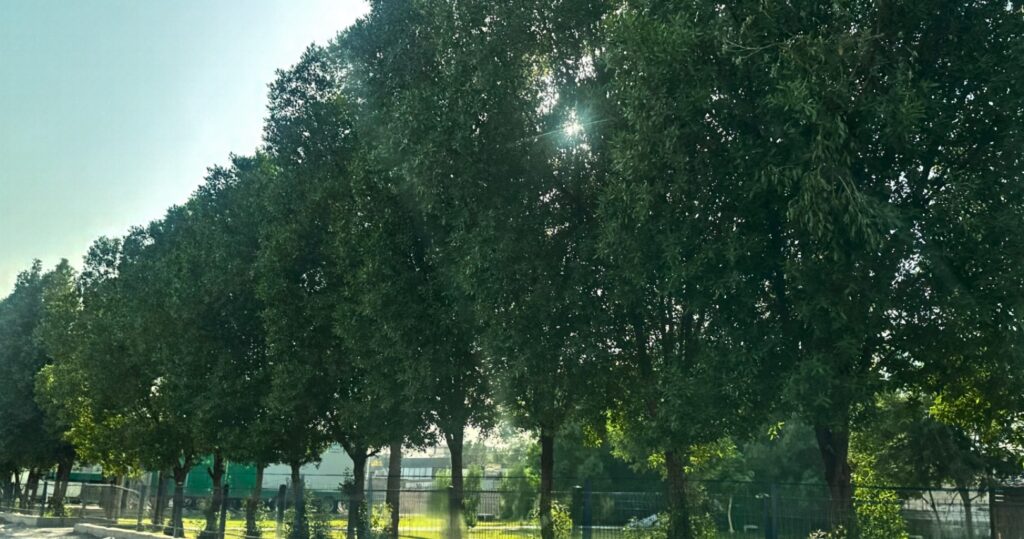
In the summer of 2025, tree-felling machines arrived on Green Belt Street in Najaf Governorate, and left only after they had cut down about 200 mature conocarpus trees. The governor justified the decision to fell these trees by saying they were “harmful and in poor condition.” The head of the local council, meanwhile, denied having granted any felling permits and threatened legal action. At around the same time, the media director of the Najaf Water Directorate said that the roots of these trees had spread so far in search of water that they could cut off the water supply to an entire area. One incident, three different official positions.
 Iraq
 October 22, 2026
 Environment and Climate
Source: AFP
By Tamara Emad
In the summer of 2025, tree-felling machines arrived on Green Belt Street in Najaf Governorate, and left only after they had cut down about 200 mature conocarpus trees. The governor justified the decision to fell these trees by saying they were “harmful and in poor condition.” The head of the local council, meanwhile, denied having granted any felling permits and threatened legal action. At around the same time, the media director of the Najaf Water Directorate said that the roots of these trees had spread so far in search of water that they could cut off the water supply to an entire area. One incident, three different official positions.
Green Belt Street, a service road, is a vital last buffer between the built-up area of Najaf and the barren desert beyond. The trees that were uprooted had formed a canopy of shade that kept the temperature down and provided relief from the heat for both passersby and residents.
The contradictory positions taken by local officials of this issue are not new. They date back to claims made several years ago that conocarpus trees, planted along many medians and sidewalks in Iraqi cities, damage sewage systems and water pipes.
The decision to cut down trees has a hidden environmental cost. When a mature tree is felled, what is lost is not just the tree but its ability to reduce the surrounding air temperature by between 2 and 8 degrees Celsius, according to estimates by the UN Food and Agriculture Organization (FAO). The World Resources Institute (WRI) says that pavement that loses its tree shade can be up to 8 degrees Celsius hotter than shaded pavement. Streets also lose a natural barrier against wind and dust, in cities already prone to frequent heat waves and dust storms.
The story begins in early March 2019, when maintenance staff at the sewage department in Dhi Qar province warned against plating conocarpus trees after having to clear blocked pipes in the Sumer and Eridu districts. That same year, a resident of Babylon province launched a campaign to uproot conocarpus trees, claiming they made it hard to breathe and damaged infrastructure. Meanwhile, the municipal council in Najaf launched Meanwhile, the municipal council in Najaf launched its first campaign to cut down these trees along the city’s Al-Ghadeer Street and plant an alternative, supposedly more environmentally friendly species.
In 2021, a report broadcast on UTV claimed conocarpus trees had caused millions of dinars’ worth of damage to pipes in Hilla but provided no reliable figures. Two years later, the state-run Al-Sabah newspaper published an article describing the conocarpus trees as “time bombs on the streets of Baghdad.” A member of the parliamentary Health and Environment Committee stated that the roots of these trees had destroyed sewage networks, making them unsuitable for planting within cities. By 2024, the Basra Municipality was announcing ongoing campaigns to remove these trees, culminating in the scene in Najaf.
Ironically—and tellingly, given the confusion surrounding the issue — conocarpus was among the species the state itself deliberately planted in Najaf. As part of the Green Belt project in the north of the governorate – 80 percent of which was declared complete in 2011–12-kilometre-long rows of eucalyptus, olive and conocarpus trees were planted, with the stated aim of blocking northwesterly winds and acting as barriers against desert dust. Fourteen years later, tree-felling equipment was at work on a street bearing the same name: The Green Belt.
Six years were enough to turn a baseless claim into public policy — one now used to justify cutting down trees in city after city. So where did this tree originally come from, and what does the science say about it?
Conocarpus is a non-native, invasive plant species that was introduced to Iraq and has spread widely. Its high adaptability to arid environments has enabled it to spread and compete with native plants, threatening to displace them, according to specialists in the Biodiversity Department of the Iraqi Ministry of the Environment. The tree has a highly efficient root system for seeking out moisture, and it grows quickly. Experts say the tree has a remarkable ability to withstand dust storms, stabilize the soil, resist salinity and absorb greenhouse gases. The problem, they say, lies not with the tree itself but with “planting it in the wrong place.”
The only field research done on the subject was a 2020 study by the University of Maysan, in which its researchers monitored the trees across the governorate for two years. The study documented only four cases of root-related damage over the two-year period. Three involved roots penetrating drinking-water pipes in the Al-Risala, Al-Wahda and Al-Shabana neighbourhoods of Maysan, though these pipes were already delipidated. The fourth case was a blockage in the Al-Sadiq district. The study recorded no such incidents on paved roads or sidewalks or around telecommunications cables or electricity lines.
Soil tests identified the driving factor to be “irrigation deficit,” since the trees were only being watered only one to three times a week. This lack of water at the roots triggered hydrotropism, a process in which plant roots respond to moisture gradients in the soil: the root tip senses a water source, and plant hormones called auxins direct the root to bend and grow toward moisture areas. In other words, the roots were drawn to existing leaks in old pipes, not to intact ones.
A 2001 scientific review in the Journal of Infrastructure Systems concluded that damage to sewer networks “most often occurs in old systems and cracked pipes; and factors contributing to the damage include pipes that are narrow, near the surface, or have old joints, rather than the type of tree involved.”
A University of Maysan study also showed that a lack of regular pruning allowed roots to grow to a depth of 2.7 meters.
These findings were not an isolated case.A scientific symposium held at the University of Baghdad in March 2019 had reached the same conclusion a year earlier.
The greatest irony, however, was that the very same newspaper – Al-Sabah – which described the tree in 2023 as a “time bomb,” had published an article the year before headlined “False Myths About the Conocarpus Tree.” That article stated that scientists did not even classify the conocarpus as harmful to infrastructure and that the roots of willow, lebbek and sidr trees do far more damage. The paper managed to contradict itself within the space of a year.
According to the online platform Fanack Water, a mere 30 percent of Iraq’s population has access to proper sanitation, and only 10 out of 18 governorates have working treatment plants, while the remaining eight discharge wastewater with no treatment at all.
A UNICEF report on the water crisis in Basra confirms this decline in services. It says that years of war against ISIS and falling oil prices have shrunk operating and maintenance budgets to “virtually zero” in several governorates, leaving treatment plants and distribution networks outdated and corroded. The result is a fragile system highly vulnerable to disruption by natural or biological factors.
This comes amid an extensive loss of Iraq’s green cover. In a study published in 2022 in the journal Revue d’Intelligence Artificielle, researchers Rasha Abdulkarim Ali and Inaam Al-Bazzaz used artificial intelligence to analyze satellite images of an area of Baghdad between 2008 and 2022. They found that the proportion of green space had fallen from 22.46 percent to 5.46 percent – a loss of about three-quarters of the area’s green cover in 14 years.
At the national level, the Green Iraq Observatory announced in September 2025 that the country had lost around 1 million trees in just two years, due to factors including drought, the cutoff of water supplies to orchards, and tree felling for infrastructure and commercial projects. The Department of Forests and Combating Desertification at Iraq’s Ministry of Agriculture had previously announced that 55 percent of Iraq’s land area was at risk of desertification, and that around 27 million dunams had already become desert. In other words, every tree felled on a street depletes an already dwindling supply.
Statements by the Iraqi Ministry of the Environment reveal a gap between its stated regulatory policy and what is actually being implemented on the ground. In August 2023, the Dhi Qar Environment Directorate ran an awareness campaign that banned nurseries from selling or trading conocarpus trees on public health grounds.. In 2025, by contrast, the ministry’s official website said that planting conocarpus was permitted under urban afforestation guidelines and that a tree could be removed only if a clear technical assessment proved it was causing significant damage.
Amir Ali Hassoun, director general of the Environmental Awareness and Media Department, acknowledged that the roots of the conocarpus tree “cause problems for municipal infrastructure… if the tree is planted where utility lines run.” But he In other words, the problem is where the tree is planted, not whether it should be planted at all.
On the legal side, the ministry’s biodiversity department noted that managing urban vegetation is the responsibility of municipalities, not the ministry. It cited Article 18 of the Law No. 27 of 2009 on the Protection and Improvement of the Environment, which requires a permit to fell perennial trees in public places, and Article 480 of the Penal Code, which imposes imprisonment and a fine for cutting down a tree in a public place without official permission. The department also noted that the Ministerial Committee for the Management of Alien and Invasive Species supports relocating these trees to green belts outside cities rather than destroying them, which it considers “a waste of biomass.”
Agricultural engineer Muhannad Hussein al-Issawi sums up the debate by saying categorically that it is “scientifically impossible” for tree roots to penetrate intact pipes. The hydrotropic mechanism that drives roots toward water leaks “is not unique to the conocarpus; it is what most trees do to get water.” He says the findings of the University of Maysan study are “clear” and conclude that the conocarpus tree can be safely planted on three conditions: that it is watered regularly, pruned periodically, and planted at a safe distance from infrastructure.
Al-Issawi says the tree itself is not at fault; responsibility lies with local authorities to plant it away from drainage pipes, water it consistently and maintain sewers regularly to prevent leaks that might attract its roots,”he says.
Al-Issawi describes the sudden wholesale uprooting of the trees as “a disastrous solution that demonstrates administrative negligence.”He warns that the consequences of this mass felling include a loss of green cover that will take years to replace; more dust storms as windbreaks disappear; higher street temperatures; added strain on soil and groundwater; and doubled economic costs.
His comments are in line with the response we received from the organization Green Vision for Environmental Protection. It said: “A distinction must be made between damage caused by poor infrastructure and damage caused by the tree itself… Blaming the tree for everything that goes wrong may lead to the wrong conclusions.” The biodiversity department at the Ministry of the Environment also supports al-Issawi’s views: “Tree roots accelerate the destruction of these pipe networks, but they are not the primary cause.” All of these accounts agree on one fundamental point: the sewage crisis reflects primarily the state of infrastructure, not the characteristics of any particular tree.
While the debate rages on, tree felling has continued unabated on the streets of Najaf, Karbala and Basra. Some see every tree cut down as a loss, even if that loss does not appear in any official report.
The National Climate Resilience Assessment for Iraq, published by the International Energy Agency in January 2025, found that the number of dusty days in the country rose from 243 to 272 per year over two decades and is expected to top 300 by 2050. Temperatures in Iraq rose by an average of 0.48°C per decade between 2000 and 2023 — faster than the global average. The number of days a year above 40°C is projected to increase by 33 to 62, depending on emissions levels. Ten major dust storms were recorded in Baghdad in the first half of 2022. This is the environment in which windbreaks are being cut down.
In a study published in The Lancet in January 2023, a team led by Tamara Iungman of the Barcelona Institute for Global Health, looked at 93 European cities with a combined population of around 57 million and found that 4.3 percent of deaths during the summer months were attributable to the urban heat island effect. They also found that increasing tree cover across 30 percent of the city’s area would have prevented around a third of these deaths.
The World Resources Institute estimates that every 10 percent increase in tree cover reduces ambient air temperature by around 0.3°C, while a study of 806 cities worldwide showed that increased tree cover is associated with a reduction of around 1.5°C in midday surface temperature. In researching this report, we have found no published Iraqi study measuring how much hotter Najaf, Karbala, or Basra have become since the tree-felling campaigns.
Khulood al-Amiry, chair of the Women Journalists for Climate Network, believes the biggest problem is not the tree itself but cutting it down without replacing it: “A 15-year-old conocarpus tree needs to be replaced with one that is at least 10 years old to make up for the oxygen it provides.”
She describes the felling of conocarpus trees in Najaf as a “grave error” because the trees are “meant for the green belt and intended to be planted outside the cities.” She warns that cutting down the green belt “will cause soil erosion and more dust storms.”
With the persisting gap between what officials say and what the statistics show, Iraqi cities are losing their shade during a decade in which the annual number of dusty days in the country is expected to reach 300 . And trees are being felled at the height of summer with no announced plan to replace them and no published assessment of what the streets have lost.
The scene at the start of this report sums up the past six years: tree-felling equipment on Green Belt Street in Najaf, a governor offering justifications, and a local council head in denial. Decisions are made on the ground, while the only study that actually looks at what is happening to the soil – in Maysan – tells a completely different story: roots growing only into pipes that are already damaged, and a tree just looking for the water it needs and finding it in the nearest available crack.
This report was produced with the support of ARIJ