


'/%3E%3C/svg%3E "Youtube")
October 14, 2025
In each election cycle in Iraq, female candidates running for the House of Representatives find themselves fighting not only at the ballot box, but also hidden cyber armies and a society that actively their access to the political arena. This was evident during the fourth and fifth elections, in 2018 and 2021 respectively, and it is likely that it will happen again in the run up to the November 2025 elections.
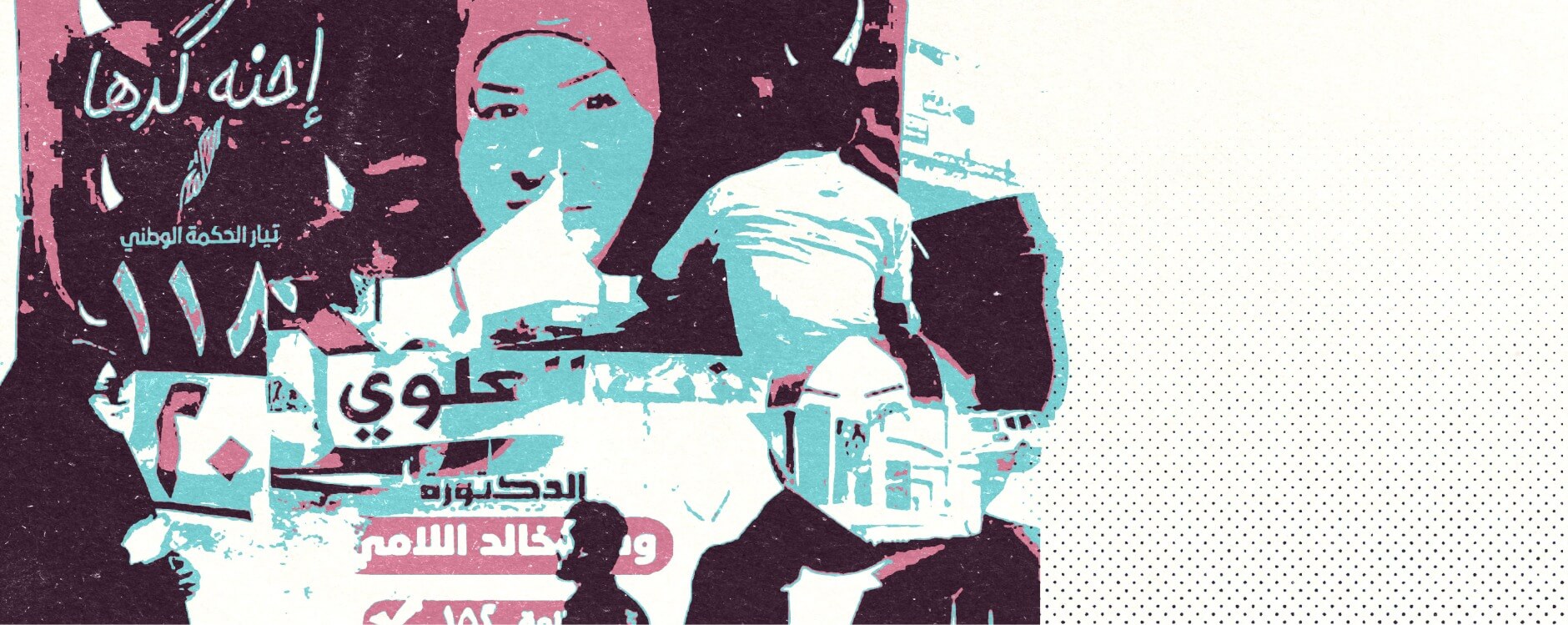
Walls are adorned with posters bearing the images of male and female candidates. It might seem odd for someone to stand in front of the picture of a woman candidate to take a selfie. But what is truly deplorable is the sight of men gathering around and kissing the image. Such a thing will not go unnoticed by the woman depicted. It could embarrass her and even force her out of the electoral race altogether, in a society that sees such a thing as dishonourable – for the woman herself and her whole clan.
An illustration of this bitter paradox is the case of Shahd Kazem Kharbit Khalifa, a business graduate and fashion designer who,at age 30, ran for the Baghdad Provincial Council. Realising the dangers and the lack of online protection, Shahd took a rare decision: “I stopped publishing my photos.” She says she did so, after already launching her election campaign, out of fear for her reputation and that of her family.
She says she decided to do so because she believed that the laws that protect women were not being enforced and that there was no oversight of social media sites, where some users employ fake accounts.
But even doing this was not enough. Being a well-known figure in her field, Shahd was not safe from attack.
She remembers receiving accusations like: “Her work’s not enough for her; she wants to ruin the country.” Even though did not post any photos online that could be fabricated, smear campaigns on Facebook targeted her with false rumours, insults, and intimidation. And she was subject to threats and harassment from anonymous accounts.
Shahd faced these attacks calmly. She did not approach the Independent High Electoral Commission or any other authority, believing that “silence in the face of ignorance” was the best way to avoid escalating things. In any case, facts show that the legal frameworks in Iraq have not offered any protection for female candidates.
Motivated by a belief in the need for change and a passion for public policy, 32-year-old Zainab Issam Fadhil Al-Takmaji ran in the 2021 parliamentary elections. Like many others, she was met with “rejection and violence.” The harassment she faced went beyond criticism of her age or her choice not to wear a veil—it questioned her very ability to lead in a society that, she says, still struggles to accept women in positions of power.
Zainab says her campaign posters and billboards were vandalized, particularly in areas where electoral competition was intense. Online, she faced smear campaigns on social media—especially Facebook—where “paid” pages sought to damage her credibility and tarnish her image among the public and voters.
Zainab sought legal help, but she thinks that the legislative frameworks need to be improved as they provide no “immediate intervention, rather only routine procedures.”
Hana Hamood Abbas, a board member of the Shams Network for Monitoring Election (the organization’s official English name), says the network has monitored more than 15 elections since 2005. She explains that political violence often stems from entrenched stereotypes about a woman’s “proper” role. When women become too visible, she adds, “they become targets for bullying, defamation, or slander.”
Hana says that these attacks are aimed specifically at “women’s honour and reputation,” and exploit the societal concept that “women personify the honour of the family, the clan, and society.” Men, by contrast, usually come in for attack over financial corruption, she says.
The 2018 elections were the worst in terms of violence against both female candidates and voters. “Cyber armies” waged fierce campaigns against women standing in various lists, using fake photos and videos of some of these candidates. One of these was Intizar al-Shammari, a university professor who had decided to run for election.
Just before the election, a fabricated “pornographic” video of her was circulated, leading the coalition she was running with to withdraw her candidacy. Intizar faced widespread attacks on social media and stated at the time that she was the target of a political smear campaign.
Shams board member Hana Hamoud Abbas commented about the incident saying, “Her image was ruined by a pornographic video, even though she was completely innocent.” Even though she managed to prove in a UAE court that she was the victim of an electronic forgery, she was still expelled from both her party and her university.
Hana adds that though Intizar tried to defend herself, no one believed her, and the “fake” video went viral and was shared by social media users, even women.
From an academic viewpoint, Lina Al-Mousawi, an assistant professor in the Center for Strategic and International Studies at the University of Baghdad, confirms that violence against female candidates has increased significantly, to include deep fakes, hacking of personal accounts, and posting disinformation and fabricated videos. She attributes this increase to “ inadequate legal frameworks to address cybercrimes, weak accountability, and failure to track down the perpetrators.”
These campaigns influence “society’s perception of a woman’s role in politics,” while the resulting publicity amounts to “societal terrorism.” Lina says that these campaigns, especially when it comes to politics, have “stereotyped women” as unsuitable for leadership and decision-making. This, she says, weakens “society’s confidence in women in general” and makes them ‘reluctant to even go out and vote.’”
She says that a female candidate “bears the honour of the clan,” and that this stops many families from allowing their womenfolk to run in elections out of fear of the consequences.
The Iraqi House of Representatives Election Law No. (9) of 2020, under which the 2021 elections were held, stipulates that women should hold a minimum of 25 percent of the 329 seats in the House of Representatives, i.e. not less than 82 seats. This ratio should also apply in all provincial parliaments, to ensure women’s representation at the local level.
The law also stipulates that when parties submit an open list, women should be entered in sequence on the basis of “one woman for every three men.” This requirement is supposed to increase the chances of women being elected to parliament.
If women fail to win enough seats in a given constituency to meet the female quota, the law allows for a reallocation mechanism. Under this system, one (virtual) seat is added to the number of winning female candidates in each constituency. The resulting total is then divided by the number of seats allocated to the constituency to determine the percentage of female winners. After that, one more seat is added to the total in the constituency with the lowest percentage of winning female candidates.
If this still does not produce the required number of seats for female candidates, the process is repeated, taking into account the percentage increase achieved the first time.
Despite lawmakers’ eagerness to promote women’s participation in political life, “the government introduced no mechanisms in 2018 to protect female candidates or detect electronic fraud, allowing online violence to reach its peak,” says Hana Hamood Abbas, a board member of the Shams Network for Monitoring Election.
She notes that things changed in 2021, when the government formed a committee to protect women during the elections. This focused particularly on female candidates most at risk of bullying and attempts to “remove them from lists” as the electoral competition became increasingly fierce. Hana says that the committee provided important methods of protection, such as streamlining bureaucracy to allow complaints to be filed directly with the court, and providing reporting hotlines. This development “effectively identified abuses committed against women.”
In the 2023 provincial council elections, this committee added an extra layer of protection by contracting an outside company to remove offensive posts within 24 hours of reporting, with support from UNFPA. Hana says this “gave women a sense of reassurance,” especially after the sharp decline in female candidates in 2021, caused by the experiences of 2018.
But even though such protection tools have been brought in, a culture of impunity still exists. Hana Hamood points out that perpetrators of digital violence are cunning and often claim that their videos come from abroad and therefore cannot be controlled.
Hana Hamood also points to other forms of violence that extend beyond women candidates to include female voters and election observers, particularly younger women. They are often subjected to “distressing questioning” about their families and places of residence. The Shams Network has even documented cases of harassment by security forces at polling stations.
The network also points to the violence experienced by women and girls with disabilities, especially the elderly. They are verbally bullied by being told: “She’s paralyzed, she can hardly walk… Stay at home and rest.” Such bullying persuades many families to stop their daughters from taking in any part in the electoral process.
Lina Al-Mousawi, assistant professor at the Centre for Strategic and International Studies at the University of Baghdad, blames rival parties or groups for running these campaigns, using “cyber armies” to “tarnish the image of female candidates” and force them to withdraw. She warns that turning a blind eye to this phenomenon, or even financing it, makes the political environment more dangerous and leads to the loss of competent female candidates, who are discouraged from taking part in elections.
The biggest problem, according to Lina, is the “culture of impunity.” There are no legal precedents in Iraq to show that those who attack female candidates will be held accountable. And the slow pace of legal proceedings prevents victims from obtaining justice.
If such behaviour continues and is not brought under control, it will have a “negative impact on the presence of women in the public sphere,” warns Lina Al-Mousawi.
Shahd Kazem, who ran for election, acknowledges that the experience had a negative impact on her: “There us no way I can take part in elections, it’s impossible.” She says there are female candidates who withdrew from elections out of fear for their reputation. She calls on the government to protect women from cyberattacks and to raise awareness in society of the important political role women have. She also advises future female candidates to stay strong and to face the risks and difficulties with courage.
Aisha Rafi Al-Obeidi, a candidate in the Iraqi elections scheduled for November 2025, is preparing to enter the race, drawing on her experience as a political researcher and advocate for women’s empowerment. Her decision to run was not made on a whim; it is a natural continuation of her activism and her conviction that silence in the face of injustice is a form of complicity—and that “the place for capable women is where decisions are made.”
Aisha is well aware of challenges she faces, especially “disinformation and defamation campaigns,” which she intends to confront “using the law.” She has a clear message for the voters: “Women are not outsiders in politics; they are authentic partners. If you vote for a woman, you’re voting for real reform.”