


'/%3E%3C/svg%3E "Youtube")
 Palestine
 September 27, 2025
 Politics
Carole Kerbage – Independent Journalist – Lebanon
Laughter and joy, drawings of heart symbols, cheers for the US, and women – their faces hidden – repeatedly praising American aid and thanking US President Donald Trump. These are the scenes that appear on the official page of the Gaza Humanitarian Foundation (GHF) on X (formerly Twitter), reinforcing a narrative promoted by the GHF since it began operating in late May 2025, following 11 weeks of complete blockade of the Gaza Strip by Israel. The GHF narrative is that it is more efficient in distributing aid within Gaza than the UN channels, and that it does a well organized and secure job.
In contrast, Time magazine published a photo on August 1, 2025 of women and girls carrying empty containers, waiting for food aid. The image reflects the official announcement by the UN on the 22nd of the same month that the Gaza Strip was in a state of famine, confirmed by reports from UN and international organizations documenting cases of starvation and malnutrition. But the publication of this photo was followed by a systematic disinformation campaign accusing Palestinian journalists, including photographer Anas Fteiha of fabricating scenes of famine in a bid to undermine the UN narrative of a worsening humanitarian crisis in Gaza.
On August 3 and 5, 2025, German newspapers Suddeutsche Zeitung and Bild published reports claiming that Hamas was fabricating images of starvation in the Gaza Strip in order to elicit sympathy from the West and fuel anger against Israel. On August 6, the GHF reposted what it described as an “investigation” by Bild, claiming that “a staggering percentage of images coming out of Gaza are staged by Hamas-aligned photographers and sold to Western media outlets.”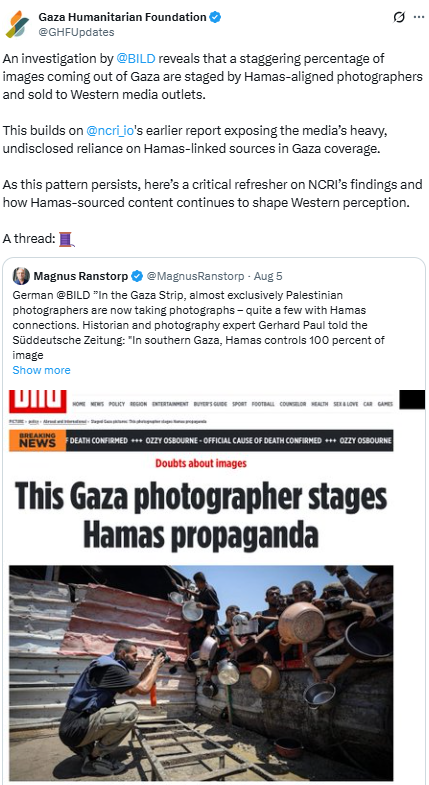
Screenshot of the GHF post on the Bild story-August 6, 2025
It did not take long before official Israeli accounts, including that of the Israeli Ministry of Foreign Affairs, started widely reposting the claim. It was alleged that the photo on the cover of Time magazine was faked by Palestinian photographer Anas Fteiha, even though it was actually the work of Ali Jadallah. The photo was immediately labelled “Pallywood” to promote the narrative that images of starvation and death coming out of Gaza were fabricated and staged.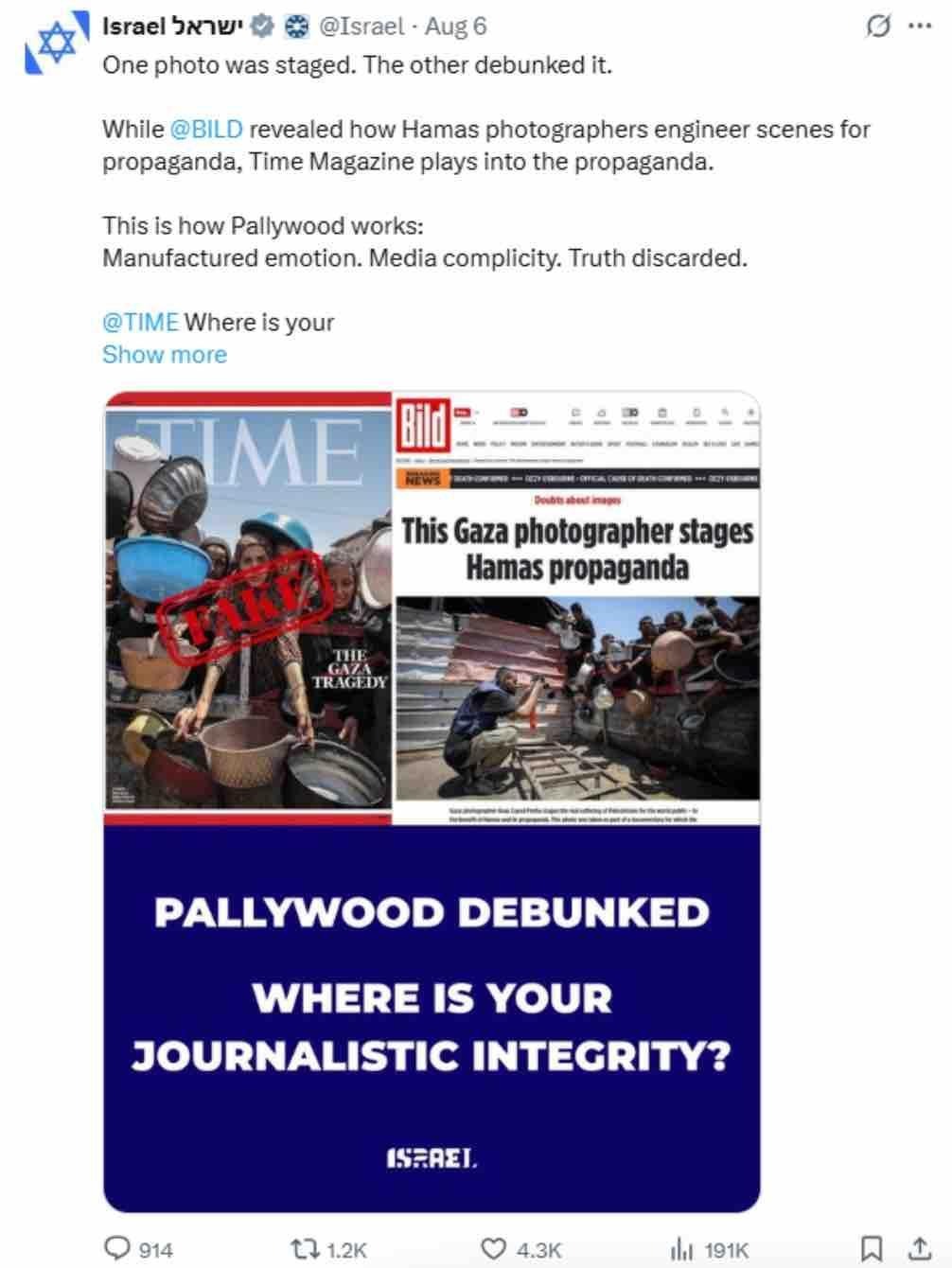
Screenshot of a post on official Israeli account promoting
Bild Story of August 6, 2025
The term “Pallywood” has been used as an Israeli propaganda tool for years to cast doubt on the credibility of Palestinian media coverage, by claiming that images and videos coming out of Gaza and the West Bank are faked or staged. The aim of this characterization is to undermine international public confidence in the Palestinian narrative and to hamper the effort by the UN and other international bodies to document abuses by the [Israeli] occupation. The term was coined to echo the “Hollywood” style of American cinema and “Bollywood” cinema in India and thus suggest that events were being staged and presented in dramatic form far divorced from reality.
Bild’s allegations centred on two photos showing Palestinian photographer Anas Fteiha taking pictures of people carrying empty containers as they waited for food rations. The paper’s supposed “investigation” took these two photos to be “evidence” that the crowds of people desperate for aid were staged by photographers affiliated with Hamas. However, a review of the video and other photos by the Anadolu news agency on July 24, 2025 tells a different story. It shows that the photo was taken by a colleague of Fteiha as part of a report documenting the conditions of journalists working in Gaza during the ongoing genocide, and not as part of any fabrication of images.
Anas Fteiha explained to the Arab Fact-Checking Network (AFCN) of ARIJ that the photos were designed to document how Palestinian journalists cover the starvation they experience every day, noting that there were several cases of journalists fainting while working in the field. So Anas was actually taking part in a report by the Anadolu Agency on journalists’ experience covering the famine in Gaza.
The other Anadolu Agency photos show clearly that the image was indeed taken in front of a hot meal distribution centre in the Ansar area west of Gaza City, run by the charity, whose name is clearly visible on the clothing of the volunteers. A video published by the agency on the same day also shows that people did indeed receive food.
Though the claim of fabrication was weak and lacking any conclusive evidence, it spread widely and turned into a campaign of incitement against Palestinian photographers aimed at undermining the credibility of their work and denying there was a policy of systematic starvation in Gaza.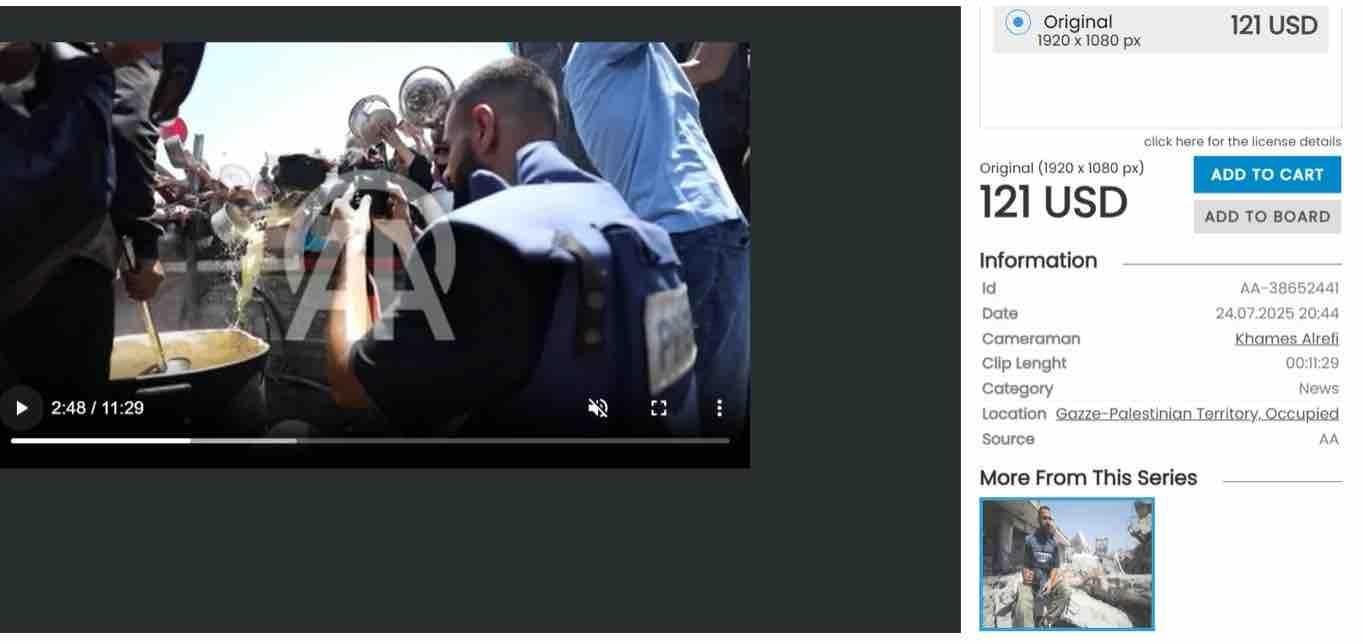
Screenshot from Anadolu Agency proving that the photo was taken by
Palestinian photographer Khamis Al-Rifi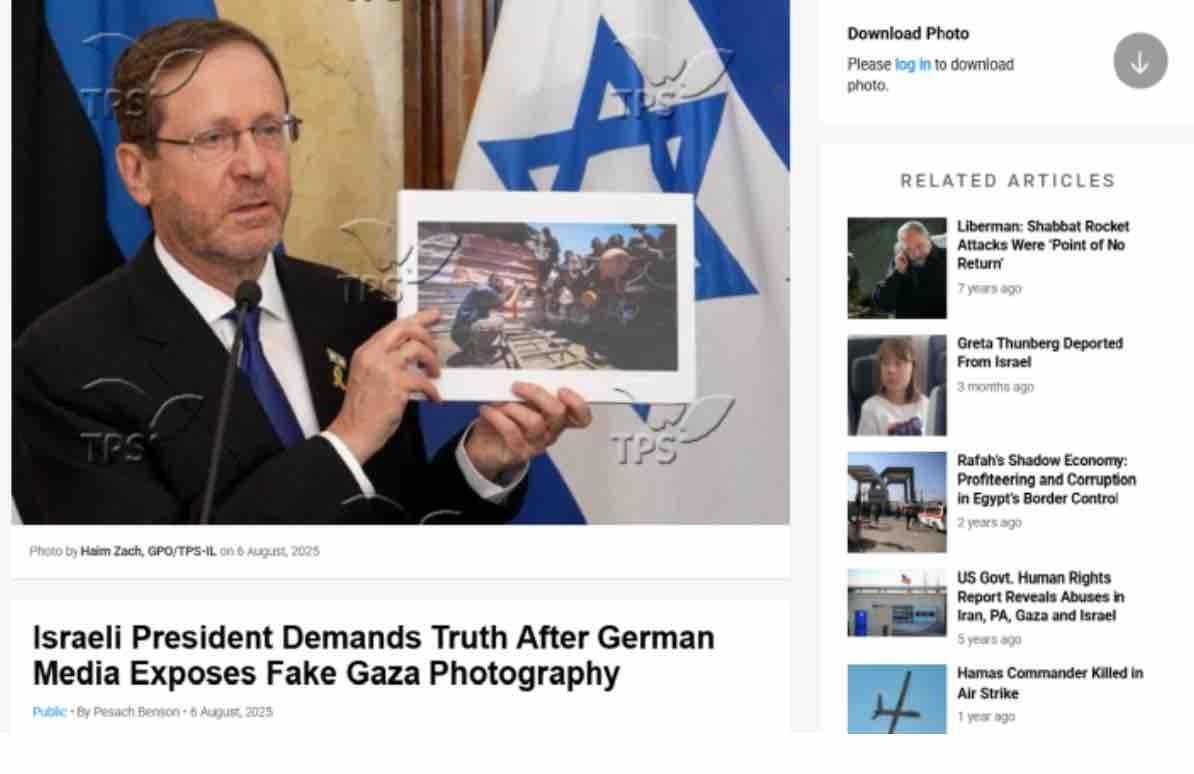
Israeli president promotes narrative that photos of famine were faked – August 6, 2025
While local photographers face accusations of fabrication and are the target of campaigns of incitement, the GHF continues to produce carefully selected visual material of children laughing and drawing hearts, and of women thanking the US and President Trump, and insisting that the foundation is more effective than the UN in delivering aid.
Although these images and interviews are not necessarily fake, they are directed and taken out of the political and social context of famine and fear of hunger. In interviews with three women posted by the GHF on X, they were asked leading questions, such as: “How is the situation in Gaza after GHF came and brought aid?” and “What is your message to President Trump?”
More important than the type of questions, however, is the context in which these photos and videos were taken. Israel’s policies of starvation – from complete or partial blockades of food, medicine, and fuel, to destruction of livelihoods such as agriculture, fishing, and markets, and preventing the entry of UN aid – have not only led to widespread famine and the deaths of more than 360 people from malnutrition by the end of August 2025, but have also created a complex social reality that has affected people’s collective consciousness. The GHF is effectively exploiting the suffering of starving people, coaching them to deliver political messages that serve the goals of the foundation and those supporting it, through leading questions aimed at denying the reality of starvation.
These selective clips are used not only to refute the deliberate killing and wounding of thousands close to aid centers, but also to deny the broader context of the famine: siege, starvation, and mass destruction of the very foundations of life. The goal is not only to strip away the evidence – statistics, testimonies, or images – but also to portray the GHF, the state that funds it, and its president as “saviors.”
In this time of genocide, images are no longer merely a way of documenting crimes, but have become part of the battle of narratives itself. On the one hand, local photographers in Gaza work under nearly impossible conditions, risking their lives to document hunger and ongoing massacres. On the other, an organized disinformation machine tries to undermine their work with accusations of fabrication, while taking images of starving women and children out of their political and social context to promote a narrative that denies the reality of famine in Gaza.
The issue here is about more than the cover of Time or the name of a particular photographer. It goes to the heart of the narrative: either admitting that hunger exists or denying it; either exposing genocide or justifying it.
This report was produced as one of the graduation projects for the Arab Fact-Checkers Network’s (AFCN) “ARIJ Fact-Checking Diploma 2025.”