


'/%3E%3C/svg%3E "Youtube")
Amman- 2nd June 2021
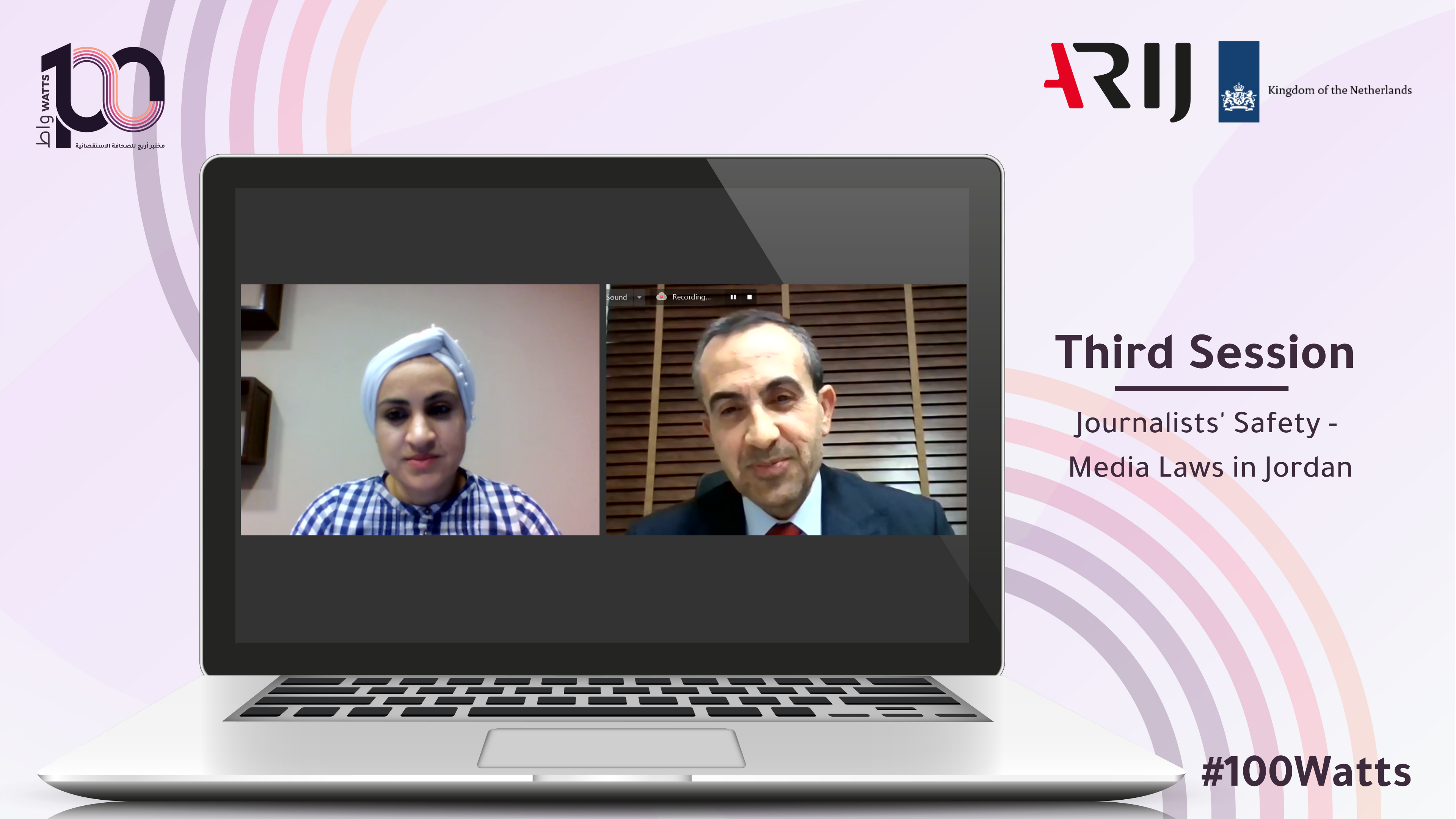
The 3rd webinar of “100 Watts” project, addressed the most important legislation related to press and media in Jordan, and the legal responsibility of journalists while practicing their work, in order to avoid any legal violations.
“100 Watts” is a three-year project launched by ARIJ (Arab Reporters for Investigative Journalism) network with the support of the Embassy of the Kingdom of the Netherlands in Jordan. The project aims at training more than 100 journalists, content creators, journalism and media students, and professors in Jordan on digital storytelling with a focus on audio storytelling that addresses vital societal issues in Jordan, to promote accountability and reform.
The webinar, held on 2nd June 2021, hosted Khaled Khleifat, lawyer and expert in media and publishing cases, and was moderated by ARIJ trainer Safaa Alramahi.
Khleifat started his speech pointing out that despite some restrictions on the journalists and media outlets by the legal system controlling media, the Jordanian legislation remains distinct in this regard, as journalists are not arrested for press and publications laws, noting that sometimes a journalist might violate his or her freedom of expression and practice greater self-censorship than the one imposed on him.
He added that the most common issue that journalists face in any media outlet is slander and libel, when a journalist describes any natural or legal person with terms undermining his honor and dignity. However, sometimes it could be permissible, for example, if there is a proven crime against an official, then the law defines him as a thief, embezzler, or otherwise.
Responding to a question raised by one of the participants about the necessity of the cyber-crimes combating law, while there is a civil law, Khleifat indicated that the former aims at general deterrence while the latter aims at making amends, noting that not all crimes taking place on cyberspace are relevant to freedom of thought and expression. Rather, there are more crimes such as blackmailing, human trafficking and others committed. Yet, this law should be regularly updated to cope up with the rapid technical development, as he said.
The session also touched upon the right to criticism, defining it as: “expressing an opinion on a behavior, business or opinion, without directly affecting the person of its actor”, as Khleifat pointed out that the Jordanian law guarantees the criticism right is for all journalists. Moreover, it is considered a duty for the journalist to practice as a part of the role of the press as a fourth authority.
Nevertheless, for criticism to be permissible, it has to meet some criteria such as: addressing the actions related to the public interest not the persons, the correctness or belief of correctness of the incident, and its social importance. As well as directing criticism primarily to the work, and not abusing it, in addition to the good faith of criticism in achieving the public interest.