


'/%3E%3C/svg%3E "Youtube")
Arab Reporters for Investigative Journalism (ARIJ), in partnership with Free Press Unlimited (FPU), held a two-day workshop on digital protection in the age of artificial intelligence, bringing together journalists, editors, and editors-in-chief from across the Arab world to strengthen their capacity to navigate an increasingly complex digital threat landscape.
Two days, two audiences, one context
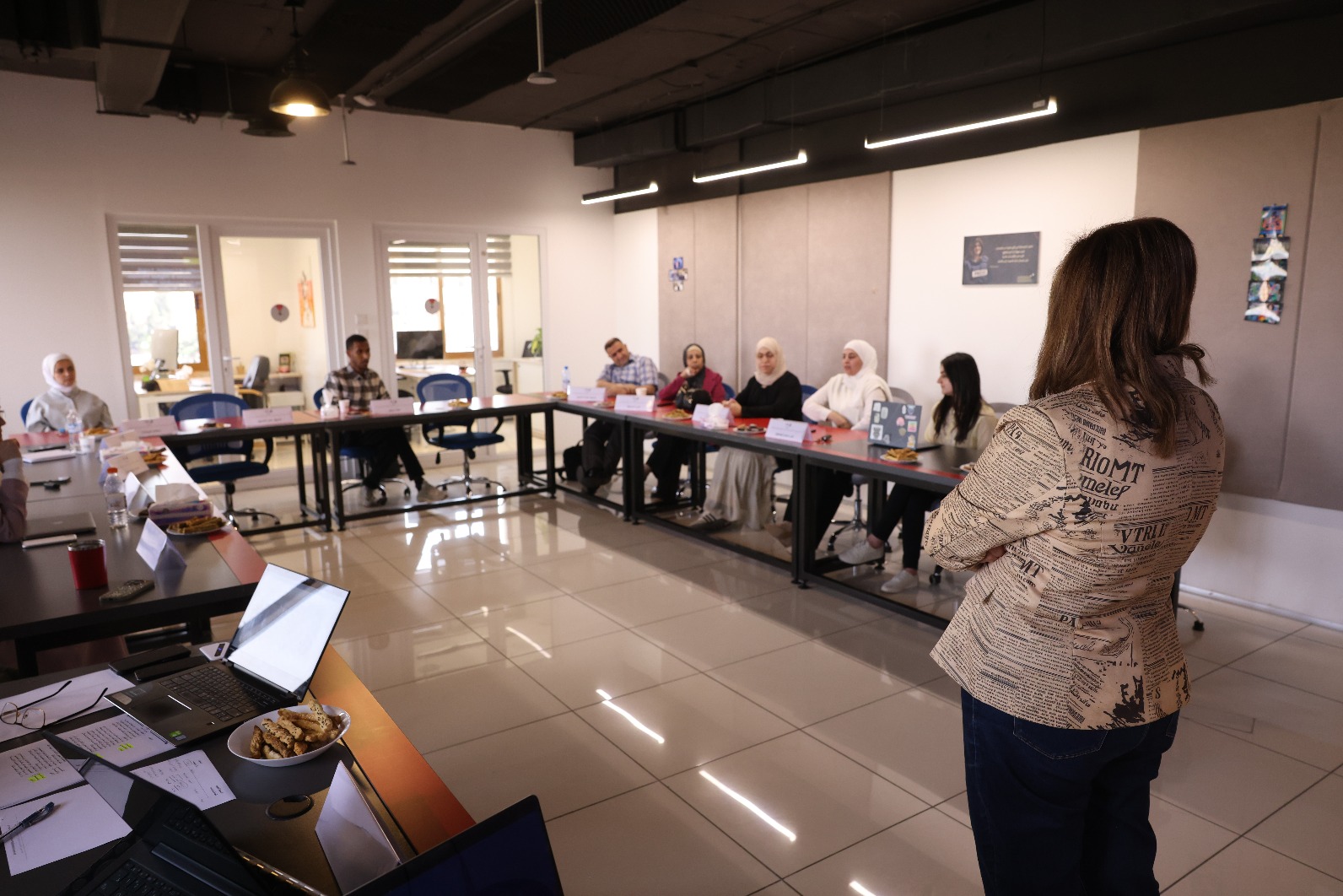
The first day was held virtually under the title “Digital Protection in the Age of Artificial Intelligence for Arab Newsrooms,” with the participation of 15 editors (40% female) from a range of independent media outlets from Arab countries. The second day was held in person at ARIJ’s office in Amman and was dedicated to Jordanian media outlets, bringing together 11 journalists, editors, and editors-in-chief (73% female) for a focused look at the national legal and digital security context.
Both sessions opened with a presentation by ARIJ’s Director General, Rawan Damen, of the findings from a paper prepared by FPU analysing the legal environment and digital threat landscape across the Middle East and North Africa, drawing on the realities faced by eight partner organisations under the “Core Support for Independent Media in the Southern Neighbourhood” programme.
At the core: hands-on digital security
The core of both trainings was a hands-on session led by ARIJ Senior Digital Specialist Saeed Hammad, focused on the essentials of digital security and how to safeguard accounts, personal data, devices, and digital identity. Hammad guided participants through digital footprint and risk assessment, the main forms of digital violence, and how to confront them, including phishing, photo metadata, and tracking tools. He also addressed AI-related threats, identity protection, building an emergency response plan, and documenting incidents of digital violence. The session relied on practical exercises built around real-world scenarios that journalists may encounter in the course of their work, providing participants with concrete tools they could apply directly in their newsrooms.
A Jordan-specific focus: the law and source protection
The in-person Jordan session featured an additional segment delivered by media-specialised lawyer Khaled Khleifat, who addressed Jordan’s digital media laws and newsroom and source protection practices, and presented a set of actionable recommendations to help journalists navigate the current legislative environment.
Strong participant satisfaction
Post-session feedback recorded an overall satisfaction rate of 98% for the in-person Jordan session and 80% for the virtual session, with consistently high ratings across content quality and trainer competence
Participant Voices
Muna Abu Hammour, from Al Ghad Newspaper and Website in Jordan, said: “Everything I took from the training was new and important, and revealed mistakes I had been making in my work.”
Fatima Al-Zahraa Rasras from Chayyek, Lebanon, noted that the training “discussed real-world examples and practical applications, rather than dry theoretical content.”
Samia Allam from Raseef 22 based in Leganon, a participant in the virtual session, added that “the updates on the level of potential digital threats in the age of artificial intelligence were striking.”
The initiative reflects ARIJ’s ongoing commitment, in partnership with FPU, to safeguarding journalists and supporting the resilience of independent media across the region.