


'/%3E%3C/svg%3E "Youtube")
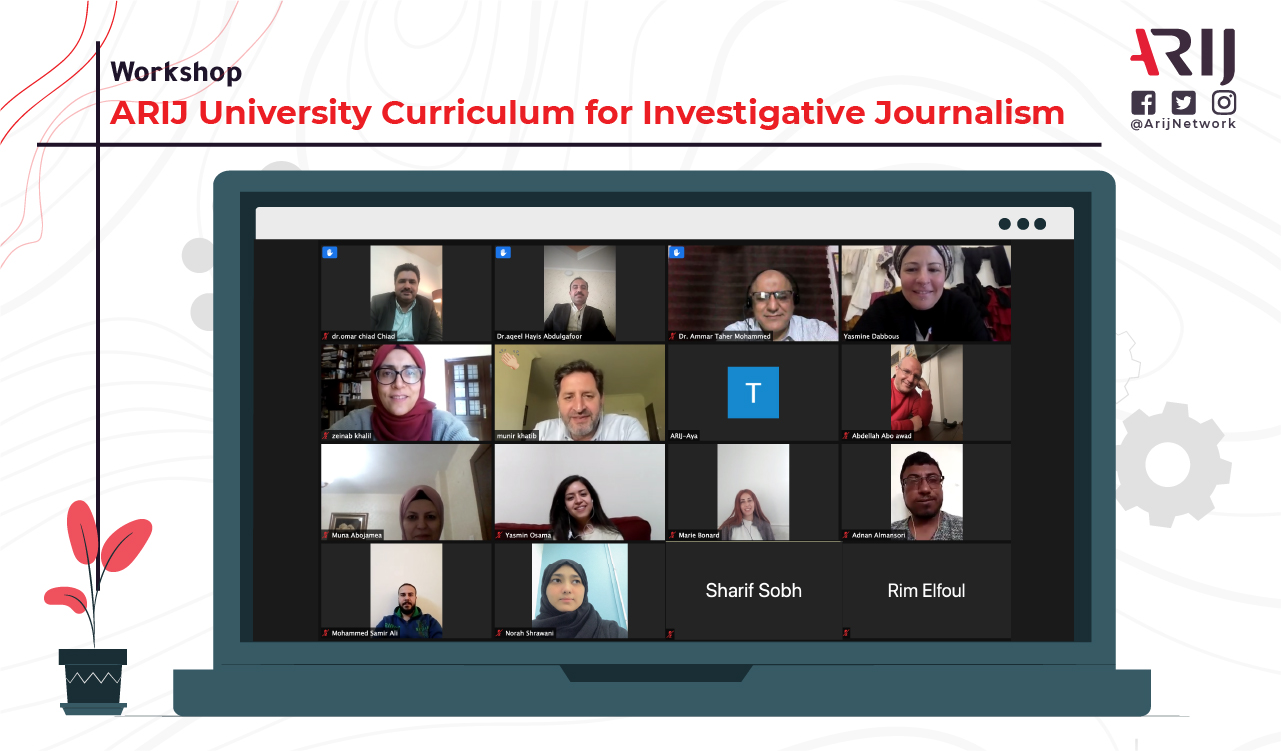
How are investigative journalism techniques presented to students of mass communication faculties in Arab universities? And how can we make it easier for university professors to explain complex investigative skills to their students? And how can we enhance the concepts of journalistic safety and refine investigations in universities? And how can we mix between the academics and practical knowledge on campus? These were among some of the questions that were presented during the “ARIJ University Curriculum for Investigative Journalism” workshop held by ARIJ Network (Arab Reporters for Investigative Journalism) last Thursday.
The workshop lasted for three days with the participation of 17 university professors from nine Arab countries who are teaching the investigative journalism curriculum in their faculties.
Dr. Yasmine Dabbous, the former chairperson of ARIJ’s Board of Directors, talked about investigative journalism and explained its difference from in-depth reports, and she spoke about what the professors can expect when teaching investigative journalism to university-level students. She also introduced the investigative journalism guidebook “On the Path to Truth” by Mark Hunter and Luuk Sengers, and its educational guidebook, which is considered the first Arabic reference for investigative journalism that is being taught in dozens of universities in addition to translating it into ten languages by UNESCO.
Munir Al-Khatib, Editor-in-Chief of ARIJ Network, spoke about the hypothesis and linked it to the timeline as a basis for investigation according to the ARIJ curriculum, and the importance of explaining its composition to students, and he advised: “When you discover that the hypothesis is incorrect, you must change it, because stubbornness does not help and may reflect negatively on you and make you lose your credibility.”
On the second day, Dr. Dabbous touched on the village of sources, open-sources, and searching techniques that have become widely available, which make journalists face great opportunities and greater responsibilities as well. She said: “The problem isn’t that students are searching for information on Google, the problem is they’re doing the searching wrong.”
She also explained, “Everyone surrounding the story has direct or indirect contact with it that helps the journalist form a broad idea of the investigation and access the needed sources, which forms a source village.”
On the third day of the workshop, Al-Khatib reviewed the types of closed sources, interview techniques, and ways to protect information and its sources. On writing techniques, he pointed out that, “It is not easy for all students to convey the victim’s trauma and build a story around it to explain how they were harmed,” which makes it hard for students to submit their investigation drafts.
Dr. Dabbous concluded the workshop with ways to organize classes and evaluate students’ work, and listened to university professors’ challenges and suggestions that fueled the debate about ways to improve how investigative journalism is taught on campus.