


'/%3E%3C/svg%3E "Youtube")
Amman, 3 May 2021
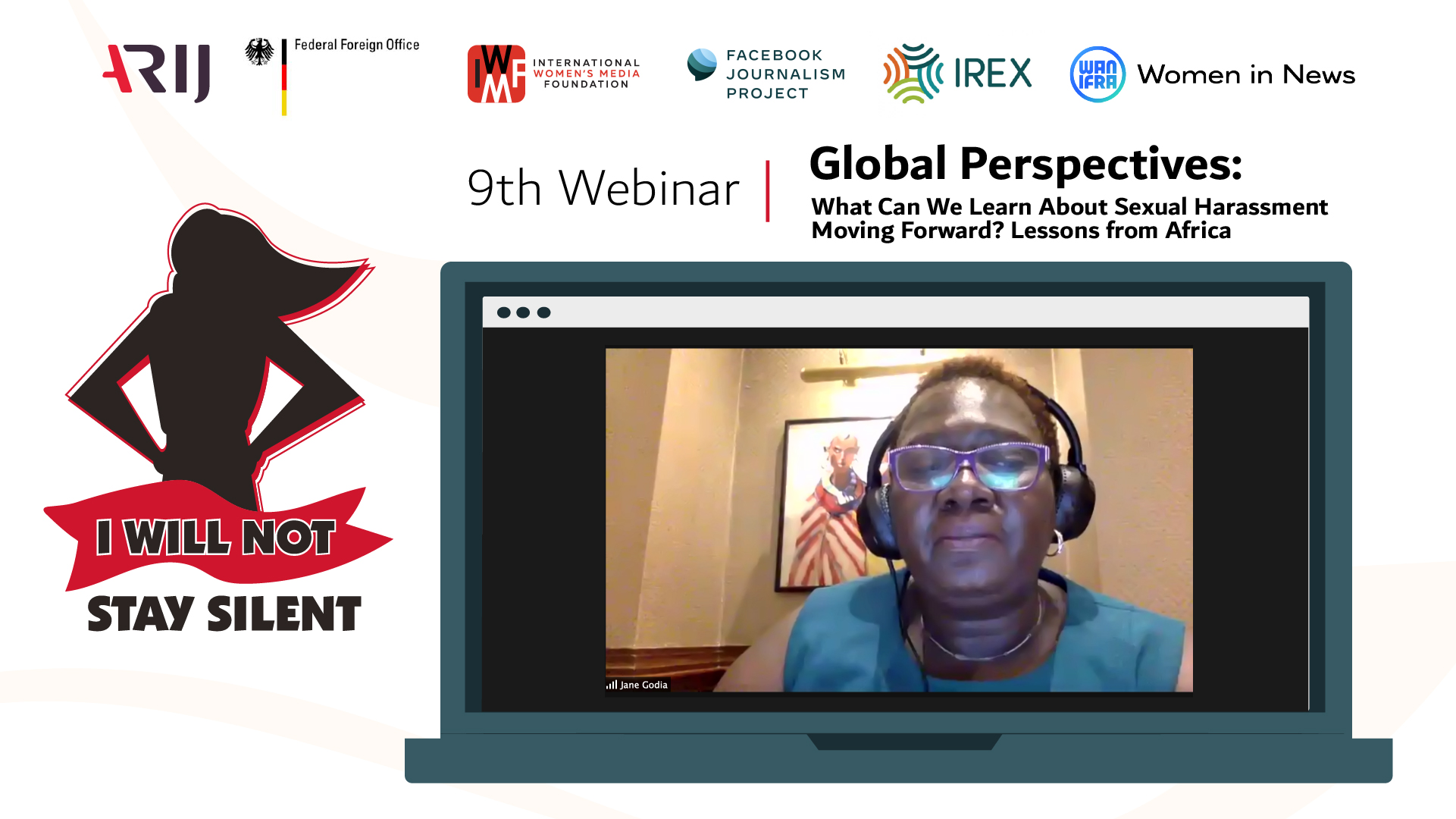
The ninth webinar under I Will Not Stay Silent addressed the challenges and best practice examples in understanding and dealing withsexual harassment in the African continent. I Will Not Stay Silent is a year-long project launched by ARIJ (Arab Reporters for Investigative Journalism) in partnership with the Facebook Journalism Project, Women in News / WAN-IFRA, the International Women’s Media Foundation (IWMF), and SAFE, IREX, and supported by Germany’s Federal Foreign Office, and aims to create a safe, pluralistic, and diverse media working environment that is free of discrimination.
The 9th webinar in the 12-part series, held on 3 May 2021, was presented by Jane Godia, journalist, sexual harassment expert, and Women in News (WIN) Africa Director, and moderated by Dr. Rouba El Helou, political communication and gender lecturer at the Faculty of Law and Political Science at Notre Dame University-Louaize, Lebanon.
At the outset of the 90-minute session, Godia pointed out that sexual harassment is a global problem that is not restricted to any region or social status, noting that sexual harassment is a serious problem in Africa that is shrouded by a veil of silence.
Godia noted that the first challenge that sexual harassment survivors face is the lack of evidence available. When they do report, their accounts are doubted or ridiculed, leading the victim to normalize sexual harassment in some cases. Meanwhile, decision makers are occupied with questions about data, statistics on complaints and reports.
Godia presented a case study from Rwanda about a survivor who reported that she was sexually harassed in her workplace, a media organization.
The management listened to her account and believed her, which led to many other women coming forward with similar stories, exposing the extent of the problem at the organization. As a result, the organization implemented a new sexual harassment policy and set out a plan to deal with sexual harassment complaints, which was key to transforming the organization to a sexual harassment free environment.
The WIN Africa Director stressed the importance of raising awareness on sexual harassment, not only because sexual harassment threatens people’s safety and security, but also because of the physical and psychological trauma victims/survivors experience, which negatively affects their performance at work.
Godia called for training employers and employees on the sexual harassment issues to ensure that both parties are able to put in place protocols to prevent sexual harassment in the workplace.
Godia also shed a light on employers’ responsibilities in preventing and confronting sexual harassment, including: creating a sexual harassment free working environment, understanding the scale of the problem and barriers to reporting, adopting a clear and effective sexual harassment policy, and educating managers. Employers should also ensure safe online working environments that are free of hostility.
On the importance of sexual harassment policies, Godia emphasized that they are meant to protect employers and employees, and clearly set out the responsibilities and roles of every member in the organization.
In the next webinar scheduled for 17 May 2021, journalist Fathiya ElDakhakhni, will tackle issues of framing, privacy, and libel in media reporting on sexual harassment cases. Registration is available through the link.