



'/%3E%3C/svg%3E "Youtube")
Muath Zreqe
27 October 2025
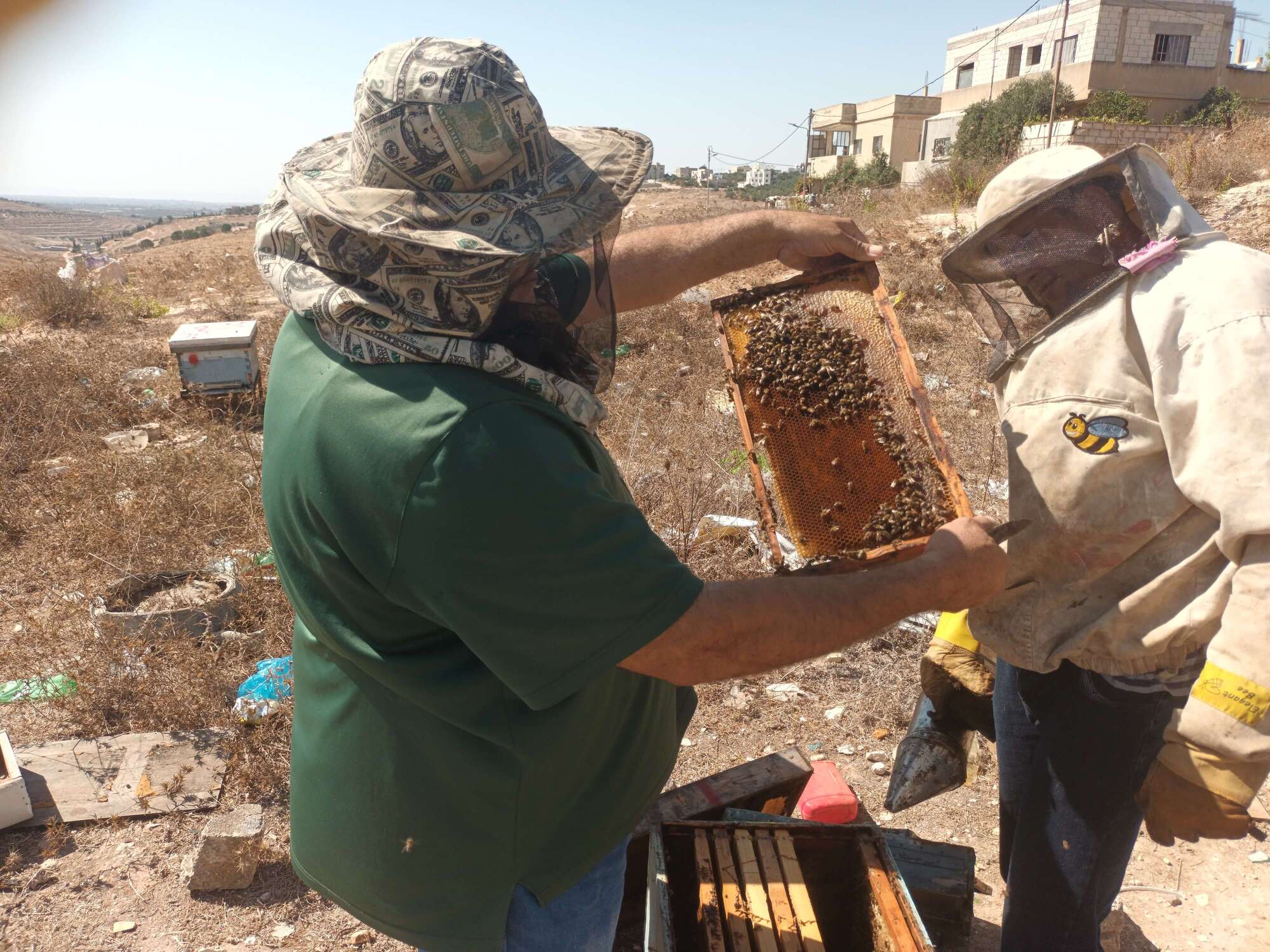
Mufleh Al-Aqrabawi, a 63-year-old beekeeper, travels more than 150 kilometres from the village of Malih, south of Madaba, in search of good pasture for his bees. He gets out of his car and inspects the wooden boxes containing beehives that he transports in his vehicle.

A single beehive’s box consists of ten wooden frames or less
Al-Aqrabawi started beekeeping more than three decades ago. “I used to move the hives to areas with good pasture. The use of agricultural pesticides was not as widespread at the time. But the pesticides used nowadays are highly toxic. It is unimaginable,” he says.
Al-Aqrabawi moves the beehives to Shafa Badran in the north and, occasionally, to the Jordan Valley in the east, in search of suitable pasture. To keep bees safe, he avoids pastures whose owners use pesticides.
Al-Aqrabawi, who owns around 75 beehives, notes that production declined last year (2023), with yields not exceeding one kilogram per hive. Usually, production ranges between five and six kilograms, depending on the rainy season. He attributes this decline to several factors, but believes that pesticides used in agriculture pose the greatest threat to his bees.
In 2023, Al-Aqrabawi lost two of his hives after the bees inside them died.This incident reminds him of a “greater disaster” that occurred ten years ago when he lost the most hives. He says: “I chose a vast farm where many farmers worked, and which was rich in pollen. I left the bees there and returned a week later to find that half of the hives had died. They had clearly been poisoned.”
The same thing happened to Asri Al-Rusan, a 64-year-old beekeeper from Beit Ras in Irbid. Al-Rusan says: “Every year, there is a problem with pesticides. As soon as the foraging bees start to die, I know the whole hive will die or the colony will collapse without producing a single gram of honey.”

Asri Al-Rusan stands with his son who inherited his profession
He also moves from place to place, and the timing of his trips depends primarily on weather fluctuations. In February and March, he goes to the Jordan Valley. In April, he takes some of the hives to Shafa Badran, and others to desert areas such as Ad Dulayl, al-Khalidiya, Zarqa, and, occasionally, Mafraq. Al-Rusan adds that he needs to make about four round trips to transport his 80 boxes, in addition to the weekly trips he makes to check on his bee colonies.
Arij obtained data on 113 beekeepers from the Jordanian Beekeepers Association. Of these, 90 (79.6 per cent) confirmed that their bee colonies had been decimated by pesticide spraying. Similarly, 37 beekeepers confirmed that they had encountered this issue at least three times during their careers.
According to the UN Food and Agriculture Organisation (FAO), bees and other pollinators around the world are under serious threat. Human activities have increased their risk of extinction by nearly a thousand times the natural rate.
Although the figures recorded between 2016 and 2020 do not show a sharp decline in bee populations, Mohammed Al-Rababah, President of the Beekeepers’ Union, says that spraying pesticides causes beekeepers to suffer significant losses each year. These losses may exceed 60 hives at a time, costing thousands of dinars.
Pesticides are used to protect crops from various pests and to control weeds. There are more than 1,900 pesticides registered and licensed by the Ministry of Agriculture in Jordan.
According to Nasser Roumieh, a prevention researcher at the National Centre for Agricultural Research, pesticides are classified into three toxicity levels. The first includes highly toxic pesticides that harm living organisms and are being increasingly restricted worldwide. The second category covers moderately to highly toxic pesticides, while the third includes those with low toxicity.
Roumieh notes that, while most types of pesticides are toxic to bees, they are registered and licensed by the Ministry of Agriculture and meet the necessary requirements. He explained that residue of licensed pesticides remains in plants for up to 21 days and that the Ministry has stopped registering pesticides with residue exceeding this period.
Dr. Mohammed Al-Qasim, an expert in plant disease research and the Consulting and Training Manager at the National Agricultural Research Centre (NARC), also believes that most insecticides are lethal to bees and should not be sprayed where they are present. He distinguishes between three main types of pesticide: insecticides, most of which are lethal to bees; fungicides, which are harmless to bees; and acaricides, some of which can harm bees, particularly when used in high concentrations. He points out that most of the pesticides used by farmers are of the first type.

A beehive
The 2020 National Situation Report on Highly Hazardous Pesticides confirms that 88 of thosesuch pesticides are registered for use in Jordan. These include Clothianidin, Imidacloprid, and Thiamethoxam, which are active substances classified as neonicotinoids.
In 2013, the European Commission imposed strict restrictions on the use of plant protection and seed treatment products made by major companies, containing Clothianidin, Imidacloprid, and Thiamethoxam, to protect bees. It banned the use of these three pesticides on crops that attract bees and restricted their use to greenhouses, where bees cannot forage, winter crops, and the treatment of certain crops after flowering. This measure was based on a risk assessment carried out by the European Food Safety Authority (EFSA) in 2012.
Biodiversity expert Ihab Eid, who specialises in wildlife and nature reserves, says that some types of pesticides, especially insecticides from the neonicotinoid group, directly affect the health of bees and their ability to perform vital functions such as pollination. He explains that these pesticides affect the bees’ nervous systems, disrupting their movement and navigation and impairing their ability to find flowers or return to their hives.
A review of the pesticides registered and licensed in Jordan, as listed on the Ministry of Agriculture’s website, reveals that many active ingredients banned or restricted in the European Union (EU) countries, such as neonicotinoids, are still in use in Jordan.
Regarding the pesticide licensing mechanism in Jordan, the aforementioned national report states that the Ministry bases its pesticide ban policy on lists provided by the US Environmental Protection Agency (EPA) and the EU. Consequently, the Pesticide Registration Committee reviews pesticides banned in the US and the EU before taking similar action.
Article 53: A. “The import of registered pesticides from outside of the country of origin may be permitted, provided that they are from countries with advanced registration systems. Pesticides may also be imported from the markets of these countries, provided that they are registered and permitted for use in these countries and are manufactured or processed in one of these countries.”Source:
Instructions for the registration, classification, processing, import, trade and handling of pesticides No. 5/Z of 2023
Furthermore, companies that import pesticides or local factories that produce them submit numerous toxicity studies for the substances to be registered, including toxicity studies on bees. The Ministry of Agriculture grants or rejects them subsequently. l.

In addition to farmers’ continued use of highly toxic pesticides that are lethal to bees, 65 percent of surveyed beekeepers believe that farmers are not taking the necessary precautions to avoid harming apiaries. Mohammed Al-Rababah, President of the Beekeepers Union, believes that the pesticide use is not sufficiently regulated between farmers and beekeepers.
According to the regulations governing the handling of pesticides and their residues, as well as the licensing of agricultural pest control and public health and storage facility services (No. 1 of 2022), Article 13 stipulates that “The farmer or individual responsible for using the agricultural pesticide must follow the instructions on the label, particularly with regard to the method of use, the safe period, the crops to be sprayed and the precautions to be taken during treatment or spraying.”
Article 18 of the same law stipulates the need to “comply with the procedures and requirements when using agricultural pesticides, in order to protect humans, animals or the environment.”
The Ministry’s spokesperson, Lawrence Al-Majali, said that the Ministry, through its Agricultural Guidance Directorate, provides farmers with guidance on proper pesticide spraying procedures through training workshops and field schools. He emphasised that the Ministry has stressed the importance of raising awareness of the safe and responsible use of pesticides through regular visits to farmers. This forms part of the measures taken under the national plan for monitoring pesticides and pesticide residues.
Al-Majali partly blames the beekeepers: “There are supposed to be designated areas for beehives, but some beekeepers do not comply with this and move their hives around.”
Beekeepers are also trying to be more careful in their choice of pasture and timing. Al-Aqrabawi has set his sights on mountainous areas where the use of agricultural pesticides is unlikely. Meanwhile, Al-Rusan has had to change the timing of his trips with the bees to the northern Jordan Valley, moving them from February to March, to avoid the spraying period.
Union President Al-Rababah asks: “Where can we go if beekeepers cannot take their bees to agricultural areas and are not welcome in residential areas?” He believes that the Ministry favors farmers over beekeepers, because of the greater economic value of the agricultural sector, compared to beekeeping.
Numerous studies show that bees are vital pollinators for around 30-35 per cent of global food crops.
In the same vein, with regard to food and food security in Jordan, biodiversity expert Eid says that many agricultural crops, such as fruits and vegetables, depend on bee pollination to achieve high productivity.
Eid highlights that this impact is amplified in Jordan, where agriculture is a key pillar of national food security. Similar losses in pollinated crop production could drive up food costs and exacerbate food insecurity.
The decline in bee populations leaves an impact on agricultural crops and vegetation cover, which affects the climate. Plants pollinated by bees play a significant role in carbon dioxide absorption. It is estimated that the Earth’s forests and ecosystems absorb around 30 per cent of carbon emissions from human activities.
Eid called for the need to support bee-friendlysupport to bee-friendly strategies, such as reducing pesticides use, preserving natural habitats, and promoting sustainable agriculture.
Beekeeper Mufleh Al-Aqrabawi tries to avoid his bees foraging on farms as much as possible. Instead, he opts for mountainous areas, fearing a repeat of the 2015 incident, in which he lost half of his bee colonies.
Al-Aqrabawi calls on the Ministry of Agriculture to stop licensing pesticides that are toxic to bees, and hopes that farmers will stop using them.
For beekeeper Asri Al-Rusan, beekeeping is no longer as profitable as it once was. Despite losing up to two thousand dinars a year because of pesticides, he refuses to give it up: “Win or lose, I will not stop beekeeping.”