
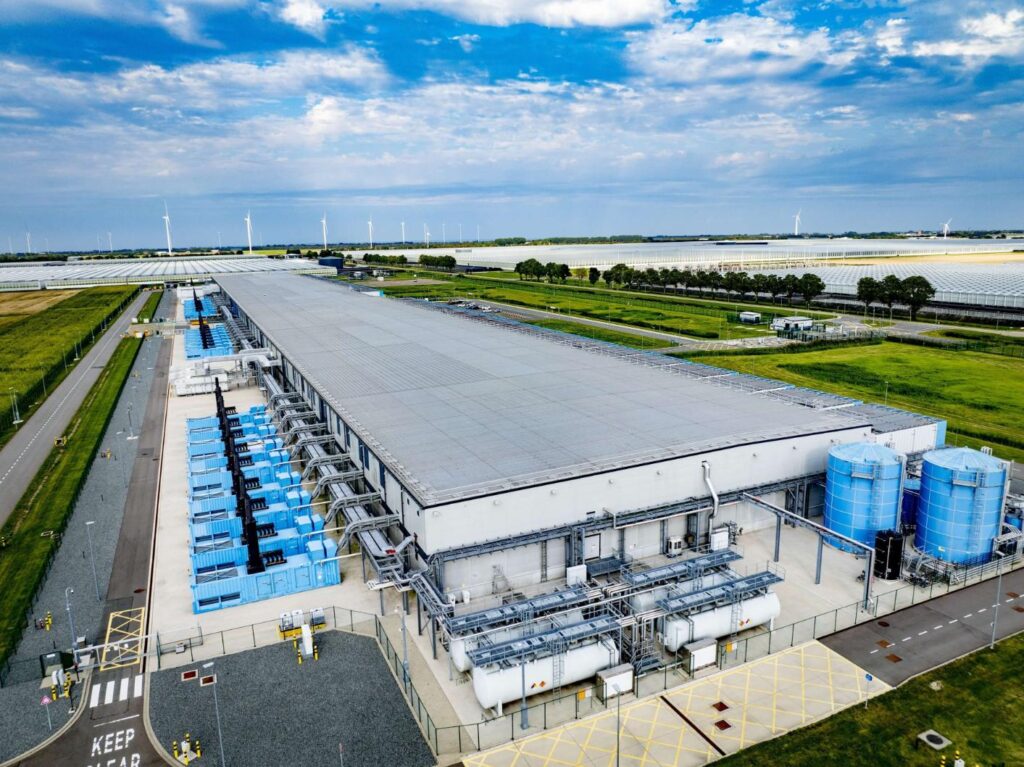



'/%3E%3C/svg%3E "Youtube")
This report examines official statements from Microsoft and Google that fail to give the full picture of how much water is consumed by the infrastructure used to train or run their generative artificial intelligence (AI) models. Neither company has disclosed precise details of water consumption for specific data centers or AI models. This limits researchers’ ability to study the full climate impact of the infrastructure supporting these models.
 International
 October 22, 2026
 Technology
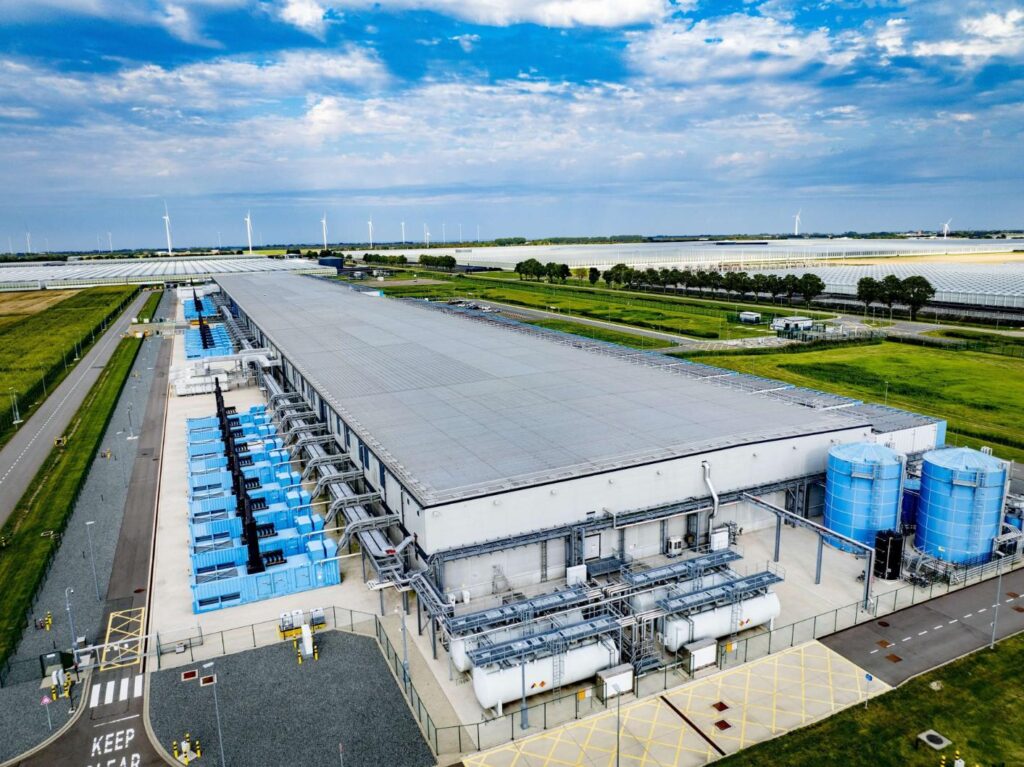
Source: AFP
By: Safaa Ashour – Journalist and fact-checker from Egypt
This report examines official statements from Microsoft and Google that fail to give the full picture of how much water is consumed by the infrastructure used to train or run their generative artificial intelligence (AI) models. Neither company has disclosed precise details of water consumption for specific data centers or AI models. This limits researchers’ ability to study the full climate impact of the infrastructure supporting these models.
Many researchers have recently highlighted environmental concerns over the increase in the “water footprint” of the infrastructure required to train and run large generative AI models – such as Gemini and GPT – particularly as many of these facilities are located or under construction in water-stressed areas, such as Kuwait and the United Arab Emirates.
This infrastructure consumes more energy than that of conventional servers, which in turn generates more heat in the data centers supporting these models. This, among other factors, increases the need for water-based cooling technologies, alongside other factors.
The UN Food and Agriculture Organization (FAO) defines the water footprint as “the total volume of fresh water used to produce the commodities, goods and services consumed by the person, company or nation.”
As concerns mount over water consumption, major tech companies such as Microsoft and Google, claim that expanding their AI data centers does not necessarily increase their water footprint. They go further, claiming that their new facilities use less water. .
The companies highlight their advanced, closed-loop cooling technologies, but fail to release data that would give the full picture of how much water their servers actually consume.
“Does using these technologies necessarily reduce the water footprint? And are these companies providing a complete picture of their actual water consumption?”
On August 25, 2025, Al Jazeera’s website reported on Google’s estimates of the environmental footprint of its Gemini AI apps, including water use, energy use, and carbon emissions. Al-Arabi Al-Jadid and Asharq Al-Awsat had carried the story earlier, on August 21, noting Google’s estimate that a Gemini “prompt” consumes the equivalent of five drops of water.
Screenshots of reports carried by Al Jazeera and Al-Arabi Al-Jadid in 2025
These reports were based on a technical paper by Google researchers and engineers, published on August 21, 2025, titled“Measuring the Environmental Impact of Delivering AI Services at Google Scale.” In it, they claimed that “an average text prompt in Gemini Apps consumes the equivalent of five drops of water (0.26 ml).”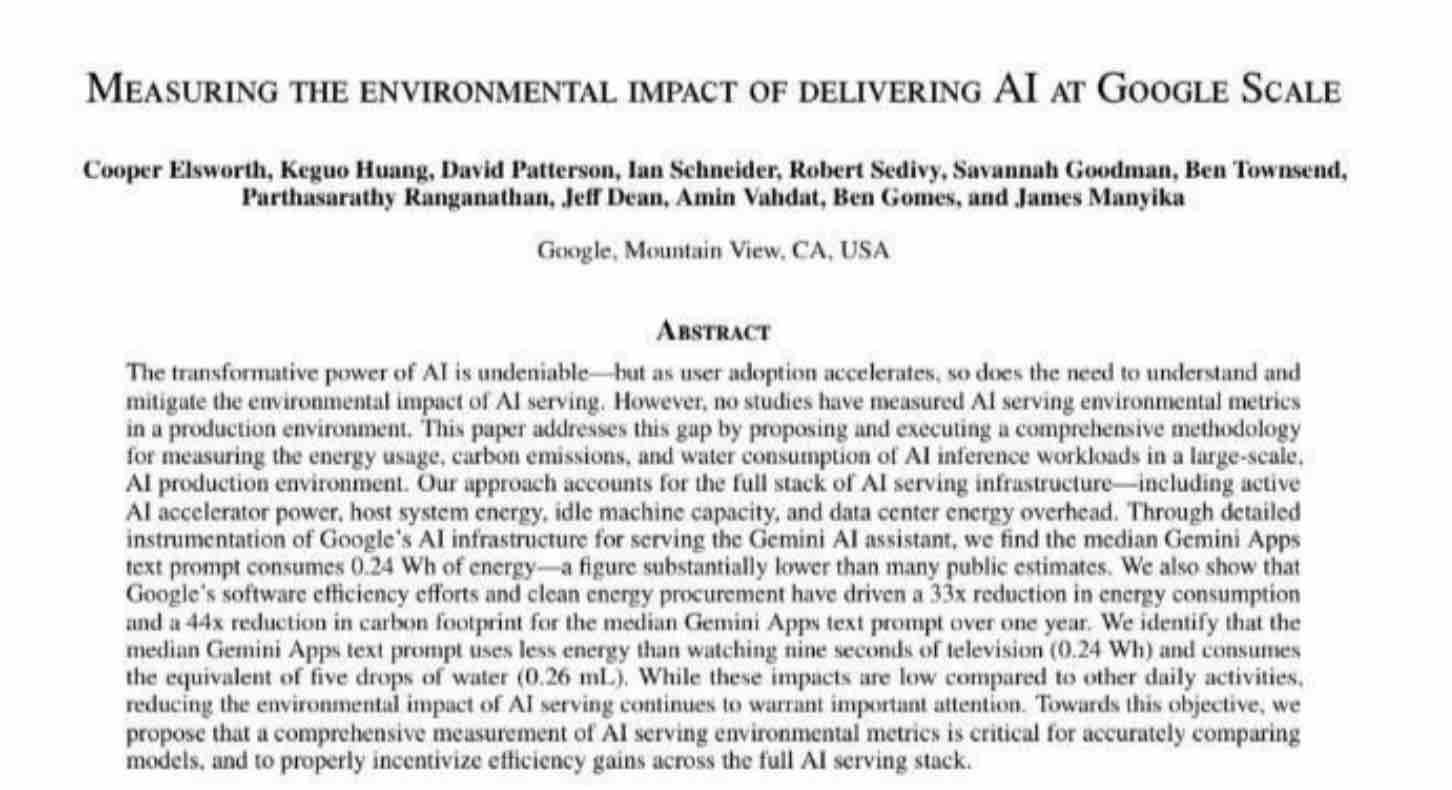
Screenshot from the technical paper published by Google
From a technical perspective, actual consumption varies according to the prompt and the response, the model and processing pathway used, the efficiency of the hardware, and the location of the data center. Google says its methodology is based on data from the infrastructure used to operate the service, including computing components, power systems, and the supporting infrastructure of the data centers.
However, a review of the paper shows that the figures are based on a methodology developed internally by Google. The paper was not published as a peer-reviewed study, nor did it provide detailed data that would allow researchers to recalculate the results. This means that the published evidence cannot be independently verified.
Researchers have criticized them methodology behind Google’s figures. Shaolei Ren, a professor of electrical and computer engineering at the University of California, Riverside, says that the company left out key information, which could give the public a misleading impression of how much water AI data centers consume.
Calculating the water footprint means looking not only at the water used directly to cool the servers, but also at the water consumed indirectly to generate the electricity powering them. Researchers therefore need clear data and methodology from companies if they are to accurately compare the environmental impact of AI services – something major technology firms do not provide.
Ren’s criticism is echoed by Alex de Vries-Gao, founder of Digiconomist, a platform specializing in tracking the environmental impact of modern technologies. In an interview with The Verge, he said that “Google is making an unfair comparison.” Google maintains that its water footprint estimate is more accurate than those of studies it describes as “based on models that lack direct data.” The two researchers counter the earlier studies, including one they took part in that Google itself cited, used average values rather than median value Google’s researchers relied on.They also criticize Google for not explaining in sufficient detail how it calculated this median.
Google claims that its estimated consumption of 0.26 ml per prompt is “significantly lower than estimates in other research papers.” But Professor Ren told The Verge that Google’s comparison is “misleading”, because a research paper he co-authored takes into account a data center’s total direct and indirect water consumption, whereas Google’s figures leave out indirect consumption.
This observation is consistent with the findings of the report “Regulating Data Center Water Use in California,” published in February 2026 by the Center for Law, Energy and the Environment at the University of California, Berkeley. It argues that data centers’ limited disclosure of their water consumption makes it harder for researchers and regulators to assess their real environmental impact.
According to a 2026 report by the United Nations University Institute for Water, Environment and Health, limited operational disclosure means that global estimates are based on “modelling.” The report estimates that generating the electricity used by data centers worldwide required about 4.5 trillion liters in 2025, and assumes that AI workloads account for 20 percent of this impact. The report predicts this figure will rise to 9.3 trillion liters by 2030 – enough to meet the minimum domestic water needs of all the 1.3 billion people living in sub-Saharan Africa for a whole year
In June 2026, Arab news sites – including Wasla Economy and Business and Jamhara – reported on comments by Microsoft CEO Satya Nadella about water use at the company’s new-generation AI data centers. He said one of these data centers uses roughly as much water in a year as “a single restaurant”.
Screenshot from the Jamhara website.
Headline reads: “Microsoft is reducing water consumption at its data centers to 125 ml.”
Nadella made this statement at Microsoft’s annual developer conference, Microsoft Build, on June 2, 2026. He credited the improvements to closed-loop cooling systems, which recycle water internally, reducing the need to keep replenishing it.
Microsoft, however, has so far published none of the detailed data required to independently verify such claims. It has not disclosed the size or type of restaurant used to make its comparison, nor the methodology it relied on for its calculations. Nor does its announcement of the cooling system offer any estimate of the full water footprint, including water used in electricity generation or in the manufacture of equipment.
According to Microsoft’s own website, we found that this new system does not apply to all its facilities. The company states that it operates over 500 data centers in more than 34 countries, which it does not name. But the “zero water for cooling” design (i.e., one that does not consume water in the cooling process) applies only to its new-generation facilities and is not planned as an upgrade for its existing data centers.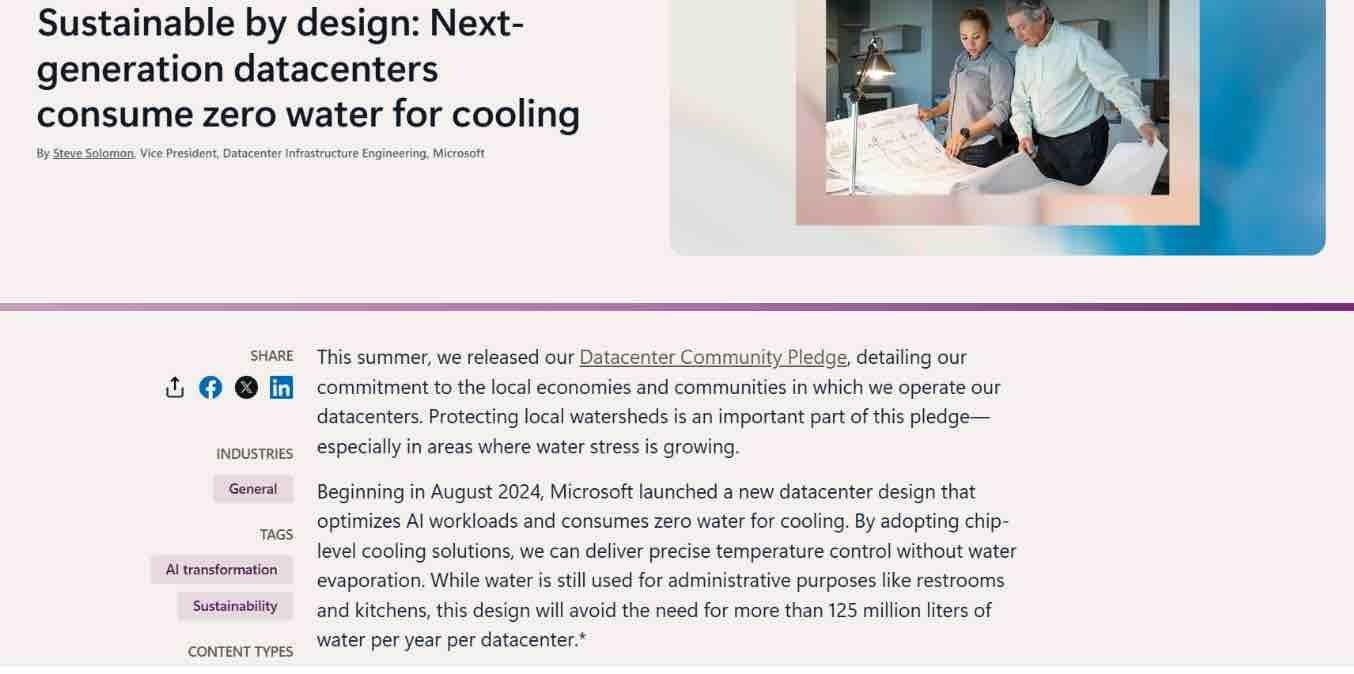
Screenshot of a blog post on Microsoft’s official website – December 9, 2024
Microsoft focuses on water consumption in data center cooling systems, but has said nothing about the water used to generate the electricity that powers these centers or the water associated with the manufacture of equipment. This practice, which Google follows as well, keeps the full picture of the companies’ water footprints from view.
A study published in the journal AGU Advances in 2026 highlights the importance of calculating indirect water consumption, since the water footprint of data centers is not limited to water used for on-site cooling but also includes indirect water use associated with electricity generation and the supply of equipment.
The International Energy Agency (IEA) estimated in 2025 that about two-thirds of the water consumption linked to data centers worldwide came from primary energy supply and electricity generation, while about a quarter was associated with cooling. The IEA pointed out that these ratios vary significantly depending on the source of energy, the location of the data center, and the design of the cooling systems.
A study titled “Making AI Less Thirsty,” published in Communications of the ACM in 2025, estimated that training GPT-3 in Microsoft data centers in the US could consume about 700,000 lters of water, with significant variation depending on location, the type of cooling system and the source of the electricity.
A study estimated the water footprint of AI data center infrastructure in 2025 at between 312.5 billion and 764.6 billion liters—comparable to global annual consumption of bottled water, which is around 446 billion liters.
However, the study stressed that the operators of these data centers need to release their full data, since assessments can currently draw only on broader performance indicators published in the operators’ own environmental reports. As a result, the published figures carry a significant degree of uncertainty.
In an joint investigation published in 2025 by Source Material and The Guardian, journalists mapped 632 data centers belonging to Microsoft, Google and Amazon. Because the companies do not systematically disclose where these facilities are, the reporters relied on local sources and specialized databases.
This investigation found that 38 operating data centers and 24 under development are located in areas experiencing water stress, including in Arab states such as the United Arab Emirates and Kuwait. It warned that the limited data available made it difficult to assess the full impact of these centers on water resources and to plan for their future management.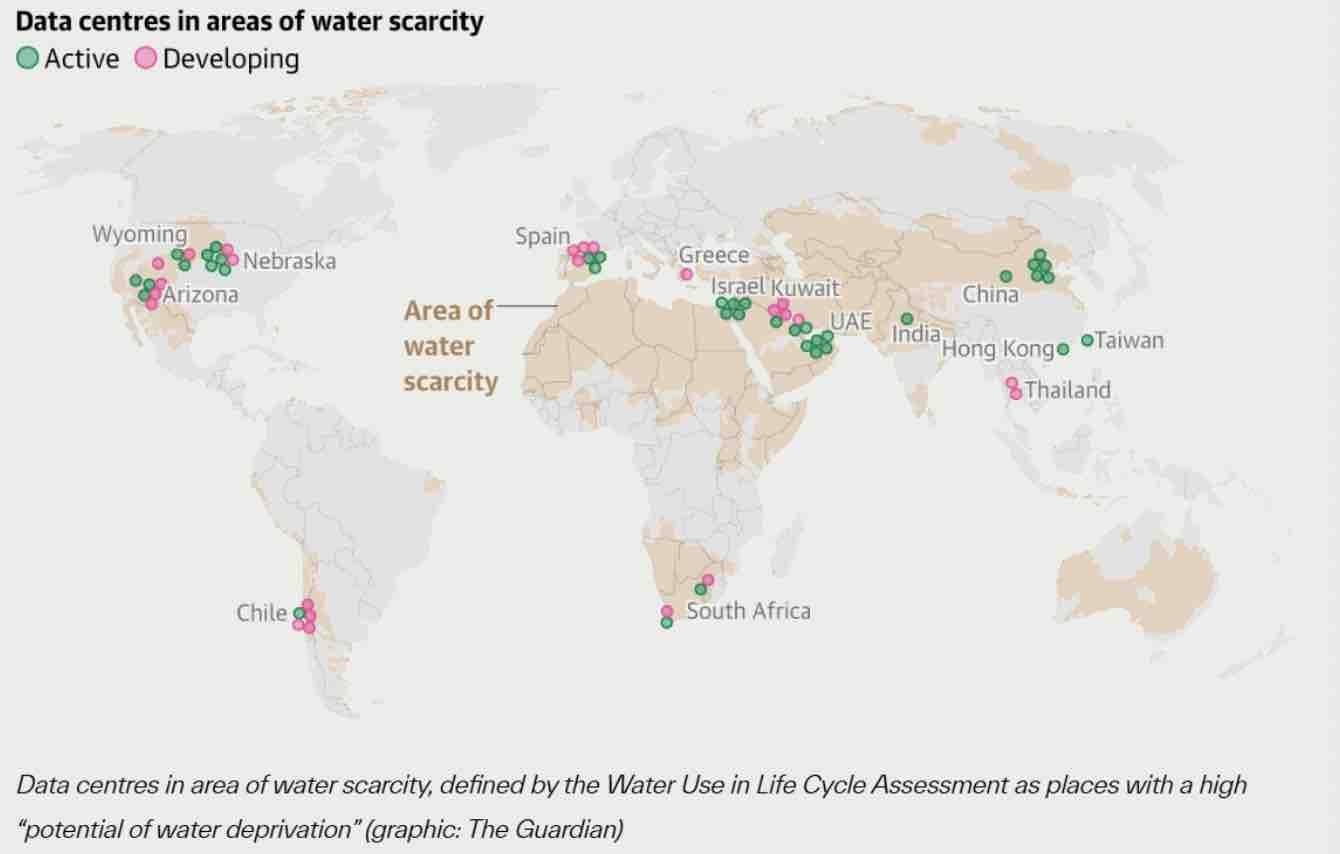
Data centers in water-scarce regions, defined by a life-cycle water use assessment as locations with “high potential for water deprivation” (Graphic: The Guardian).
A 2025 study titled “The water footprint of artificial intelligence: Emerging solutions and governance imperatives” reached a similar conclusion, finding that two-thirds of data cenetrs setup since 2022 were in regions already experiencing water stress, and that this had increased pressure on local water resources and raised questions over the sustainability of expanding AI infrastructure.
In researching this report, we found no rigorous, published study that could definitively determine the water footprint of data center infrastructure for AI models. All the available studies relied on estimates or assumptions, which their authors attributed to major tech companies’ lack of transparency about their direct and indirect water consumption.
Our findings point to a recurring pattern: Major tech companies cite only partial indicators of generative AI’s water footprint to showcase improvements in a specific area, such as lower cooling water consumption or the median water consumption per text prompt.
These indicators do not always provide a complete picture of the actual water footprint, which includes both direct and indirect consumption. The problem is compounded by the lack of detailed, location-specific consumption data, which makes it harder for researchers and policymakers to make sound decisions about conserving environmental resources and to understand the implications of further investment in AI.