



'/%3E%3C/svg%3E "Youtube")
Maryam Ammar
29 October 2025
The die-offs have recurred several times in the same area — the central stretch of Aqaba’s shoreline — and roughly around the same time of each year. In 2020, a similar incident claimed other marine species besides shrimp, including smaller numbers of squid.
Fisherman Mohammed — who usually works along various parts of Aqaba’s coastline — said he had only ever caught shrimp in the northern waters, and only in small, non-commercial amounts. The sudden appearance of such large numbers in Aqaba, he added, raises serious questions.
The Gulf of Aqaba is both a tourism and economic center, attracting visitors — especially diving enthusiasts from around the world — to its distinctive coral reefs and rare marine life. But recurring die-offs of juvenile shrimp, or any other marine species, could jeopardise Aqaba’s bid to have its marine reserve recognised as a World Heritage site.
Nasser Al-Zawaydeh, director of the Aqaba Marine Reserve, said that juvenile shrimp often approach the shore in search of nutrients. But once they reach the shallows, many die as water temperatures rise — especially in summer.
However, Al-Zawaydeh’s conclusion is far from conclusive, with several scientific reports challenging his assessment.

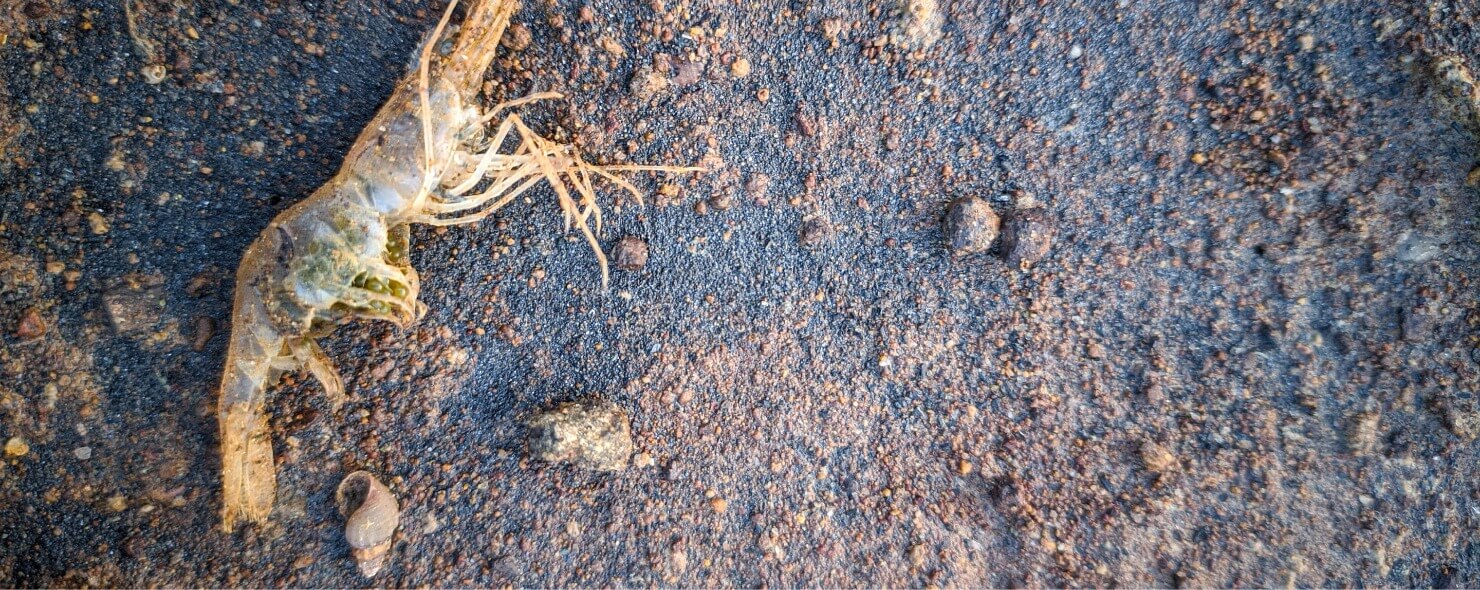
A report from the Aqaba Marine Reserve on the incident noted that large numbers of juvenile shrimp, measuring roughly 1.5 to 3 centimeters, were found dead along the central beach. Marine scientists and environmental experts linked die-offs to changes in water temperature, which trigger both vertical and horizontal mixing of nutrients. This, in turn, can lead to blooms of marine organisms, including algae, which may grow densely in these areas and alter levels of dissolved oxygen.
Laboratory analyses revealed elevated nutrient levels, including nitrite — a compound associated with excessive wastewater — alongside microbial test results that exceeded Jordanian standards, pointing to sewage contamination detected through a bacterial indicator.
Following these findings, the Aqaba Marine Reserve recommended that the Aqaba Special Economic Zone Authority (ASEZA) carry out further tests, including assessments for heavy metals, organic pollutants, and biochemical oxygen demand.
Ali Al-Sawalmeh, director of the Marine Science Station in Aqaba, pointed to a factor highlighted in the report: increased evaporation due to rising temperatures, which concentrates pollutants.“Evaporation caused by high temperatures alters the quality of coastal waters,” he explained, “leading to higher concentrations of pollutants such as ammonia, which in turn can produce nitrite and nitrate when wastewater and other contaminants enter the sea.”
An unnamed official confirmed this conclusion, pointing to a sewage leak along the central beach as the cause of both pollution and the shrimp die-offs.
Earlier suspicions had pointed to chemical pollution as the cause, but subsequent investigations revealed partial contamination from wastewater, likely linked to construction work for a hotel in the Corniche area. Excavation and construction near the shore reportedly released large volumes of water, which were discharged straight into the sea through a pipeline.
In contrast, Dr. Ayman Suleiman, Commissioner for Environment and Natural Reserves at the Aqaba Special Economic Zone Authority (ASEZA), said the pipeline in the central beach area belongs to one of the projects and carries seawater. He explained that the authority had initially planned to divert the water to the ancient city of Ayla, but when the Department of Antiquities began restoration work, the decision was made to release the water into the sea.
Suleiman added that water samples are collected regularly to monitor quality, and any changes are treated at the desalination and purification station.
In response to the die-offs, the authority halted the discharge from the pipeline into the sea and removed the water using 39 tanker trucks for treatment at the purification station.
The unnamed source also pointed to another possible factor in the shrimp die-offs: fishing boats and glass-bottom boats whose engines run on a gasoline-oil mix.
Dr. Ali Al-Sawalmeh, director of the Marine Science Station (MSS) in Aqaba, emphasized that water quality at the central beach can differ from other areas of the sea due to intense human activity, including swimming and other recreational uses, which often result in littering.
He added, “Human pressure from recreational activities, tourist boats, and water sports has both direct and indirect effects on seawater and marine life.”
Nasser Al-Zawaydeh, director of the Aqaba Marine Reserve, noted that plastic accounts for roughly 85 percent of the waste collected during seabed cleaning campaigns. Authority teams removed 13 tonnes of debris that had accumulated in Aqaba’s waters and natural habitats over a seven-month period from early 2024.
The geography and contours of Al-Ghandour Beach, including its inlets and coves, can sometimes restrict water renewal, further contributing to environmental stress in the area.

Shrimp are highly sensitive to light and tend to move closer to shore at night in search of nutrients. However, the presence of industrial facilities and other developments along Jordan’s coastline means that artificial nighttime lighting could be contributing to shrimp die-offs, according to some experts.
This view is echoed by Dr. Fuad Al-Hourani, a professor at the Faculty of Science at the University of Jordan, who linked the die-offs of juvenile shrimp to light pollution. Streetlights in Aqaba extend their glow over the sea near the central beach and across the port along the southern shore. By contrast, in many developed countries, industrial lighting is never directed toward the coast, preventing young marine organisms from being drawn to artificial lights — which can lead to their death and disrupt their reproductive cycles. Many species rely on moonlight for what is known as the “lunar cycle,” rather than bright artificial illumination.
Al-Hourani added that he had submitted a recommendation to the Aqaba Special Economic Zone Authority (ASEZA), calling for clear regulations for coastal facilities. He noted that pollutants pose one of the greatest threats to marine life — particularly coral, which, despite a potential lifespan of up to a hundred years, remains highly sensitive to contamination, including light pollution.
However, Dr. Ayman Suleiman, Commissioner for Environment and Natural Reserves at the Aqaba Special Economic Zone Authority (ASEZA), maintained that there is no link between lighting and the shrimp die-offs. He clarified that the professors’ concerns referred to the installation of floodlights along the southern beach, rather than the central area where the die-offs took place.
Mass marine die-offs have been recorded repeatedly across the Arab region. In Kuwait, for instance, a major fish kill in the waters of Kuwait Bay in August and September 2000 wiped out more than three thousand tonnes of fish — roughly seventy million in total, according to estimates at the time.
In Yemen’s Al-Shihr area of Mukalla, Hadhramaut, tons of shrimp died in 2024. Experts in countries facing similar incidents attributed the die-offs to the dumping of chemical and petroleum industry waste, compounded by natural factors such as sudden and significant changes in the water’s biological, chemical, or physical properties. Human activities also played a major role, resulting from widespread and recurring environmental mismanagement along coastal areas and other bodies of water.
Mass fish die-offs can also occur naturally due to sudden and unusual blooms of plankton or microscopic algae, which proliferate rapidly in surface waters and deplete dissolved oxygen, often resulting in widespread mortality.
The Aqaba Special Economic Zone Authority (ASEZA) has affirmed that tourist boats do not discharge sewage into the sea. In cases of suspected pollution, the authority said it monitors water quality through samples analysed by its own Bin Hayyan Laboratory.
Dr. Ayman Suleiman, Commissioner for Environment and Natural Reserves at the Aqaba Special Economic Zone Authority (ASEZA), said the authority had carried out the necessary tests and consulted marine science experts, who confirmed that the phenomenon was entirely natural.
As such, the causes of juvenile shrimp die-offs in Aqaba remain disputed, leaving open the possibility that they could recur in the absence of a clear explanation.