



'/%3E%3C/svg%3E "Youtube")
The report reveals that a specialized Yemeni public institution issued inaccurate weather warnings attributed to climate change without providing scientific evidence. This caused widespread concern among the population of Aden residents prompting some to take costly measures.
 Yemen
 October 22, 2026
 Environment and Climate

By photographer Mohammed Saeed
Zainal AAbdain Ali
The report reveals that a specialized Yemeni public institution issued inaccurate weather warnings attributed to climate change without providing scientific evidence. This caused widespread concern among the population of Aden residents prompting some to take costly measures.
Ahead of summer 2026, the General Authority of Civil Aviation and Meteorology (GACAM) in Aden issued an “urgent climate warning” on Facebook, alerting residents to an impending “dangerous” heat wave.
Users reacted by sharing the statement, while others posted alarmed comments on their own profiles. Comments included “Bottom line: angina” and “Aden’s temperatures are nearing lethal levels.” Users also shared posts quoting the statement alongside unsourced information, further fueling alarm.
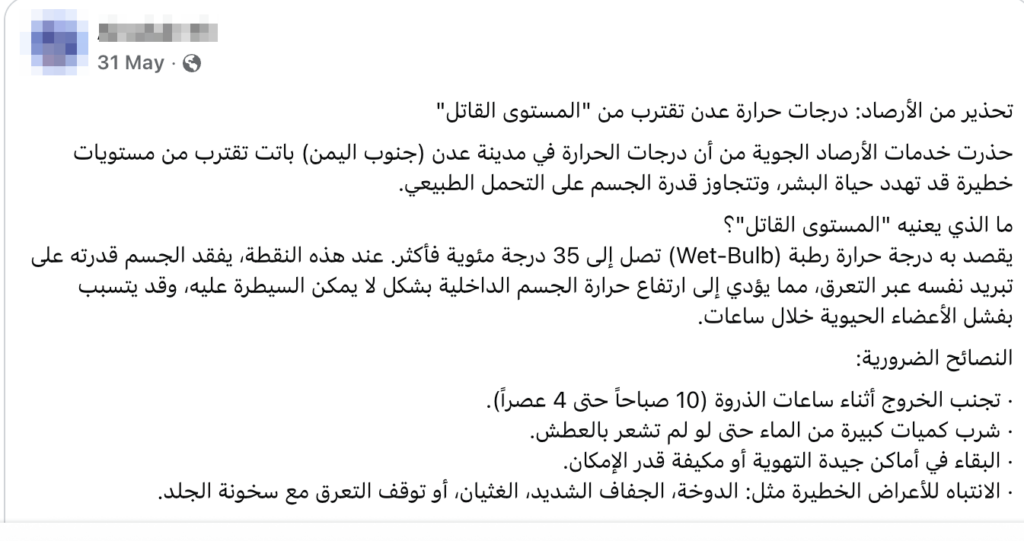
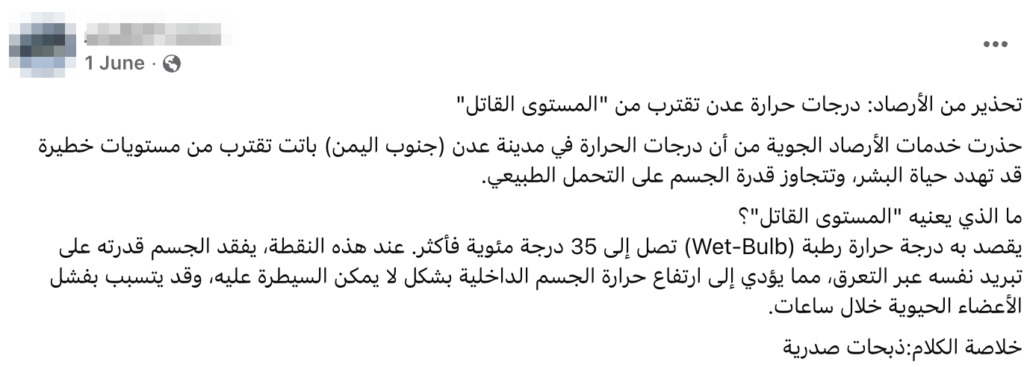
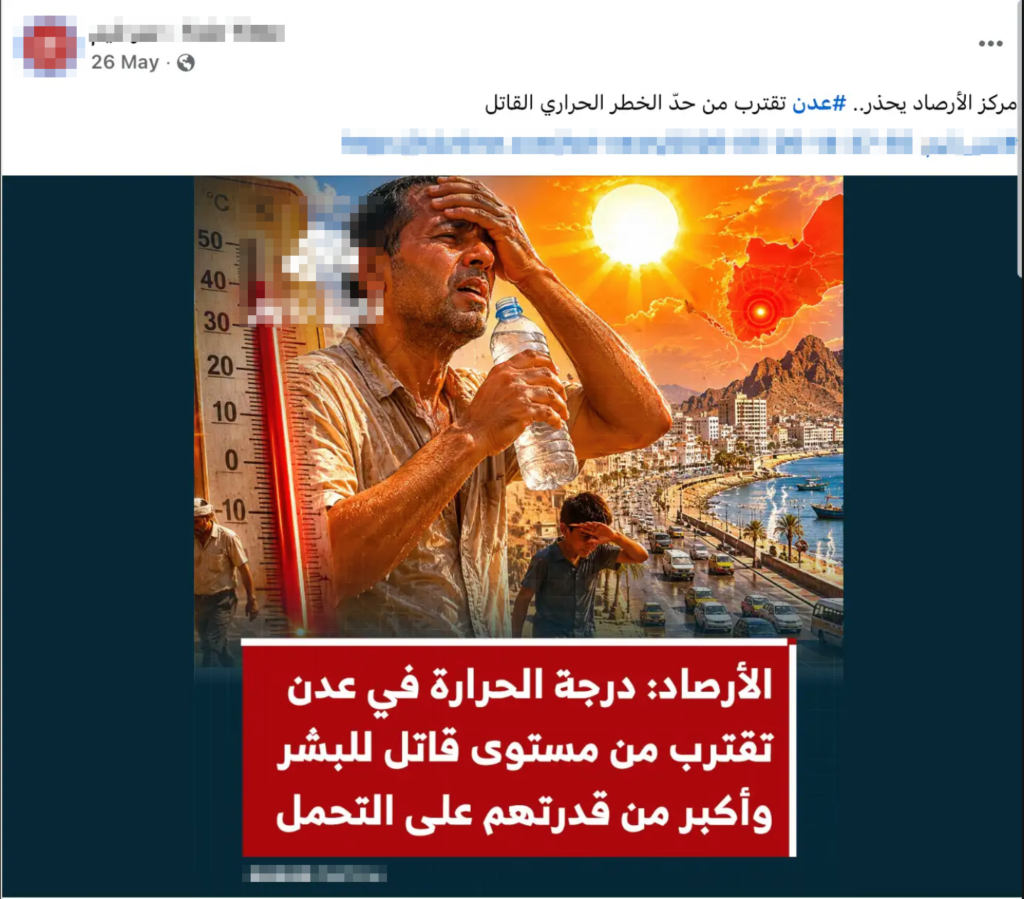
Facebook accounts shared the statement of the Aden Meteorological Authority and added phrases reflecting the panic that gripped the residents
Residents of the Crater neighbourhood in Aden awoke to the alert. Rising temperatures were nothing new to them, as the area lies within the crater of an extinct volcano. Nevertheless, the inaccurate statement contained language that heightened their fears.
Mohammed al-Sha’bi, 39, lives in Crater, where his father has lived for decades. The area is surrounded by mountains formed from volcanic lava, and its coastline opens onto a vast expanse of sea that has provided residents with fresh air for more than 2,000 years. The area is also home to a port that has played an integral role in its history.
The GACAM statement made Mohammed worry about his 80-year-old father’s health. Although he could not afford one, Mohammed considered buying a solar-powered air conditioner, as electricity is not always available. He asked a friend to act as his guarantor so he could purchase one from a trader.
Mohammed’s father owns an electric air conditioner, but it is of little use given the city’s prolonged power outages. The warnings prompted Mohammed to purchase the expensive cooling system because he believed the situation was particularly serious. According to GACAM, the city was bracing itself for a dangerous increase in “humid heat stress wave that threatens the population”, with a sharp rise in temperatures accompanied by humidity levels exceeding human tolerance.
On May 25, 2026, the GACAM’s Weather Forecasting and Early Warning Centre issued an urgent health and weather warning about a dangerous heat wave accompanied by high humidity that threatened Aden residents.
The Yemen news agency “Saba” published the GACAM statement. Numerous news websites also picked up the story, and the warning spread widely among Facebook users..
However, the statement failed to provide key information, including when the heat wave was expected to occur and how long it would last.It used alarmist language, and phrases such as “urgent health and climate warning,” “dangerous climatic phenomenon,” and “threatening the residents of Aden”.
Furthermore, the Meteorological Authority’s statement linked this particular heat wave to climate change. It asserted that “the city of Aden is among the most affected” and that “climate change has become a tangible reality”, but provided no scientific evidence linking this specific weather event to climate change.
In the days following the publication of the statement, the Authority issued temperature forecasts that fell within the annual average but provided no information on humidity levels, despite having previously warned about them. The subsequent forecasts also made no reference to the heat wave.
A review of the Authority’s 2025 forecasts revealed that temperatures recorded at the end of May 2025 exceeded those announced for the same period in 2026. The absence of humidity indicators in the Authority’s data, despite its previous warnings about the dangers of humidity coinciding with rising temperatures, made the May 2025 heatwave appear more severe. This highlights the need to provide the public with clear information.
Hover over the chart to view the details
20262025
26May
34°
34°
27May
34°
38°
28May
35°
39°
29May
35°
39°
30May
Not announced
38°
31May
36°
Not announced
01June
39°
38°
Climate expert Dr. Yasser al-Hattari believes that the Forecasting Center’s statement exaggerated both the information presented and the anticipated harm. He explained that it lacked accurate scientific data and noted that Aden had not seen such an alarmist tone even during the pandemic, despite the number of deaths recorded among the population at that time. He adds: “When you read this statement, you feel you have to leave Aden.”
Al-Hattari, a climate geography specialist, explains that such heat waves may occur as part of natural climate variability. While they may be linked to climate change, establishing such a connection requires precise scientific data and comparisons with indicators from previous decades..
Al-Hattari stressed the importance of warnings issued by the relevant authorities but said their content should not be exaggerated in ways that could undermine public trust.
Meanwhile, an official from the GACAM in Aden has acknowledged that the information contained in the warning statement was inaccurate. However, the authority has neither withdrawn the statement nor issued an apology.
Alwi Al-Abdali, Acting Assistant Undersecretary for Meteorology at the Authority, says that “It is not possible to link a specific event to climate change without relying on a specialized scientific study.”
He explains that heat waves may occur as a result of natural seasonal weather conditions, including pressure systems, winds, air mass and sea temperatures. However, he adds that climate change affects average temperatures and increases the likelihood and severity of heat waves.
He emphasizes that Aden has experienced high temperatures in the past and adds that, to determine whether the heat and humidity were “the highest on record” during that heat wave, it would be necessary “to analyze the historical hourly records from the Aden weather station.”
Researchers argue that exaggerating climate-related information without sufficient transparency can negatively affect public understanding. In a 2024 article published in the climate research journal PLOS Climate, they warn that alarmism and exaggeration by experts may fuel further scepticism.
This issue is particularly significant in countries such as Yemen, which is among the countries most vulnerable to the effects of climate change due to its chronic water crisis, according to the United Nations Development Programme (UNDP).
Aden has historically experienced scarce rainfall. Documents published in 1908 describe irregular rainfall in the “Crater” region, which averaged three inches or less per year. The region was also known for experiencing hot, sandy winds between May and September. Western areas, however, experienced gentle sea breezes, according to British archives.
Conditions in Aden are now worsening due to rising temperatures, changing rainfall patterns, and poor water management. The region faces a water deficit of approximately 90 million cubic meters due to the depletion of groundwater wells, its main source of water.
A survey by the US-based Pew Research Center on climate communication suggests that exaggerated messages on the issue may have an adverse effect on some people. Rather than motivating the public, such messaging can raise doubts and deepens mistrust.
One example of this public reaction appeared in a comment on a widely shared post about the Meteorological Authority’s statement: “Is this a warning or a threat?”
Local resident Omar Hassan says the Authority’s statement also circulated widely on WhatsApp groups. He adds: “After reading the weather warning in one of the WhatsApp groups, I started to worry for my wife.”
He explained that his wife has a medical condition that is exacerbated by high temperatures. He said: “What made me even more afraid was that this warning coincided with another one circulating on Facebook at a time when we were experiencing power outages for nearly 20 hours a day.”
Omar borrowed money to secure suitable accommodation for his family during the “dangerous” heat wave, as his home does not have air conditioning. He paid for a hotel room, where he stayed with his wife and children—not for leisure, but because he believed it was necessary. He described the expense as an “unavoidable necessity” to escape “the dangerous humid heat stress threatening the population” described in the Authority’s warning.
This report was produced with the support of ARIJ.