


'/%3E%3C/svg%3E "Youtube")
August 11, 2026
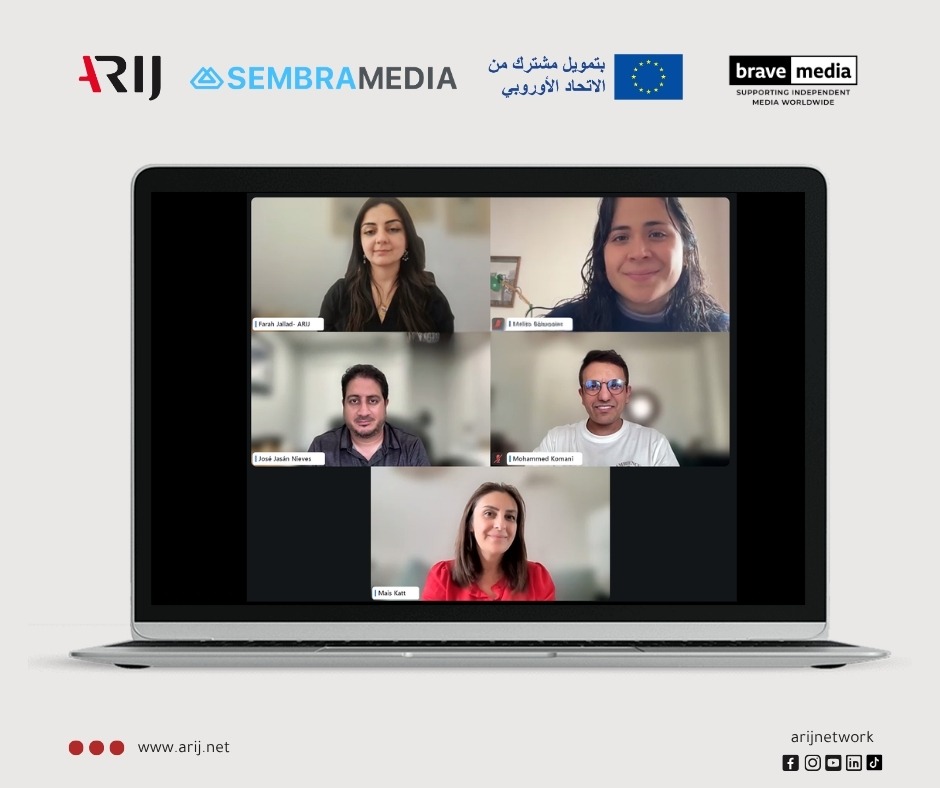
Arab Reporters for Investigative Journalism (ARIJ), in partnership with SembraMedia, a Spanish-language network supporting independent media across 60 countries, hosted a webinar on Tuesday, August 11, titled “Migrant Journalism: Experiences from the Arab World and Latin America.” The live session brought together more than 100 journalists from across the Arab world, Europe, and Latin America.
The webinar explored the experiences of four journalists from the Arab world and Latin America who were forced to continue their professional careers away from their home countries, highlighting the challenges of migration and displacement, the importance of professional networks, safety, mental health, and journalists’ ability to adapt and continue practicing their profession despite changing locations and circumstances.
The session was moderated by ARIJ Senior and Editor Coach, Farah Jallad, and featured the following speakers:
Mohammed Komani opened his remarks with a quote: “A Change of Place, but a Lasting Impact”, reflecting on his professional journey, which began with ARIJ in his home country of Yemen, continued in Amman during his years outside Yemen, and eventually led him to Berlin.
Komani highlighted ARIJ’s role as the institution that welcomed and supported him during his years away from home. He stressed that having a supportive organization, along with a network of fellow journalists, professional contacts, and sources, can be a decisive factor in enabling journalists to continue their work after relocating to a new environment far from home.
He emphasized the importance of building a strong professional network, noting that while a journalist’s location may change, their role need not. He added that even when journalism is temporarily interrupted, the passion for the profession and the journalistic spirit remain, making it possible to return to journalism when circumstances allow.
José Nieves spoke about his journey from Cuba to Florida and the challenges of practicing journalism from outside one’s home country, particularly in managing a media platform whose team is distributed across different countries, including journalists working from within Cuba.
Nieves stressed that maintaining a network of professional relationships is not a secondary matter but an essential element of sustaining journalistic work in exile. He also described the mechanisms he uses to protect journalists working with him, explaining that operating from within Cuba requires extremely careful procedures.
He noted that team members sometimes do not know one another, or what their colleagues are working on, to minimize risk and protect everyone involved. When covering stories from within Cuba, some tasks are strictly limited to verifying information and confirming its accuracy.
He emphasized that protecting journalists must take precedence over the desire to publish a story, explaining that the team is sometimes forced to abandon stories when publishing them could put colleagues at risk.
Nieves also spoke candidly about the possibility of temporarily stepping away from journalism when circumstances become too difficult for a journalist to continue. He affirmed that working in another field entirely, even one completely unrelated to journalism, does not mean failure or a permanent departure from the profession, as a journalist may work in another field for a time and then return to journalism when circumstances allow.
Melisa Rabanales spoke about her experience leaving Guatemala and migrating to Argentina after facing legal prosecution over her coverage of a Guatemalan public prosecutor who was imprisoned and politically detained.
Rabanales noted that she never expected to face legal prosecution and threats because of her journalistic work in a country she had not previously considered among the most restrictive toward freedom of opinion and expression.
She explained that moving to another country gave her a different perspective on the reality she had experienced in Guatemala. Things she had come to see as normal in her everyday life, and had covered as part of her journalistic work, appeared differently when viewed from outside the country. Experiencing other realities helped her recognize that what had been normalized at home was not necessarily considered normal elsewhere.
For Rabanales, home is not only tied to a geographic place; she said that home, for her, is writing and journalism, and that a journalist far from home searches for it through the stories they write and the profession they continue to practice.
For her part, Mais Katt opened her remarks by discussing what it means to live in two countries, describing it as having “two parallel lives”. She highlighted the difference between migration by personal choice and forced migration driven by circumstances, and the different effects each has on a journalist and their career.
She spoke about the phenomenon of “journalistic silence”, which affects some journalists after leaving their countries, when trauma, a change in environment, or the loss of professional networks can make it difficult to continue working or expressing oneself.
Katt noted that self-reflection was one of the most important factors in her success in exile, explaining that assessing her strengths and weaknesses, understanding the resources available to her, and making strategic decisions at the right time helped her build a new professional path despite the challenges.
She also stressed the importance of allowing oneself to enjoy life in the new country, rather than reducing the migration experience to work and hardship alone, emphasizing that caring for one’s mental health and wellbeing is an essential part of the ability to persevere.
She called for embracing change in one’s professional environment and treating it as an opportunity to strengthen skills and expand professional options in line with the job market and opportunities available in the new country.
The webinar created space for dialogue around several issues facing journalists working outside their home countries, including building new professional networks while maintaining ties to the journalistic community back home, adapting to new professional environments, digital safety and the protection of sources and colleagues, as well as psychological pressure and burnout.
The four speakers’ experiences converged around the idea that migration does not necessarily mean the end of a journalistic career, but may require journalists to redefine how the profession is practiced, building new networks, developing new skills, making use of technical tools, and, at times, accepting a temporary pause or a change in career path until the conditions for returning become available.
The webinar concluded by emphasizing the importance of not working in isolation, investing in networks of journalists, sources, and colleagues, prioritizing safety and mental health, and viewing relocation and migration as a phase that can open new paths rather than mark a departure from one’s journalistic identity or passion for the profession.
This webinar was held as part of the Brave Media project, led by BBC Media Action in partnership with ARIJ and others, and co-funded by the European Commission
The webinar can be viewed in both Arabic and Spanish.