



'/%3E%3C/svg%3E "Youtube")
Rim Ben Khalifa
26 April 2026
At the crack of dawn, Ibrahim pushes open the door of the cramped room he shares with four others. Its walls are soaked with damp, as if exhaling mold from every corner. In one of Sfax’s neighborhoods, he makes his way toward the port, an old bag slung over his shoulder, a worn fishing boot dangling from his hand like a weary companion. The cold sea air lashes his face, so he tightens his collar, watching the fishing boats lined along the docks. Waves strike the quay in a heavy rhythm that deepens the chill of the scene and stirs in his chest another morning of waiting.
When Ibrahim—known as “El Bouzidi” after his hometown—hauls his net from the water, the strain on his already injured shoulder intensifies, burdened by the plastic waste tangled in it, crowding out his catch. His hardship is compounded by exposure to industrial pollutants, the fumes of which have seeped into his lungs, leaving him with breathing difficulties.
Now in his mid-thirties, El Bouzidi once spent his youth studying law in Sfax. He dreamed of case files and courtrooms, not torn nets and salt stinging open wounds. But debt thwarted his ambitions, forcing him out of university. He did not return to his home province defeated; instead, he remained in Sfax, chasing a livelihood along the shoreline, among roughly 35,000 fishermen who awaited the dawn call as if it were a final chance.
Yet dawn no longer promised a pristine view.. It is now a scene clouded by mounds of plastic and industrial waste creeping along the city’s coast. Each time Ibrahim casts his net, it returns with empty hopes and a deferred promise of a livelihood lost amid the debris.
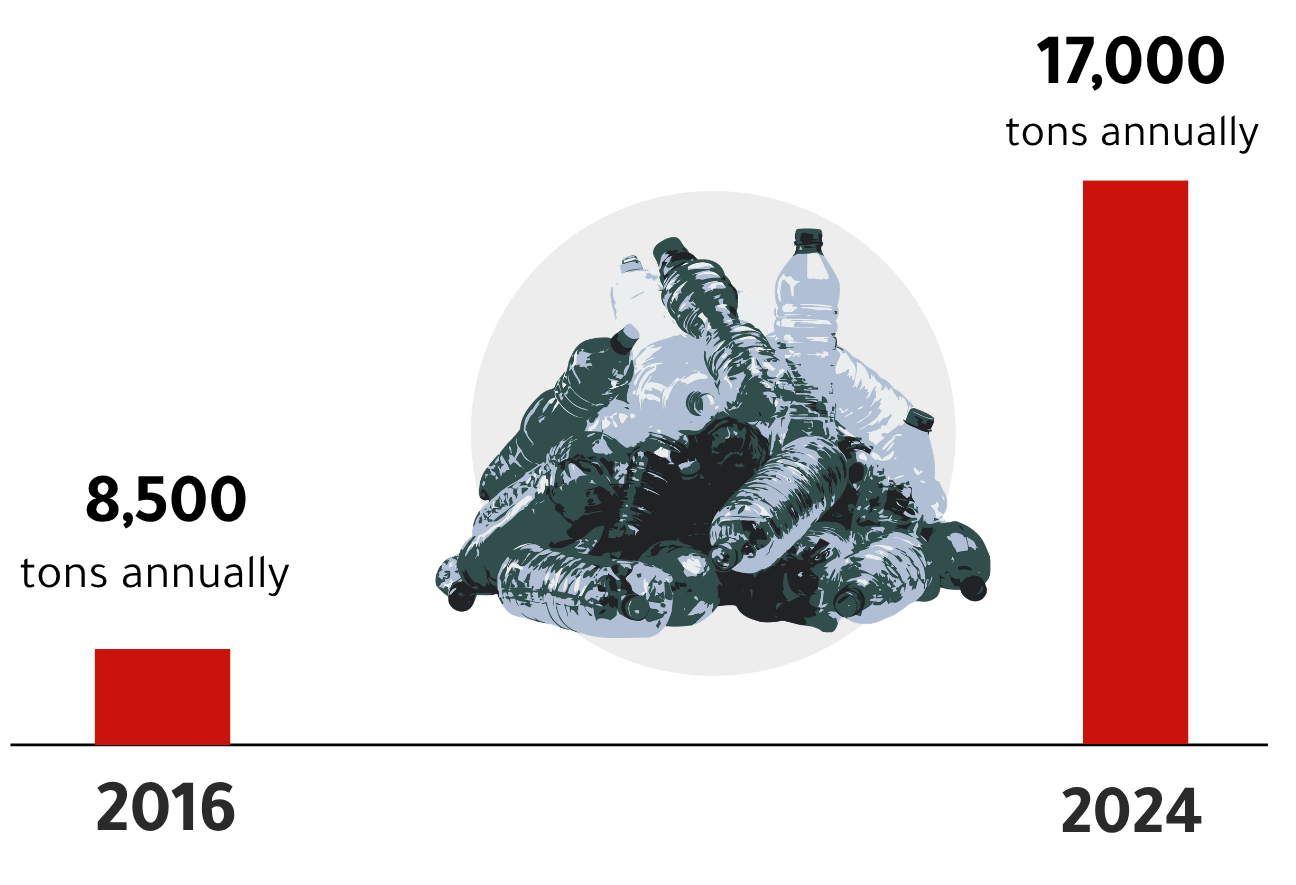
The figures leave little room for doubt. Between 2021 and 2024, roughly 17,000 tons of plastic waste entered the sea from Tunisia’s coastline, accounting for between 54 and 70 percent of total beach waste, according to a 2024 study by the German Institute for Aquatic Environment.
But the crisis did not begin in 2024. Eight years earlier, the Mediterranean Sea received around 8,500 tons of plastic waste annually from Tunisia in 2016, according to a 2019 report by the World Wide Fund for Nature (WWF). The comparison revealsthe scale of the disaster: the volume of waste has nearly doubled, while the sea continues to swallow everything cast into it.
In response to the mounting plastic waste crisis, a government decree issued in 2020 banned certain plastic bags, including single-use varieties, alongside the rollout of international initiatives such as the World Bank–supported Plastic‑Free Coastline Strategy through the PROBLUE fund.
The strategy’s first phase was launched along Tunisia’s coastline in 2020, with full implementation scheduled for completion by 2035.
Despite the launch of the strategy, a report by WWF North Africa under the “Adopt a Beach” program found that “plastic pollution along Tunisia’s coast reached alarming levels between 2023 and 2024.” Plastic, it seems, is encroaching toward the sea faster than efforts to contain it.
Types of waste recorded in the study (in thousands)
Mehdi Abdelli, an environmental expert and former advisor at Tunisia’s Ministry of Environment, argues that plastic waste is no longer merely a component of daily refuse—it has become a burden in its own right, accounting for nearly half of the country’s total waste. He notes that Tunisians consume over 4 billion plastic bags annually. This heavy consumption not only puts pressure on the environment, but also overwhelms a waste management system capable of handling only about 4 percent of the total plastic waste.
The Plastic‑Free Coast strategy—outlined in the World Bank document Plastic-Free Coast Strategy and Action Plan – Tunisia—focuses on reducing plastic pollution in coastal areas. To achieve this, the strategy proposes a set of measures, starting with improving waste collection, then sorting, and finally strengthening recycling.
According to timelines outlined in the World Bank document, the project’s first phase (2021–2022) was dedicated to assessing the state of plastic waste along the coast.
However, project documents released in 2024 reveal a different reality. While plans pointed to a transition toward more advanced phases, the documents indicate delays in implementing announced measures, alongside a lack of clear data on measures that were supposed to be initiated that same year.
To advance the implementation of the strategy, the World Bank recommends establishing an effective monitoring and evaluation system that keeps pace with the different stages of implementation, alongside measurable indicators to assess progress, verify adherence to the roadmap, and measure the strategy’s actual impact.
The problem deepens when it becomes clear that the strategy relies entirely on a World Bank grant, without establishing sustainable national financing mechanisms to ensure continuity. Moreover, the absence of transparent data on the size of allocated budgets or the mechanisms for tracking them raises pressing questions: How is progress measured? Who oversees spending? And can a plan without clear accountability mechanisms endure until 2035?
In Sfax, the sea was not always so choked with plastic and waste. When Ibrahim (El Bouzidi) began fishing in 2015, his nets returned heavy with fish, not debris. But the scene gradually shifted: plastic and industrial waste accumulated in the waters, turning every fishing trip into a daily confrontation with torn nets and damaged equipment.
“Pollution inevitably reduces fishing income and cuts into fishermen’s earnings overall, pushing us into a suffocating financial crisis,” Ibrahim says, before adding, as if recalling the sea before plastic’s advance: “If the sea were not polluted with plastic and discarded bottles, production would be abundant and fishing would be far better.”
Despite the talk of plans and projects, Ibrahim insists he has never actually heard of any initiative addressing plastic waste. He sums up the situation bluntly: “Pollution is worsening in Sfax. Even when officials from some associations visit the port, there are no real initiatives to eliminate this pollution. Everything fishermen hear is just promises—nothing that actually changes the situation on the ground.”
El Bouzidi calls for state intervention: “We work under harsh conditions in the cold and rain, and in the end we return with such a small catch that it doesn’t even cover basic expenses—fuel costs and fishermen’s wages. At the very least, the state must find a solution so we can work under reasonable conditions, without torn nets or damaged equipment.”
According to the World Bank, Sfax has been classified as a “priority hotspot,” based on an analysis of 14 environmental, social, and economic indicators, due to the accumulation of coastal pollutants. It received a “low” environmental rating specifically for plastic waste.
Satellite imagery analysis (Sentinel-2) of Sfax’s beaches shows that in 2021—coinciding with the project’s first phase—plastic pollution rose by 15 percent, reaching 11.36 square kilometers. In contrast, 2025 saw a slight decline compared with 2020, with the affected area measuring 7.82 square kilometers, down from 9.88.
The methodology for monitoring plastic pollution on Sfax’s beaches is based on multispectral imagery from the Sentinel-2 satellite. Data was collected via the Google Earth Engine (GEE), complemented by spectral index calculations, classification algorithms, temporal analyses, and interactive visualization tools. The approach relies on several key indices, including the Normalized Difference Vegetation Index (NDVI), the Floating Debris Index (FDI), and the Plastic Index (PI), which allow for the distinction of plastic debris from other floating materials in coastal waters.
Plastic pollution comparison on Sfax beaches (2020–2025)202020212025
2020-01-062020-12-31
Mehdi Abdelli explains that Sfax is classified as an “environmentally fragile gulf” because it is a semi-enclosed basin, which weakens marine currents and accelerates pollutant accumulation. Seagrass meadows and tidal dynamics are also under pressure from intense industrial activity.
He adds that the sea has effectively become a reservoir of pollution, leading to marine die-offs and ecological imbalance.
Tunisian economic expert Sofiane Werimi notes that Sfax is Tunisia’s second economic hub after the capital, with a concentration of industrial and commercial activities. He adds that its port is the country’s leading outlet for fish products, with the governorate accounting for around 45 percent of national production and commercial capacity in the sector.
Given Sfax’s maritime importance, several local initiatives have been launched alongside the Plastic‑Free Coastline Strategy to curb rising pollution. In 2022, nationwide awareness campaigns were introduced to enforce the single-use plastic bag ban, including in major cities such as Sfax—among them the campaign “It’s Time to Take Responsibility.”
The Taparura project—funded in part by the European Investment Bank—provides another example of recurring delays in implementation since 2010.
Although the project started in the 1980s with the aim of rehabilitating the polluted industrial coastline and turning it into an integrated urban area, it remains unfinished to this day.
Morsi Faqih, regional director of the Coastal Protection and Planning Agency in Sfax, says the governorate’s coastline faces growing threats, most notably pollution in its various forms, including plastic waste and contaminated industrial water.
He adds that the agency works to mitigate these risks through ongoing coordination with the Office of Merchant Marine and Ports, aiming to limit environmental impact without harming economic activity. Industrial institutions have also been required to conduct environmental studies and follow their recommendations.
When asked about its support for the strategy led by the Tunisian government, the World Bank stated that it has ceased its involvement, noting: “While the World Bank supported the preparation of the strategy, its implementation falls under the responsibility of the government, specifically the Ministry of Environment.”
The Tunisian Ministry of Environment did not respond to questions regarding delays in implementation of the strategy or the continued accumulation of plastic waste in targeted areas.
Tunisia’s Plastic-Free Coastline Strategy sets ambitious goals on paper, but the reality along the shoreline tells a different story. Plastic waste continues to build up along the coast, untouched by the awareness campaigns and outreach efforts that dominate the official response. For fishermen like Ibrahim, the gap is personal — they are left out of the very conversations meant to solve a problem they live with every day.
Ibrahim sits on a pier, his fingers cracked and raw from years of salt water — so dry they could split at the slightest pressure. He works a coarse needle and thick thread through the torn sections of his nets, mending damage left behind by the debris that clutters these waters: plastic waste, splintered wood, and rusted metal, the remnants of factory runoff and abandoned migrant boats alike.
As pollution takes its toll on fish stocks, boat owners have begun cutting crew — and Ibrahim is among those who have lost their place. Each time, he searches for another vessel willing to take him on, only to find himself back at the edges of a livelihood that keeps slipping out of reach. Marriage, stability, a life he can plan around — these are dreams he hasn’t abandoned, only deferred, pushed further toward a horizon that never seems to get closer.
With contributions from Abdullah Sakar.
This report was published in collaboration with Ozon.